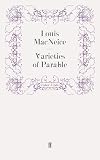
Varieties of parable
by Louis MacNeice
8 Members (3.00)
On This Page
Description
In Varieties of Parable, which comprises the Clark Lectures given by Louis MacNeice at Cambridge in 1963, a few months before his death, the poet discusses the significance of 'parable' for the times in which he lived, and implictly for his own poetic. The discussion ranges widely, including Samuel Beckett, Harold Pinter and William Golding (new writers with whom MacNeice felt an obvious kinship), and backwards genealogically to Spenser's The Faerie Queene or Bunyan's Pilgrim's Progress, by show more way of Alice in Wonderland and the fantasy tales of George MacDonald - as well as outwards into the exemplary European fictional world of Kafka. Most importantly, MacNeice ponders the uses of parable for poetry, and Varieties of Parable stands as an implict handbook to the landscapes and 'thumbnail nightmares' of his own later verse, whose new horizons were abruptly foreshortened by the poet's untimely death in autumn 1963. Varieties of Parable stands as MacNeice's last considered statement about poetry and poetics, and one of his most atmospheric and personal acts of literary criticism. show lessTags
Member Reviews
Members
- Recently Added By
Author Information

53+ Works 1,412 Members
Born in Belfast and raised in Carrickfergus, MacNeice was the son of an Anglican clergyman who became a bishop. His education in English schools and Oxford University made him ill at ease with his Puritan upbringing, but it never caused him to lose his sense of northern Irish roots. At Oxford, MacNeice became friends with Stephen Spender and show more later, W. H. Auden, with whom he collaborated on "Letters from Iceland" (1937). After graduating with a double first, MacNeice accepted a lectureship in the classics at Birmingham University and, after the traumatic elopement of his first wife, at Bedford College of the University of London. He joined the BBC as scriptwriter and producer in 1941 and remained with it for the remainder of his career. He also did an admired translation of Aeschylus's "Agamemnon" and the well-known book "The Poetry of W. B. Yeats" (1941). MacNeice defended his own poetry and that of Auden, Spender, and C. Day Lewis in his book "Modern Poetry" (1938). There he called for an "impure poetry" that would react against the giants of the previous generation by embracing the partisanship that he missed in W. B. Yeats and involvement with life that he found lacking in T. S. Eliot, both of whom had otherwise influenced him. While engaged with personal and political issues of the 1930's, MacNeice maintained a more skeptical stance than many of his contemporaries. His best verse---such as "Valediction" or "Bagpipe Music"---brings wit and strong rhythms to bear on contemporary life and often harks back to scenes of his youth. After joining the BBC, he also wrote more than 150 scripts, of which a dozen radio dramas have been published. An autobiography, "The Strings Are False," was published posthumously in 1966. During his lifetime, MacNeice was overshadowed by Auden, but in recent years, reevaluation of his work has regarded him as a major literary figure. (Bowker Author Biography) show less
Classifications
Statistics
- Members
- 8
- Popularity
- 2,509,305
- Rating
- (3.00)
- Languages
- English
- Media
- Paper
- ISBNs
- 2