
Cool For You
by Eileen Myles
On This Page
Description
Why can't I live right now. Because I am not rich, I am not a saint. But I do know this: not all of us were sent here to work. The first published novel of legendary poet and performer Eileen Myles follows a queer female growing up in working-class Boston, straining against the institutions that hold her: family, Catholic school, jobs at a camp, at a nursing home, at a school for developmentally disabled adult males. Free-ranging and deadpan, tragic and joyful, this is a book about women, show more gender, class, bodies, escape, and what it means to be "inside." show lessTags
Recommendations




































Member Reviews
Experimental without being difficult to read--Myles plays with the form of the memoir, switching up details and messing around with language in this work that is situated between fiction and autobiography. The end result is more fun than not, especially considering some of the grim content in this story.
"Is there a recipe book for 'anyone?' Here’s something, a cup of coffee, a bowl of oatmeal, that not you or I or anyone we know would ever want to eat, but food that anyone would eat when they had finally been determined to be in that position that they would eat anyone’s food. I don’t mean eating from the dumpster. I mean the [institutional] lunches you got in school. Those vegetables no one wanted because you could see they had been prepared for anyone. Extra food. To think you might wind up eating it one day,"
— Eileen Myles, Cool for You
Food for Anyone
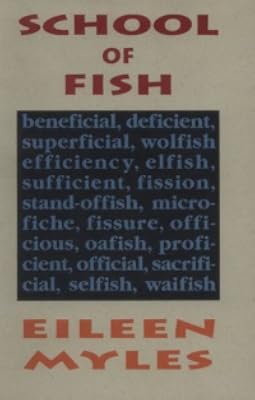
Reading is somewhat like cooking; not in the sense that both are 'nourshing endeavors' (they often are not) but in the sense that, more than ever, everyone finds himself [sic] show more capable of doing these things — Nonetheless they are often done poorly. The careless cook of 'food for anyone' has his partner in those veritable devourers of paragraphs whose reading passes over the critical structure of this text: what it means to be an ingredient in the sandwich between institutions. (See Myles in School of Fish (1997): " could I accidentally / get eaten / slipping into your / sandwich".)
The events of this text are bracketed (sandwiched) between the site of Myles's first institutional-expressions (The Walter E. Fernald State School, closed in 2014) and the location of the grandmother's final institutional extrusions (Westborough State Hospital, closed in 2010). (Truly i tell you, the closure of these institutions seems to mark the end of an era of a certain kind of 'institutional care.') Recognizing this relation helps us understand why the conclusion of this text is so affecting. The (miraculous) reproduction of the grandmother's occasional spoken phrases in her state medical record feels so effective because they remind us of the pure excess of interstitial, unrecorded moments of early Myles at the Fernald School where candies and gold stars were awarded for 'Behavior Modification' though we recall that they mostly eaten out of the closet.
The defining alimentary characteristic of these state institutions should be 'Food for Anyone' (such that stale M&M's are a treat), yet the term appears to be a catachresis. "The State expresses a dense white nutritious sauce he has made for the poor." (142) Oatmeal only becomes 'Food for Anyone' at the moment when the substance becomes sufficiently overcooked that it excludes those who 'wouldn't ever want to eat it.' Being 'for anyone' only comes to define the institution precisely because it excludes everyone outside it. Agamben (sorry) reminds us that the constituting power of the state is the "Sovereign violence [which] is founded not on a pact but on the exclusive-inclusion of bare life in the state." (Homo Sacer, 1994) 'Bare life' in this context being the biological fact of those merely living (vegetating 'zoe' in contrast with the political life, 'bios,' of active citizens).
Agambenian 'sovereign violence of exclusive-inclusion' reaches its apotheosis in the concentration camp whose residents are reduced to mere biological facts. This is certainly true, though we remain dubious of the Homo Sacer project nonetheless; not the least because of Agamben's characteristic misfiring on pandemic mitigation practices, but particularly because 'exclusive-inclusion' of 'bare life' appears to apply more precisely to the daily practices of our most powerful 'educational institutions,' "I was getting pimples and they were not. There was a day when all the alums would come back and crowd Harvard Square and wear fake straw hats which had class of ‘39 on them etc. and everyone was so happy and sometimes they had a young golden son with them, and even outside you could hear the goony Harvard Band marching around the Square and when you rode along Memorial Drive they would be out there sculling and you could see it was their river and you were entirely fucked. Slam" (19).
Of course, from the perspective of the Cantabrigian, those pimply Bostonian onlookers are always already as-good-as-dead. Yet, if one cares to think of them, one notices that these persons have somehow avoided extermination — of course this is because they are needed for such things as working the catering services and staffing the counter at Filene's basement (closed in 2011). The situation for onlookers-to-Harvard-festivities, never fully inside or outside the institution, (never fully 'bare life' and yet always already merely this), seems to trouble the Homo Sacer project, "One of the things you learned quickly about the Fernald School was that it was a nightmare of misclassification or just no classification" (13). Whereas Agamben has always chosen the masculine ascetic extreme to headline his project, the more fitting application appears to be located in the neither-inside-nor-outside moment in which like Myles sneaks a taste of 'food for anyone' from the closet.
Exampli Gratia: Inside and out
1.
'Food for Anyone,' as Annemarie Mol notes (Eating in Theory, 2021), is totally appropriated within the consumer's body, yet the gastrointestinal tract, strictly speaking, is never more than a tube of extra-corporeal contents.
2.
As Alex Blanchette notes (Porkopolis, 2020), in order to become the high-quality animal product worthy of care in the cooking process (i.e. 'food for someone'), the industrial pig must possess an anonymous body that meets the strict mechanical standards of industrial slaughterhouses. Pigs that are 'somebody,' in the sense that they possess unique bodies, are de facto excluded from the butchering process, written off as a 'partial loss,' and rendered down into what will (likely) become 'food for anyone.'
3.
The agonal respirations of the author's postman father, slipping out of his institutional sandwich (sandwiched between the United States Postal Service and Massachusetts General Hospital), finds himself at home on his couch (precisely where he shouldn't be), "I watched my father [. . .] he was changing colors and his breath became nasal, pure snot, like one gleaming part of him was left, banging in an ash can. I was stuck, couldn’t get up. My mother was outside hanging clothes, the breeze was perfect that October afternoon, a great day to sail, clip some laundry" (141). If the father were not encephalopathic, perhaps he would describe the topology of his situation like that of being shoved into the Tolstoyan sack (from Ivan Ilyitch): anxiety at being shoved in from outside and down to the bottom of the sack and also the anxiety that inside he might not fit.
'Food for Anyone,' suggests itself as the nutritive equivalent of Agamenian 'bare life' in the sense that it's nothing-more-than-food. Yet, just like bare life, 'food for anyone' isn't a static object. 'Food for anyone,' being merely food, is synchronically on the border of 'food freed from the oblgation of being food' and is therefore always already something else. One imagines overcooked institutional oatmeal in the form of a sculpture on the plate, a projectile, or a commodity — these possibilities are closed to that Agambenian reader, inimical to humor, who concludes his investigation when he sees an object and merely imagines a taste. What Myles is communicating in this text is the contingency of these institutional structures, the closure of which Agamben is hypostatizing as the monolithic arbiter of bare life. It seems Myles's point is that only a bare fraction of these realities makes it down to us (and only that fraction that can be xeroxed): "The picture of my grandmother is a bad xerox. It’s on the top of the pile. There’s hands around Nellie’s neck, so her head won’t fall down. Her hair’s pulled back. It looks black. Each sheet from my grandmother’s records, there’s about ten, has the hands of the man who xeroxed them. He’s wearing a ring and his shirt is striped. Nellie’s old records were awkward so the man had to lean and press to get it all. He was a state employee, a law student, I bet" (142). The content of these documents describes the outline of an existence which barely appears to circumscribe the movements of that life, and Myles's recitation is worth quoting at length:
"Massachusetts asked her if she liked this institution, She said, 'This place is alright if you have to stay here.' [. . .] According to Massachusetts, Nellie believed that she had done something in her life that was wrong and she could never be forgiven for it. I did not do that did I. I did not do that did I. They did not use commas. It’s black and white, her record. Xeroxed, typewritten forms, a Nellie count, that tradition. [. . .] Let me tell you about her urine. Brownish, amber, clear and yellow over the years. Her piss is a pond. Lake Walden. The state measures and weighs Mrs. Myles. The size of her heart, enlarged. They patted her belly. Abdomen was soft and rounded, it reported. MAMMARY GLANDS: Atrophic. No matter. Mother of seven, she’s got food in the bank. Massachusetts will nurse her, again and again. In 1955 when she has been in Westborough for fifteen years (APPETITE: Normal, SLEEP: Normal. Patient is ambulant. SPEECH: Clear) it mentions under mood and emotion that 'Mrs. Myles is resentful at times,'" (143).
These brief encounters between patient and psychiatrist, including physical exam and in's-and-out's (extrusions), likely exists only to meet the state's minimum accountability standards for institutionalized patients. These data, captured in the medical language which seems to be the only way Massachusetts knows how to record the occasions of 'bare life,' suggests that, even here, there is 'living' going on. Brian Massumi (Ontopower, 2015) calls this 'Bare Activity,' "[Bare activity] is human life in the instant’s offbeat. In that instant, a life is barely there, recoiled, bodily consumed in its infra-relation to itself. It is a life without determinate content. In that imperceptible instant, what its content will be next is in the making. A life is formatively barely there, tensely poised for what comes next. In that measureless instant, a life is intensely barely there, regathering in an immediacy of its capabilities." The notion of 'bare activity' is not incompatible with 'bare life,' which, from a certain perspective is performing a calculus of integration over the space all these infinite potentials. Though it should be stated that if these in-finite uncountable potentials of Bare Activity are the things that Bare Life is made of, then we are in a tricky situation in which the sum of these parts seems to be larger than the whole; which means (as Myles already gives us to know) that, in order to fit together, these parts must be therefore deeply invaginated. show less
i really tried to like this book. it's just really not my thing. the first third or so kept me more or less interested enough while i was reading - is this a memoir? is it fiction? is she pretending to be the main character? is she fictionalizing her life? what the hell is a "nonfiction novel?" - but every time i put this book down i had to force myself to pick it up again. and by the last third i had to just push through to get it over with. i don't tend to like more experimental writing (as much as i would like to think i would) and this is no exception for me.
This book has the most confusing cover ever. No less than three places does the book say "a novel," then it also proclaims itself to be "fiction" and "a nonfiction novel." I have no idea if I read a memoir or a fabricated first-person narrative, but either way it was an enjoyable read.
This is not my style of book. I realize that Myles was an "other" in many ways, and this is her way to show it, but I found it boring and repetitous.
I tried to read this when I was still down on Eileen Myles and didn't finish, but now that I am up on her it seemed pretty good to me. Still don't like the picture on the cover though, except for that afghan.
Love her. I heard her read years ago. Awesome lady.
Members
- Recently Added By
Author Information

37+ Works 2,278 Members
Eileen Myles is an American poet and writer born on December 9, 1949 in Cambridge, Massachusetts. She is a graduate of the University of Massachusetts Boston (1971). She moved to New York City in 1974 where she participated in workshops and worked with and for several famous poets. Her career includes working as Artistic Director of St. Mark's show more Poetry Project, serving as Professor of Writing at the University of California, San Diego, and Visiting Writer at seven colleges. Myles's first book, The Irony of the Leash, was published in 1978. Some of her other work include A Fresh Young Voice From the Plains, Not Me, Inferno, Maxfield Parrish/early and new poems, School of Fish, Skies, On My Way, Snowflake / Different Streets, and The Importance of Being Iceland. She has also written articles, essays, plays and other works of fiction and nonfiction. She founded the Lost Texans Collective with Elinor Nauen and Barbara McKay and performed in group and solo performances. She has received numerous awards for her work. Her latest awards include The Clark Prize for Excellence in Arts Writing (2015) and The Lambda Pioneer Award (2016). (Bowker Author Biography) show less
Awards and Honors
Classifications
Statistics
- Members
- 241
- Popularity
- 135,521
- Reviews
- 7
- Rating
- (3.44)
- Languages
- English
- Media
- Paper, Ebook
- ISBNs
- 4
- ASINs
- 1