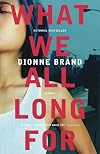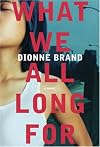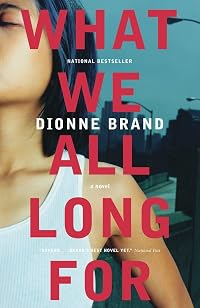
What We All Long For
by Dionne Brand
On This Page
Description
"Dionne Brand delves into uncharted aspects of urban life, the bittersweetness of youth, and secrets families try to hide. Tuyen is an aspiring artist and the daughter of Vietnamese parents who've never recovered from losing one of their children while in the rush to flee Vietnam in the 1970s. She rejects her immigrant family's hard-won lifestyle, and instead lives in a rundown apartment with friends - each of whom is grappling with their own familial complexities and heartache." "Tuyen's show more lost brother - who has since become a criminal in the Thai underworld - journeys to Toronto to find his long-lost family. As Quy's arrival nears, tensions build, friendships are tested, and an unexpected encounter will forever alter the lives of Tuyen and her friends." "Gripping at times, heartrending at others, What We All Long For is an ode to a generation of longing and identity, and to the rhythms and pulses of a city and its burgeoning, questioning youth."--Jacket. show lessTags
Recommendations

















Member Reviews
I've spent quite a while trying to figure out how to start a review for What We All Long For, and each time I do I delete it and start anew. I feel like it's due to the fact that the novel is a tricky one to pin down: a work that is invested in multi-ethnicity but doesn't quite nail it; a work that features a mystery but isn't that mysterious; a work that wants to make a case for desire but also for a politics of morality. In the end, it tries but I'm not sure it succeeds on these counts.
The core issue with What We All Long For seems to stem from a plot that features numerous narrative perspectives and several main characters, but seems to meander rather than point in a certain direction. The main focus of our attention is on Tuyen, a show more second-generation Vietnamese-American lesbian who is struggling through both making a living as an artist and winning the affections of her neighbor and best friend Carla, who adamantly denies any homosexual tendencies. While Brand could have made a number of interesting interactions between the women, she instead stresses the silences and absences of discussion, perhaps to let the reader think there's a void to be filled, but coming off mostly as being indecisive about how to address the awkwardness.
Carla's silence, we learn, reflects her inability to deal with her brother, Jamal, who is constantly finding himself in trouble from which Carla must bail him out. While Jamal takes a secondary role in the novel, Carla's reactions to him and to how her family treats Jamal are some of the most poignant passages in the novel, a true domestic strife that comes off as authentic despite moments that threaten to descend into schmaltz. Sure, Jamal is played off to be a caricature, but at least he elicits genuineness from Carla, who reveals a deceptively hidden roundness at those moments.
This subplot, however, is underused, as are many other plots that tangle themselves throughout the novel. Tuyen's friend Oku, a black man who desires the love of Jackie, a clothing store owner already in a committed relationship, is the responsible foil to the somewhat immature Tuyen, but doesn't come off as being terribly influential to her, existing within his own story in too isolated a manner.
The same happens, most unfortunately, with the novel's most self-conscious attempt at a mysterious sub-plot: the disappearance and eventual return of Tuyen's long-lost brother Quy, who disappeared at the dock as her family left Vietnam for Toronto. Quy's first-person journey is intriguing but, again, underused -- he vanishes for long stretches of pages at a time and his tale, while fascinating, is simply not substantial enough to warrant the deviations. And while his potential return and the impact of that return on the dynamic of Tuyen's family (particularly on her long-suffering brother Binh) has incredible potential, it is hinted at but never truly mined to its fullest.
All of which leads to a finale that throws a huge wrench into the proceedings and threatens the very foundational relationships of the novel, but cops out from exploring them deeply. It's as if Brand wants us to decipher for ourselves what will happen to the people we've seen now that we have this event to consider, but it feels instead as if she simply didn't know what to make of it herself and simply cut the book off at that point. Like so many other elements of the novel, Brand has ambitious plans but falls short of executing them, leaving us wanting instead of deliberating, ironically longing for more but having nothing left to work with.
As an infusion, the novel struggles to piece everything together. From the awkward implementation of slang to the lack of development of the subplots, the novel comes off as an ambitious idea that the author couldn't quite pull off, a success in conception but a failure in execution. There's enough here to suggest that Brand has talent and ability, but What We All Long For is not necessarily the highest realization of either. show less
The core issue with What We All Long For seems to stem from a plot that features numerous narrative perspectives and several main characters, but seems to meander rather than point in a certain direction. The main focus of our attention is on Tuyen, a show more second-generation Vietnamese-American lesbian who is struggling through both making a living as an artist and winning the affections of her neighbor and best friend Carla, who adamantly denies any homosexual tendencies. While Brand could have made a number of interesting interactions between the women, she instead stresses the silences and absences of discussion, perhaps to let the reader think there's a void to be filled, but coming off mostly as being indecisive about how to address the awkwardness.
Carla's silence, we learn, reflects her inability to deal with her brother, Jamal, who is constantly finding himself in trouble from which Carla must bail him out. While Jamal takes a secondary role in the novel, Carla's reactions to him and to how her family treats Jamal are some of the most poignant passages in the novel, a true domestic strife that comes off as authentic despite moments that threaten to descend into schmaltz. Sure, Jamal is played off to be a caricature, but at least he elicits genuineness from Carla, who reveals a deceptively hidden roundness at those moments.
This subplot, however, is underused, as are many other plots that tangle themselves throughout the novel. Tuyen's friend Oku, a black man who desires the love of Jackie, a clothing store owner already in a committed relationship, is the responsible foil to the somewhat immature Tuyen, but doesn't come off as being terribly influential to her, existing within his own story in too isolated a manner.
The same happens, most unfortunately, with the novel's most self-conscious attempt at a mysterious sub-plot: the disappearance and eventual return of Tuyen's long-lost brother Quy, who disappeared at the dock as her family left Vietnam for Toronto. Quy's first-person journey is intriguing but, again, underused -- he vanishes for long stretches of pages at a time and his tale, while fascinating, is simply not substantial enough to warrant the deviations. And while his potential return and the impact of that return on the dynamic of Tuyen's family (particularly on her long-suffering brother Binh) has incredible potential, it is hinted at but never truly mined to its fullest.
All of which leads to a finale that throws a huge wrench into the proceedings and threatens the very foundational relationships of the novel, but cops out from exploring them deeply. It's as if Brand wants us to decipher for ourselves what will happen to the people we've seen now that we have this event to consider, but it feels instead as if she simply didn't know what to make of it herself and simply cut the book off at that point. Like so many other elements of the novel, Brand has ambitious plans but falls short of executing them, leaving us wanting instead of deliberating, ironically longing for more but having nothing left to work with.
As an infusion, the novel struggles to piece everything together. From the awkward implementation of slang to the lack of development of the subplots, the novel comes off as an ambitious idea that the author couldn't quite pull off, a success in conception but a failure in execution. There's enough here to suggest that Brand has talent and ability, but What We All Long For is not necessarily the highest realization of either. show less
 This review was written for LibraryThing Early Reviewers.
Move over, Amy Tan. With What We All Long For, Dionne Brand adds her fresh, authoritative voice to a mix of Asian-in-North America fiction. First published in 2005 in Canada, What We All Long For is being released in a U.S. paperback edition to be available in late 2008. Perhaps its Canada-only release is to blame for this book's absence from Booker longlists and the American literary buzz--it's shocking that this book hasn't been more widely available and appreciated before now.
Brand's novel introduces readers to a parade of strikingly real characters, of at least two distinct generations. Tuyen, who readers meet during a drab morning commute in the first chapter, is not only the protagonist but the moral center. She is the filter show more through which readers perceive all of the novel's myths, histories, occurrences, and character changes. The youngest child of a Vietnamese immigrant couple, Tuyen has a compelling past and a magnetic figure. However, satellite characters such as Carla, Jamal, Oku, Jackie, and Tuyen's brother Binh add complex layers to the plot of the novel, and are no less compelling than Tuyen herself.
It is through the name of Jackie's clothing store, Ab und Zu, that the novel's theme is revealed. Over a meal of Jamaican food, the younger generation of characters discusses the name of Jackie's new store: "'Ab und Zu! What the fuck is that anyway?'"
What the fuck it is is the central tension of the novel. Ab und zu, "'Now and then'" Jackie thinks, indicates the way all of the characters, the young ones and their parents, shuttle between their pasts and their presents. Tuyen's insomniac parents long for the son they lost while emigrating from Vietnam, but they miss more the selves they lost. Tuyen's mother misses turning a breech birth, while Tuyen's father obsessively draws the buildings of the strange city of Vancouver (in which he can only peddle Vietnamese food, not continue his career as an engineer). Tuyen, Carla, Jackie, and Oku confront and remember their parents and their parents' varied immigrant lives. Hating their parents for simultaneously capitulating to Canadian culture and for refusing to blend in, each child makes a voyage home during the course of the story, and each child makes a voyage of memory into their past.
In short, this is a surprising novel that interweaves the experiences of Canadian immigrants and their children, while revealing what we all long for: longing itself, for our pasts and for our futures. show less
Brand's novel introduces readers to a parade of strikingly real characters, of at least two distinct generations. Tuyen, who readers meet during a drab morning commute in the first chapter, is not only the protagonist but the moral center. She is the filter show more through which readers perceive all of the novel's myths, histories, occurrences, and character changes. The youngest child of a Vietnamese immigrant couple, Tuyen has a compelling past and a magnetic figure. However, satellite characters such as Carla, Jamal, Oku, Jackie, and Tuyen's brother Binh add complex layers to the plot of the novel, and are no less compelling than Tuyen herself.
It is through the name of Jackie's clothing store, Ab und Zu, that the novel's theme is revealed. Over a meal of Jamaican food, the younger generation of characters discusses the name of Jackie's new store: "'Ab und Zu! What the fuck is that anyway?'"
What the fuck it is is the central tension of the novel. Ab und zu, "'Now and then'" Jackie thinks, indicates the way all of the characters, the young ones and their parents, shuttle between their pasts and their presents. Tuyen's insomniac parents long for the son they lost while emigrating from Vietnam, but they miss more the selves they lost. Tuyen's mother misses turning a breech birth, while Tuyen's father obsessively draws the buildings of the strange city of Vancouver (in which he can only peddle Vietnamese food, not continue his career as an engineer). Tuyen, Carla, Jackie, and Oku confront and remember their parents and their parents' varied immigrant lives. Hating their parents for simultaneously capitulating to Canadian culture and for refusing to blend in, each child makes a voyage home during the course of the story, and each child makes a voyage of memory into their past.
In short, this is a surprising novel that interweaves the experiences of Canadian immigrants and their children, while revealing what we all long for: longing itself, for our pasts and for our futures. show less
This review was written for LibraryThing Early Reviewers.I've struggled greatly with what exactly I think of this book, and even more, what rating to give it. Brand's work tells the story of four twenty-somethings living in Toronto negotiating the sometimes tragic details of their lives. There are elements of this book that are very, very good. The way Brand sets the scene in Toronto and its suburbs, in the present and thirty years earlier is excellent. Brand also creates some incredible characters who exist with a reality and depth that is admirable. Brand is a good writer- while perhaps that should go without saying for published fiction, that's certainly not always the case. But with the good comes the bad, too. Parts of this book did not impress me nearly as much. While Brand does create show more some very impressive characters, there were others who were under-developed, and seemed to have little purpose in the overall work. Oky and Jackie, in particular, and even Carla, to an extent, were marginal. Tuyen was far more complex and interesting than any of the others. This book is not a plot-driven one. It is very much character-driven. Brand is clearly trying to get at some larger issues. The book is about identity, about how people construct their identity and how it is constructed for them. On one level this book is about multi-culturalism in Canada, and what it means to be a Canadian of color. But even more (and connected to that) this book is about how family shapes identity. Each of the main characters is significantly shaped by tragedy in family life. Tuyen is shaped by the loss of her brother, Carla by her mother's suicide and brother's problems, Oku by his difficult relationship with his father, and Jackie by the decline of her parents' Toronto neighborhood. This is a saga about parents, children, and siblings, and how these people play as much of a role in the formation of the self as anything else. Interestingly, all of the main characters are rebelling in some way against their families, abut their rebellions serve only to underscore how deeply they are shaped by their family experiences. Ultimately my opinion was divided on this book, hence the 3. I admired some things, but disliked others, and would have liked more attention to plot and the ending. show less
This review was written for LibraryThing Early Reviewers.Brand, Dionne. What We All Long For: a Novel. Toronto: First St. Martin (Griffin edition), 2008.
From the very beginning I thought this book looked interesting. Originally published in 2005 I had heard that it had even been used in university Lit classes. Upon knowing that tidbit I assumed a level of complication with the characters and a deeper depth of plot. Here is what I came away with: complicated characters that all want something (parallel to the title). Their relationships to one another go around and around - always circling one another - but really, going nowhere. This is where the plot came up short. That sense of longing hums along the fine lines of each relationship, and there is a common theme of boundaries but beyond those show more connections each character is lost. Tuyen is a lesbian in love with her straight best friend. Longing for someone she can't have, sexual preference is Tuyen's barrier. Carla is the biracial bike messenger Tuyen is in love with. Carla has a troubled brother. Longing to steer her brother straight, lack of money is Carla's barrier to helping him. Oku is a music-loving college drop-out of Jamaican decent. His unrequited love for Jackie is his longing while her boyfriend is the barrier. Jackie longs for simplicity. Her barrier is being attracted to more than one man.
Oddly enough, the linear, uncomplicated character of the story (told in first person) is the one with the most depth and more intriguing story. Quy is the brother of Tuyen. He was separated from his parents in Vietnam as a very young child and has been lost to them ever since. His story is how her survived refugee camps in Thailand and how eventually, he made his way back to Tuyen and her family. Tuyen has never met this long-lost brother so when he reunites with his parents life changes for Tuyen.
The last character in What We All Long For is probably Brand's most complex and mysterious: the city of Toronto itself. As the characters move in and out of its restaurants, nightclubs, streetcars, and alleys the city responds. It lives and breathes and entices just like its human counterparts. show less
From the very beginning I thought this book looked interesting. Originally published in 2005 I had heard that it had even been used in university Lit classes. Upon knowing that tidbit I assumed a level of complication with the characters and a deeper depth of plot. Here is what I came away with: complicated characters that all want something (parallel to the title). Their relationships to one another go around and around - always circling one another - but really, going nowhere. This is where the plot came up short. That sense of longing hums along the fine lines of each relationship, and there is a common theme of boundaries but beyond those show more connections each character is lost. Tuyen is a lesbian in love with her straight best friend. Longing for someone she can't have, sexual preference is Tuyen's barrier. Carla is the biracial bike messenger Tuyen is in love with. Carla has a troubled brother. Longing to steer her brother straight, lack of money is Carla's barrier to helping him. Oku is a music-loving college drop-out of Jamaican decent. His unrequited love for Jackie is his longing while her boyfriend is the barrier. Jackie longs for simplicity. Her barrier is being attracted to more than one man.
Oddly enough, the linear, uncomplicated character of the story (told in first person) is the one with the most depth and more intriguing story. Quy is the brother of Tuyen. He was separated from his parents in Vietnam as a very young child and has been lost to them ever since. His story is how her survived refugee camps in Thailand and how eventually, he made his way back to Tuyen and her family. Tuyen has never met this long-lost brother so when he reunites with his parents life changes for Tuyen.
The last character in What We All Long For is probably Brand's most complex and mysterious: the city of Toronto itself. As the characters move in and out of its restaurants, nightclubs, streetcars, and alleys the city responds. It lives and breathes and entices just like its human counterparts. show less
This review was written for LibraryThing Early Reviewers.Dionne Brand takes the youth of Toronto and brings them to vivid life in this novel about several twenty-somethings living in the city and the way their lives do - and do not - meet.
I felt the main characters to be well-developed and interesting, though some of the secondary characters could have had a bit more depth to them. The motifs of youthfulness, race, and what it is to live in a city were brought to bear skillfully, as was the over-arching theme of longing.
All in all, I enjoyed this book.
I felt the main characters to be well-developed and interesting, though some of the secondary characters could have had a bit more depth to them. The motifs of youthfulness, race, and what it is to live in a city were brought to bear skillfully, as was the over-arching theme of longing.
All in all, I enjoyed this book.
This review was written for LibraryThing Early Reviewers.I got an advance copy of this book, and found it quite interesting. Set in Toronto, it revolves around a small group of second generation immigrants- young, Black or Asian, or of mixed parentage, straight and gay, in their early twenties, in a way inhabiting the fringes of society, yet in a way very mainstream and representative of downtown Toronto. These young people are trying to get away from their ethnic origins, from their families histories and find their own voice, their own way, their place in the society. Are clean cuts possible though? Sometimes perhaps, but it’s not really that easy to break off completely with the past. Things need to be worked out.
This review was written for LibraryThing Early Reviewers.An engrossing read with great characterization -- provides an interesting and intimate view of Toronto. I read this shortly after Brand's Bread Out of Stone and noticed a lot of similar threads emerging (like the discussion of the streetcar near the beginning of the novel).
This review was written for LibraryThing Early Reviewers.Members
- Recently Added By
Lists

Top Five Books of 2013
1,562 works; 721 members

CBC Books - Canada's 100 (+ bonus 10): Which have you read?
110 works; 23 members
Author Information

35+ Works 1,601 Members
Dionne Brand was born in 1953 in Guayguayare, Trinidad and was educated at the University of Toronto and the Ontario Institute for Studies in Education. Brand was the founder and editor of Our Lives, Canada's first newspaper for black women. She has also worked on Fuse Magazine, The Harriet Tubman Review, Canadian Women Studies, and Research for show more Feminist Research. She also belongs to several community organizations including the Immigrant Women's Center and the Caribbean Peoples' Development Agency. Brand's involvement in politics is prevalent in her books, Chronicles of the Hostile Sun, Rivers Have Sources, Trees Have Roots: Speaking of Racism and Primitive Offensive, and Land to Light On, for which she received a Governor General's Award. Brand has also directed Sister's in Struggle, Long Time Comin' and Older, Stronger, Wiser for the National Film Board of Canada. (Bowker Author Biography) show less
Some Editions
Awards and Honors
Awards
Notable Lists
Common Knowledge
- Original publication date
- 2005
- People/Characters
- Tuyen Vu; Carla; Oku Barker; Jackie Bernard; Jamal; Quy (show all 7); Binh Vu
- Important places
- Toronto, Ontario, Canada; Bangkok, Thailand
- Important events
- FIFA World Cup (2002)
- Dedication
- For Marlene, still.
- First words
- This city hovers above the forty-third parallel; that's illusory of course.
- Last words
- (Click to show. Warning: May contain spoilers.)She longed to hear Tuyen chipping and chiselling away next door.
Classifications
Statistics
- Members
- 252
- Popularity
- 128,503
- Reviews
- 17
- Rating
- (3.32)
- Languages
- English, German, Italian
- Media
- Paper, Ebook
- ISBNs
- 10
- ASINs
- 2