On This Page
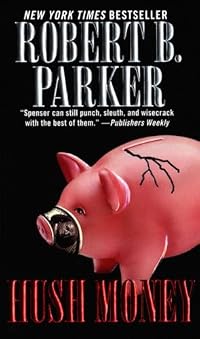
Description
When Robin Nevins, the son of Hawk's boyhood mentor, is denied at the University, Hawk asks Spenser to investigate. It appears the denial is tied to the suicide of a young gay activist, and as Spenser digs deeper he is nearly drowned in a multicultural swamp of politics: black, gay, academic, and feminist. At the same time, Spenser's inamorata, Susan, asks him to come to the aid of an old college friend, K.C. Roth, the victim of a stalker. Spenser solves the problem a bit too effectively show more when K.C. turns the tables and begins to stalk him. With Hush Money, Robert B. Parker adds another classis with a morally complex tale to this legendary series.. show less
Tags
Recommendations







Member Reviews
"Being a professor and working are not the same thing. The academic community is composed largely of nitwits. If I may generalize. People who don't know very much about what matters very much, who view life through literature rather than the other way around." - Robert B. Parker
Q: What does the Orson Welles film, A Touch of Evil, have in common with Robert B. Parker’s novel, Hush Money?
A: Both wallow in the seedy and corrupt side of life so thoroughly that upon finishing either one, you feel like running into the shower and turning on the hot water just to get the grime off.
The above quote — not from this book — reflects how Parker, who had spent time in academia, felt about what he observed and experienced there. This is what show more Spenser says in Hush Money:
“Whenever I got involved with anything related to a university, I was reminded of how seriously everyone took everything, particularly themselves, and I had to keep a firm grip on my impulse to make fun.” — Spenser
In essence, Hush Money is a scathing indictment of the institutions of supposedly higher learning; its pretension and self-importance; its overwhelming liberalism and left-leaning, and its disdain for anyone who doesn’t fall in line with university thinking; and the utter hypocrisy of many — but not all — with PhDs who have bought into such. Perhaps no statement in the novel sums this up better than the one by a faculty member whom Spenser likes:
“They think it (a Ph.D) empowers their superior insight into government and foreign policy and race relations and such. In addition these people are put into an environment where daily, they judge themselves against a standard set by eighteen-or twenty-year-old kids who know little if anything about the subject matter in which their professors are expert.” — “Exemplar of the species is Lillian Temple. There is no liberal agenda, however goofy, that will not attract her attention. There is no hypocrisy, however bald, that she will not endure if she can convince herself that it is in the service of right thinking.” — Tommy Harmon
Harmon is a faculty member, and one of the scarce decent people of integrity Spenser encounters while investigating whether a black professor named by his father after Jackie Robinson, and who is not the “right” kind of black guy, has been denied tenure unfairly. The man who named him is Bobby Nevins, an important figure in Hawk’s path out of the ghetto, which we at least get a surface peek at in this one. We also get the extraordinary revelation, that one of the male black professors at the university, who has since changed his name, once tried to seduce young Hawk.
Yes, the seediness is high, here, but it hardly ends there. In fact, it’s only just beginning. In addition to being a hard and unpleasant look at academia, this is a hard and unpleasant look at the male gay community, and it begins bothering Spenser. Just how bad it is, is revealed by gay cop, Lee Farrell’s comments to Spenser when it becomes obvious the case is making him quite uncomfortable:
“Lemme tell you what’s bothering you. You’re chasing along after whatever it is that you can’t quite catch, and every gay person you encounter is sleazy, crooked, second rate, and generally unpleasant. And, being a basically decent guy, despite the smart mouth, you fear that maybe you are prejudiced and it’s clouding your judgement. Same thing happens to me with blacks. I spend two months on drug-related homicide and everybody’s black, and everybody’s a vicious sleaze bag, and I begin to wonder, is it me? No. We deal with the worst. You got a case involving murder and blackmail, most of the people you meet are going to be scumbags.”
That almost sums up the book, as this is a walk on the sleazy side, and the ones with the most education, may be the sleaziest. Their hypocrisy is, indeed, as pointed out here, breathtaking. Looking into what seems frivolous at first, as a favor to Hawk, Spenser discovers that a suicide linked to Nevins was probably murder. It was the rumor that Nevins is gay, and having an affair with the student which kept him from attaining tenure. But Nevins is a black who doesn’t fit into an academia profile others would like. Being fairly conservative in his approach to teaching, preferring his English students to learn about dead white guys like Shakespeare, rather than studying Modern Black Anger, has not won him friends and influence. Spenser isn’t even certain Nevins is gay, much less that he was connected to the murdered student. And Nevins isn’t saying. His reason for remaining silent on the issue, which is revealed late in the novel, show him to be more like his father, Bobby Nevins, than either Robinson or Spenser had imagined.
Amir is the professor who had hit on Hawk years ago, and there is a palpable disgust here from Hawk. Spenser can’t even figure out why Hawk dislikes him so much, because he’s just another sleazy, self-important member of academia using the situation and culture for his own aggrandizement. In other words, nothing new under the sun for university life. When the reason for Hawk’s disdain is finally revealed, it is shocking. Though at this point, the series had become more entertainment than substance, it at least gave readers a glimpse into Hawk’s past, and fleshed his character out to some minor degree. Not enough that it would eclipse the Susan and Spenser show, but a little. I’ll get to that portion of the novel in a bit.
First, there is a grad-student paper called OUTrageous, which has been outing gay people on campus and off. But it turns out that someone was involved in blackmail as well. And there is a huge fund the victim had which his mother knew nothing about. It gets sleazier from there. Then Parker suddenly realizes he’s been taking an almost conservative tack, so he throws in a far fringe right leader and some more sleaze and hypocrisy incurs. It’s fair game, of course, as whackadoodle and slimy is everywhere. Yet it feels a bit like an afterthought by Parker. The new plot thread — a loose term when it comes to the middle and later Parkers — seems pulled out of the blue. It feels to this reader more like it is inserted by Parker to reclaim some of his Boston-liberal street-cred, rather than owning this particular story itself, and the dark corners of liberal hypocrisy to which it had taken him. But it could also have been due to Parker’s laziness in plotting, which had taken a back seat to the Susan Silverman show at this point. Maybe it was a little of both.
So that Parker could work his precious — imagine Gollum’s voice — into this one, we get a second case that Spenser works on as a favor to Susan. It seems a good friend of hers is being stalked. KC is artificial in nearly every way except her stunning, Hedy Lamarr-like beauty, and her voracious need for male affection. Naturally, of course, she would be an old pal of Susan’s, and naturally, she’s a head-case. Once she latches onto Spenser, however, it becomes quite obvious their friendship is as shallow as they are. But KC obviously does know Susan very well:
“What’s so great about Susan? Seriously, what’s so special about her? I’ve known her since we were in college. She’s so vain, for God’s sake. — And she’s so pretentious, for God’s sake.” — KC to Spenser
KC goes on to say that Susan is too vain and pretentious to even enjoy lovemaking. KC is a little twisted herself, but the solution to getting her off Spenser and in the direction of therapy is simplistic and gag-worthy. Susan to the rescue! Just have something for your stomach handy because it will churn as your eyes roll. It’s less unpleasant than some later scenes in the main story-line, however. They will definitely make you want to shower quickly. But it’s the sign of a good story if it can make you feel like that.
Parker’s disdain for academia is palpable here, yet each time he shows something ugly, he has to cop out just that tiny bit, marginalize it so that a fraction of its impact is lost. When a writer has something to say, and it’s important, people will not always like you. Here, and in a few other books, Parker would go right to the edge, then pull back toward political correctness, as if he didn’t want people to dislike him. In essence, Hush Money is like that Seinfeld episode which has the catchphrase, “Not that there’s anything wrong with that” but minus the laughter.
Still, Hush Money is a very interesting read, with some good stuff to recommend it. There is a wonderful opening paragraph about the music of baseball which has somehow been lost in modern times. Anyone who loves baseball will enjoy those opening comments. And there is a Brian Donlevy mention for fans of classic film which is a gem:
“I raised both eyebrows. I could raise one eyebrow like Brian Donlevy, but I didn’t very often, because most people didn’t know who Brian Donlevy was, or what I was doing with my face.”
I couldn’t stop laughing for a while after that one, but there aren’t many moments of laughter here. It is, however, pretty good for a Spenser story from this period, and worth reading. show less
Q: What does the Orson Welles film, A Touch of Evil, have in common with Robert B. Parker’s novel, Hush Money?
A: Both wallow in the seedy and corrupt side of life so thoroughly that upon finishing either one, you feel like running into the shower and turning on the hot water just to get the grime off.
The above quote — not from this book — reflects how Parker, who had spent time in academia, felt about what he observed and experienced there. This is what show more Spenser says in Hush Money:
“Whenever I got involved with anything related to a university, I was reminded of how seriously everyone took everything, particularly themselves, and I had to keep a firm grip on my impulse to make fun.” — Spenser
In essence, Hush Money is a scathing indictment of the institutions of supposedly higher learning; its pretension and self-importance; its overwhelming liberalism and left-leaning, and its disdain for anyone who doesn’t fall in line with university thinking; and the utter hypocrisy of many — but not all — with PhDs who have bought into such. Perhaps no statement in the novel sums this up better than the one by a faculty member whom Spenser likes:
“They think it (a Ph.D) empowers their superior insight into government and foreign policy and race relations and such. In addition these people are put into an environment where daily, they judge themselves against a standard set by eighteen-or twenty-year-old kids who know little if anything about the subject matter in which their professors are expert.” — “Exemplar of the species is Lillian Temple. There is no liberal agenda, however goofy, that will not attract her attention. There is no hypocrisy, however bald, that she will not endure if she can convince herself that it is in the service of right thinking.” — Tommy Harmon
Harmon is a faculty member, and one of the scarce decent people of integrity Spenser encounters while investigating whether a black professor named by his father after Jackie Robinson, and who is not the “right” kind of black guy, has been denied tenure unfairly. The man who named him is Bobby Nevins, an important figure in Hawk’s path out of the ghetto, which we at least get a surface peek at in this one. We also get the extraordinary revelation, that one of the male black professors at the university, who has since changed his name, once tried to seduce young Hawk.
Yes, the seediness is high, here, but it hardly ends there. In fact, it’s only just beginning. In addition to being a hard and unpleasant look at academia, this is a hard and unpleasant look at the male gay community, and it begins bothering Spenser. Just how bad it is, is revealed by gay cop, Lee Farrell’s comments to Spenser when it becomes obvious the case is making him quite uncomfortable:
“Lemme tell you what’s bothering you. You’re chasing along after whatever it is that you can’t quite catch, and every gay person you encounter is sleazy, crooked, second rate, and generally unpleasant. And, being a basically decent guy, despite the smart mouth, you fear that maybe you are prejudiced and it’s clouding your judgement. Same thing happens to me with blacks. I spend two months on drug-related homicide and everybody’s black, and everybody’s a vicious sleaze bag, and I begin to wonder, is it me? No. We deal with the worst. You got a case involving murder and blackmail, most of the people you meet are going to be scumbags.”
That almost sums up the book, as this is a walk on the sleazy side, and the ones with the most education, may be the sleaziest. Their hypocrisy is, indeed, as pointed out here, breathtaking. Looking into what seems frivolous at first, as a favor to Hawk, Spenser discovers that a suicide linked to Nevins was probably murder. It was the rumor that Nevins is gay, and having an affair with the student which kept him from attaining tenure. But Nevins is a black who doesn’t fit into an academia profile others would like. Being fairly conservative in his approach to teaching, preferring his English students to learn about dead white guys like Shakespeare, rather than studying Modern Black Anger, has not won him friends and influence. Spenser isn’t even certain Nevins is gay, much less that he was connected to the murdered student. And Nevins isn’t saying. His reason for remaining silent on the issue, which is revealed late in the novel, show him to be more like his father, Bobby Nevins, than either Robinson or Spenser had imagined.
Amir is the professor who had hit on Hawk years ago, and there is a palpable disgust here from Hawk. Spenser can’t even figure out why Hawk dislikes him so much, because he’s just another sleazy, self-important member of academia using the situation and culture for his own aggrandizement. In other words, nothing new under the sun for university life. When the reason for Hawk’s disdain is finally revealed, it is shocking. Though at this point, the series had become more entertainment than substance, it at least gave readers a glimpse into Hawk’s past, and fleshed his character out to some minor degree. Not enough that it would eclipse the Susan and Spenser show, but a little. I’ll get to that portion of the novel in a bit.
First, there is a grad-student paper called OUTrageous, which has been outing gay people on campus and off. But it turns out that someone was involved in blackmail as well. And there is a huge fund the victim had which his mother knew nothing about. It gets sleazier from there. Then Parker suddenly realizes he’s been taking an almost conservative tack, so he throws in a far fringe right leader and some more sleaze and hypocrisy incurs. It’s fair game, of course, as whackadoodle and slimy is everywhere. Yet it feels a bit like an afterthought by Parker. The new plot thread — a loose term when it comes to the middle and later Parkers — seems pulled out of the blue. It feels to this reader more like it is inserted by Parker to reclaim some of his Boston-liberal street-cred, rather than owning this particular story itself, and the dark corners of liberal hypocrisy to which it had taken him. But it could also have been due to Parker’s laziness in plotting, which had taken a back seat to the Susan Silverman show at this point. Maybe it was a little of both.
So that Parker could work his precious — imagine Gollum’s voice — into this one, we get a second case that Spenser works on as a favor to Susan. It seems a good friend of hers is being stalked. KC is artificial in nearly every way except her stunning, Hedy Lamarr-like beauty, and her voracious need for male affection. Naturally, of course, she would be an old pal of Susan’s, and naturally, she’s a head-case. Once she latches onto Spenser, however, it becomes quite obvious their friendship is as shallow as they are. But KC obviously does know Susan very well:
“What’s so great about Susan? Seriously, what’s so special about her? I’ve known her since we were in college. She’s so vain, for God’s sake. — And she’s so pretentious, for God’s sake.” — KC to Spenser
KC goes on to say that Susan is too vain and pretentious to even enjoy lovemaking. KC is a little twisted herself, but the solution to getting her off Spenser and in the direction of therapy is simplistic and gag-worthy. Susan to the rescue! Just have something for your stomach handy because it will churn as your eyes roll. It’s less unpleasant than some later scenes in the main story-line, however. They will definitely make you want to shower quickly. But it’s the sign of a good story if it can make you feel like that.
Parker’s disdain for academia is palpable here, yet each time he shows something ugly, he has to cop out just that tiny bit, marginalize it so that a fraction of its impact is lost. When a writer has something to say, and it’s important, people will not always like you. Here, and in a few other books, Parker would go right to the edge, then pull back toward political correctness, as if he didn’t want people to dislike him. In essence, Hush Money is like that Seinfeld episode which has the catchphrase, “Not that there’s anything wrong with that” but minus the laughter.
Still, Hush Money is a very interesting read, with some good stuff to recommend it. There is a wonderful opening paragraph about the music of baseball which has somehow been lost in modern times. Anyone who loves baseball will enjoy those opening comments. And there is a Brian Donlevy mention for fans of classic film which is a gem:
“I raised both eyebrows. I could raise one eyebrow like Brian Donlevy, but I didn’t very often, because most people didn’t know who Brian Donlevy was, or what I was doing with my face.”
I couldn’t stop laughing for a while after that one, but there aren’t many moments of laughter here. It is, however, pretty good for a Spenser story from this period, and worth reading. show less
Synopsis: 'When Robinson Nevins, the son of Hawk's boyhood mentor, is denied tenure at the University, Hawk asks Spenser to investigate. It appears the denial is tied to the suicide of a young gay activist, Prentice Lamont. While intimations of an affair between Lamont and Nevins have long fed the campus rumor mill, no one is willing to talk, and as Spenser digs deeper he is nearly drowned in a multicultural swamp of politics: black, gay, academic, and feminist.
At the same time, Spenser's inamorata, Susan, asks him to come to the aid of an old college friend, K.C. Roth, the victim of a stalker. Spenser solves the problem a bit too effectively, and K.C., unwilling to settle for the normal parameters of the professional-client show more relationship, becomes smitten with him, going so far as to attempt to lure him from Susan. When Spenser, ever chivalrous, kindly rejects her advances, K.C. turns the tables and begins to stalk him.
Then the case of Robinson Nevins turns deadly. It is, Spenser discovers, only the tip of the iceberg in a great conspiracy to keep America white, male, and straight. Spenser must call upon his every resource, including friends on both sides of the law, to stay alive.' From Fandom
Review: Getting tenure is right up there with getting into the Masons - once you jump through all the hoops, there are secret meetings of those already inducted who for reasons of their own decide whether you get to know the secret handshake or not. This book gets it right. It also points out that women are just as likely to be stalkers as men. Good read. show less
At the same time, Spenser's inamorata, Susan, asks him to come to the aid of an old college friend, K.C. Roth, the victim of a stalker. Spenser solves the problem a bit too effectively, and K.C., unwilling to settle for the normal parameters of the professional-client show more relationship, becomes smitten with him, going so far as to attempt to lure him from Susan. When Spenser, ever chivalrous, kindly rejects her advances, K.C. turns the tables and begins to stalk him.
Then the case of Robinson Nevins turns deadly. It is, Spenser discovers, only the tip of the iceberg in a great conspiracy to keep America white, male, and straight. Spenser must call upon his every resource, including friends on both sides of the law, to stay alive.' From Fandom
Review: Getting tenure is right up there with getting into the Masons - once you jump through all the hoops, there are secret meetings of those already inducted who for reasons of their own decide whether you get to know the secret handshake or not. This book gets it right. It also points out that women are just as likely to be stalkers as men. Good read. show less
I think the reasons I liked this book are the same reasons I like Spenser books in general. Spenser and Hawk are great characters. They are tough guys without being stupid; they are smart guys without being annoying. And their friendship comes through as real and believable. You can tell by the way they talk to each other that they have known each other for a long time. And the book is written with a lot of wit. So it’s fun to read. It deals with issues like prejudice and racism without reading like an after school special or a sermon and without belittling the problem. And since I tend to get annoyed when books preach at me, I appreciated that. The plot line about Nevins was more interesting to me than the other one but both were show more fine. But I was more interested in the people than in either of them. If you like detective/PI novels and haven’t read any Spenser, you should. If not this one than another. They are easy to get hooked on. show less
I turn to Robert Parker's books when I want a fast, fun read. They don't so much "read" as talk, and it''s fun eavesdropping. This one did not disappoint. The story seemed to be largely about pretension in different settings, and it had an especially satisfying ending, with all the phonies getting their appropriate comeuppences.
Feminists, intellectual women, Brandeis people are not portrayed in a positive light; I think unfairly. Being a naive, intelligent woman, I find it hard to believe that we are quite as bad as Parker says. Besides from that, like all Spenser novels, it's an easy read.
Hush Money is Robert B. Parker’s 26th novel featuring the redoubtable Spenser (with an “s”], a tough but articulate autodidactic private eye based in Boston. In this one, Spenser takes on two cases pro bono. This is not unusual for him. Having read quite a few Spenser novels, I often wonder how he pays his bills.
In the first case, he seeks to discover why an African-American English professor has been denied tenure at a local university. Spenser’s client is suspected of having a same sex-relationship with a student who apparently has committed suicide. What begins as an academic exercise devolves into a murder case as Spenser unearths some odd aspects of the “suicide.” This case takes some interesting twists on the way to show more being solved.
In the second case, Spenser does a favor for his long time girlfriend, Susan Silverman, by investigating a stalker of one of Susan’s clients. Although the stalkee (Susan’s client) becomes the stalker (of Spenser), this part of the story never really seems plausible or creates any real tension. The best that can be said for this story line is that Susan (who usually seems to me to be a pretentious airhead) turns into a sympathetic character.
Nonetheless, as is true of the many other Spenser novels I have read, the book is very enjoyable, kept alive by Spenser’s razor sharp repartee, particularly with his formidable buddy, Hawk. For example, while Spenser is interviewing one faculty member about a colleague:
“Do you know Amir Abdullah?”
“Yes.”
“Comment?”
“Amir is a fraud. He’s an intellectually dishonest, manipulative, exploitive charlatan.”
“Know anything bad about him?” I [Spenser] said.
Or, when Spenser and Hawk are planning to interrupt a meeting of an armed Neo-Nazi like gang:
“And what we going to do they start hollering and the body guards come dashing in?”
“I thought you had that covered,” I said.
“Course I got it covered,” Hawk said. “I just meant you want me to shoot them or quell them with a stern look?”
“Stern look will probably cause less ruckus,” I said.
And that is why we [there are thousands of us] read the Spenser novels. There is seldom a lot of tension—nothing like a book by Steig Larssen or Jo Nesbo — but there is usually enough complication to keep the story moving along and provide a backdrop for the conversation.
(JAB) show less
In the first case, he seeks to discover why an African-American English professor has been denied tenure at a local university. Spenser’s client is suspected of having a same sex-relationship with a student who apparently has committed suicide. What begins as an academic exercise devolves into a murder case as Spenser unearths some odd aspects of the “suicide.” This case takes some interesting twists on the way to show more being solved.
In the second case, Spenser does a favor for his long time girlfriend, Susan Silverman, by investigating a stalker of one of Susan’s clients. Although the stalkee (Susan’s client) becomes the stalker (of Spenser), this part of the story never really seems plausible or creates any real tension. The best that can be said for this story line is that Susan (who usually seems to me to be a pretentious airhead) turns into a sympathetic character.
Nonetheless, as is true of the many other Spenser novels I have read, the book is very enjoyable, kept alive by Spenser’s razor sharp repartee, particularly with his formidable buddy, Hawk. For example, while Spenser is interviewing one faculty member about a colleague:
“Do you know Amir Abdullah?”
“Yes.”
“Comment?”
“Amir is a fraud. He’s an intellectually dishonest, manipulative, exploitive charlatan.”
“Know anything bad about him?” I [Spenser] said.
Or, when Spenser and Hawk are planning to interrupt a meeting of an armed Neo-Nazi like gang:
“And what we going to do they start hollering and the body guards come dashing in?”
“I thought you had that covered,” I said.
“Course I got it covered,” Hawk said. “I just meant you want me to shoot them or quell them with a stern look?”
“Stern look will probably cause less ruckus,” I said.
And that is why we [there are thousands of us] read the Spenser novels. There is seldom a lot of tension—nothing like a book by Steig Larssen or Jo Nesbo — but there is usually enough complication to keep the story moving along and provide a backdrop for the conversation.
(JAB) show less
I just could not put this down, finished up in one day. It was well-crafted and very vivid, although I did find a minor geography problem; you can't really walk from Kirkland Street to Mass Ave, well, not to get to Harvard Square. I also kept expecting the two plots lines to merge and I was fairly suprised when they didn't. However, it was so well done those are minor quibbles.
Members
- Recently Added By
Lists

Books Read in 2016
4,666 works; 199 members
Author Information

126+ Works 72,849 Members
Robert Brown Parker is an American fiction writer of mysteries. He was born in Springfield, Massachusetts and earned his BA degree from Colby College in Waterville, Maine. He went on to earn his master's degree in English literature from Boston University. He started his career working in advertising. After some years, he went back to school to show more earn his PhD in English from Boston University in 1971. He then began his writng career while teaching at Northeastern University. He decided to become a full-time writer in 1979. His most popular works were the 40 novels written about the private detective Spenser. The ABC Television Network developed the television series "Spenser: For Hire", based on the character in the mid-1980s. Parker also wrote nine novels based on the character Jesse Stone and six novels based on the character Sunny Randall. On January 18, 2010, Robert Parker died suddenly of a heart attack at his home in Cambridge Massachusetts. (Bowker Author Biography) show less
Some Editions
Awards and Honors
Distinctions
Series

Common Knowledge
- Canonical title
- Hush Money
- Original publication date
- 1999-03
- People/Characters
- Amir Abdullah/Dennis Crawford; Frank Belson; Tommy Harmon; Hawk; Patsy Lamont; Bobby Nevins (show all 14); Robinson Nevins; Milo Quant (Last Stand Systems | Inc.); Burton Roth; Katherine Carole Roth "K.C."; Susan Silverman; Spenser; Lillian Temple; Louis Vincent
- Important places
- Boston, Massachusetts, USA; Cambridge, Massachusetts, USA; Massachusetts, USA
- Dedication
- For Joan:
all the day and night time - First words
- Outside my window a mixture of rain and snow was settling into slush on Berkeley Street.
- Quotations
- The leisurely pace of baseball had once been made for radio. It allowed the announcers to talk about baseball in perfect consonance with the rhythm of the game. We listened not only to hear what happened but because we liked ... (show all)the music of it.
"Surprised Susan don't have you color-coordinating your ammunition." - Last words
- (Click to show. Warning: May contain spoilers.)And we lay there with our arms around each other and laughed while the thunder and lightning frolicked with the rain outside.
Classifications
Statistics
- Members
- 1,257
- Popularity
- 19,421
- Reviews
- 21
- Rating
- (3.58)
- Languages
- English, German
- Media
- Paper, Audiobook, Ebook
- ISBNs
- 24
- UPCs
- 1
- ASINs
- 6