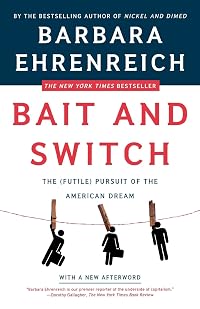
Bait and Switch: The (Futile) Pursuit of the American Dream
by Barbara Ehrenreich
On This Page
Description
Barbara Ehrenreich's "Nickel and dimed" explored the lives of low-wage workers. Now, in "Bait and switch", she enters another hidden realm of the economy-the world of the white-collar unemployed. Armed with a plausible resume of a professional "in transition," she attempts to land a "middle class job" undergoing career coaching and personality testing, then begins trawling a series of EST-like "boot camps," job fairs, "networking events," and evangelical job-search "ministries." She is show more proselytized, scammed, lectured and, again and again, rejected. "Bait and switch" highlights the people who've done everything right-gotten college degrees, developed marketable skills, and built up impressive resumes-yet have become repeatedly vulnerable to financial disaster. Like the now classic "Nickel and dimed", "Bait and switch" is alternately hilarious and tragic, a searing expose of economic cruelty where we least expect it. show lessTags
Recommendations









































Member Reviews
Barbara Ehrenreich does a great job evoking the sweaty desperation of people clinging to their station after circumstances change. That's not to say that she is unsympathetic; her sympathy for struggling people is a hallmark of her writing. Her portrayals of her fellow job-seekers (and herself) are unsparing, but not unkind.
This would be best read after [b:Nickel and Dimed: On (Not) Getting by in America|1869|Nickel and Dimed On (Not) Getting by in America|Barbara Ehrenreich|https://i.gr-assets.com/images/S/compressed.photo.goodreads.com/books/1442378091l/1869._SY75_.jpg|1840613], her book focusing on both the search for and the daily realities of blue and pink collar work. Rather than playing these categories of workers against each show more other, I think the shared themes of these two books are along the lines of solidarity and identifying the underlying structures of exploitation. They could be fodder for culture war stuff, but Ehrenreich is too smart to slip into that and reports with such closely observed detail that it would be difficult to weaponise any of it. show less
This would be best read after [b:Nickel and Dimed: On (Not) Getting by in America|1869|Nickel and Dimed On (Not) Getting by in America|Barbara Ehrenreich|https://i.gr-assets.com/images/S/compressed.photo.goodreads.com/books/1442378091l/1869._SY75_.jpg|1840613], her book focusing on both the search for and the daily realities of blue and pink collar work. Rather than playing these categories of workers against each show more other, I think the shared themes of these two books are along the lines of solidarity and identifying the underlying structures of exploitation. They could be fodder for culture war stuff, but Ehrenreich is too smart to slip into that and reports with such closely observed detail that it would be difficult to weaponise any of it. show less
A seminal book about the shrinking middle class in which laid-off employees struggle to make ends meet through unemployment benefits, multilevel marketing schemes, contract work, and commission-only sales, none of which offers the stability and reliability of a regular paycheck, paid vacations, health and dental benefits, and a retirement plan.
Ehrenreich's one year journey to find an executive level job led her to four states, dozens of networking events, three career coaches, a personal makeover complete with makeup, and $4,000.00 in job-search related expenses but resulted in only two job offers: one from AFLAC as a commission-only sales representative and one from Mary Kay as an independent sales representative. Neither "job" offered show more the typical employment package she was seeking: salaried work with benefits.
Both disheartening and enlightening, Bait and Switch exemplifies Ehrenreich's ability to balance straight forward reporting with firsthand experience. A must read for anyone trying to understand the success and failings of corporate culture in the post dot-com United States. show less
Ehrenreich's one year journey to find an executive level job led her to four states, dozens of networking events, three career coaches, a personal makeover complete with makeup, and $4,000.00 in job-search related expenses but resulted in only two job offers: one from AFLAC as a commission-only sales representative and one from Mary Kay as an independent sales representative. Neither "job" offered show more the typical employment package she was seeking: salaried work with benefits.
Both disheartening and enlightening, Bait and Switch exemplifies Ehrenreich's ability to balance straight forward reporting with firsthand experience. A must read for anyone trying to understand the success and failings of corporate culture in the post dot-com United States. show less
Not as brilliant as NICKEL AND DIMED; I get the feeling Ehrenreich can't bring herself to feel as sympathetic to unemployed white-collar corporate workers as she did to minimum-wage workers. However, it's still compulsively readable. Ehrenreich re-named herself Barbara Alexander (legally returning to her maiden name) and entered the job market, intending to get herself a corporate job and work for a few months. She never did get a job; her only offers were from AFLAC and Mary Kay Cosmetics, in both cases basically to work as an independent contractor. Along the way, she experienced job fairs, corporate counselors, employment seminars, resumé counseling, and all the other ways in which the white-collar unemployed are further fleeced. show more The thing that stands out most to me is that many of the people preying on the people looking for jobs are themselves people who can't find jobs.
After reading it, I found myself grateful I decided to become a private school teacher and not a PR person, systems analyst, or event planner. But I also feel a little less secure all around. Ehrenreich specializes in letting all the air out of the various fictions of a capitalist economy. show less
After reading it, I found myself grateful I decided to become a private school teacher and not a PR person, systems analyst, or event planner. But I also feel a little less secure all around. Ehrenreich specializes in letting all the air out of the various fictions of a capitalist economy. show less
I thought that it couldn't get any more real or depressing than Nickel and Dimed, but in this book, Ehrenreich takes on the myths of the white-collar world and finds one where inaction masquerades as self-improvement and where people are so afraid of pointing out what is wrong with the system that they spend their lives blaming themselves. Especially pertinent and prophetic in the wake (or in the throes, depending on your point of view) of The Great Recession, this book exposes the white collar ideology of self-help and self-blame for what it is: wishful thinking. I know too many people whose situations mirror or are even worse than the ones described in the book; it should be required reading for all incoming college freshmen.
Nothing new or radical here for anyone who's ever looked for an office job. But it is, as one of the job seekers Ehrenreich encountered in her search said, nice to know that you're not alone in the frustrations and bullshit experienced during a job search.
I loved Nickel and Dimed. Bait and Switch? Not so much.
The idea behind the book is a smart one: What happens to the thousands who do everything right and still get screwed by corporate America? What do they do to get by? Are they just as jaded and jilted by the American dream as those on the bottom economic rung?
But the bait here is a book promising insight into this often overlooked and undertalked about world. The switch is that, as an imposter, Ehrenreich hardly scratches the surface of promising what she says she will. You spend the first hundred pages waiting for it to begin only to realize it never will. Perhaps because it was a faux job hunt, or because everything from her resume to her name were only half-truths, she barely gets show more off the ground in this book before its over. How can a book that says so little seem so long?
She doesn't land that elusive job and gives up. Game over. By throwing in the towel, Ehrenreich only proves how little she gets it. She misses her own point. The real people whose lives she is supposed to be imitating and expounding upon don't have such a luxury. They settle. They don't give up. show less
The idea behind the book is a smart one: What happens to the thousands who do everything right and still get screwed by corporate America? What do they do to get by? Are they just as jaded and jilted by the American dream as those on the bottom economic rung?
But the bait here is a book promising insight into this often overlooked and undertalked about world. The switch is that, as an imposter, Ehrenreich hardly scratches the surface of promising what she says she will. You spend the first hundred pages waiting for it to begin only to realize it never will. Perhaps because it was a faux job hunt, or because everything from her resume to her name were only half-truths, she barely gets show more off the ground in this book before its over. How can a book that says so little seem so long?
She doesn't land that elusive job and gives up. Game over. By throwing in the towel, Ehrenreich only proves how little she gets it. She misses her own point. The real people whose lives she is supposed to be imitating and expounding upon don't have such a luxury. They settle. They don't give up. show less
One of the last lines in this book refers to Corporate America as "being evil people by day and going home to live the American Dream". In many ways, this is true and this book illustrates that point well. The author attempts to find a job as an executive and receives only two "jobs" after months of searching. It is a tough look at America today and tougher for anyone without job security. Still, its worth the read just to realize how many people are also affected by it and how ridiculous career coaches can be.
Members
- Recently Added By
Lists

LT picks: Blue Books
197 works; 44 members

"I'd Group-Read That"
20 works; 6 members
The 99% -- Most Readable Non-Fiction
37 works; 8 members

Macmillan Publishers
129 works; 3 members

Income Inequality
20 works; 4 members

Books Read in 2020
4,379 works; 123 members

Maybe This Year? Books to Look Forward To
412 works; 9 members

Club Read's Recommended Nonfiction Written by Women
618 works; 30 members
Author Information

35+ Works 22,920 Members
Barbara Ehrenreich is the author of "Blood Rites"; "The Worst Years of Our Lives"; "Fear of Falling", which was nominated for a National Book Critics Circle Award, & eight other books. A frequent contributor to Time, Harper's, Esquire, The New Republic, Mirabella, The Nation, The New York Magazine, she lives near Key West, Florida. (Publisher Fact show more Sheets) Political activist and writer Barbara Ehrenreich was born in Butte, Montana on August 26, 1941. She studied physics at Reed College and graduated in 1963. She received a Ph.D. in Cell Biology from Rockefeller University in 1968. Rather than pursuing a career in science, however, she decided to focus on social change. Ehrenreich has written columns and contributed articles to publications including Time Magazine, The Progressive, The New York Times, Mother Jones, The Atlantic Monthly, Ms, The New Republic, Harper's Magazine, and The Nation. She taught essay writing at the Graduate School of Journalism at the University of California, Berkeley in 1998 and 2000. Ehrenreich has written many books, with 2001's Nickel and Dimed: On (Not) Getting by in America and 2005's Bait and Switch, The (Futile) Pursuit of the American Dream both becoming New York Times bestsellers. Nickel and Dimed examines working-class poverty, while Bait and Switch discusses white-collar unemployment. Her next bestseller was in 2014 with Living With a Wild God: A Nonbeliever's Search for the Truth about Everything. In 1998 Ehrenreich was named Humanist of the Year by the American Humanist Association, and she received the Nation Institute/Puffin Foundation Prize for Creative Citizenship in 2004. (Bowker Author Biography) show less
Awards and Honors
Distinctions
Common Knowledge
- Canonical title
- Bait and Switch: The (Futile) Pursuit of the American Dream (Futile)
- Original title
- Bait and Switch: The (Futile) Pursuit of the American Dream (Futile)
- Original publication date
- 2005
- First words
- Where to begin?
- Last words
- (Click to show. Warning: May contain spoilers.)What they need, too, is not a "winning attitude" but a deeper and more ancient quality, one that I never once heard mentioned in my search, and that is courage: the courage to come together and work for change, even in the face of overwhelming odds.
Classifications
- Genres
- Sociology, Economics, General Nonfiction, Nonfiction, Business
- DDC/MDS
- 650.14 — Applied science & technology Management & public relations Business Skills & Management Personal success in business Success in obtaining jobs and promotions
- LCC
- HD5708.55 .U6 .E47 — Social sciences Industries. Land use. Labor Industries. Land use. Labor Labor. Work. Working class
- BISAC
Statistics
- Members
- 1,828
- Popularity
- 11,940
- Reviews
- 56
- Rating
- (3.39)
- Languages
- 6 — Dutch, English, Finnish, German, Norwegian, Swedish
- Media
- Paper, Audiobook, Ebook
- ISBNs
- 20
- ASINs
- 12