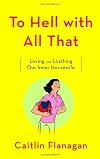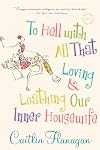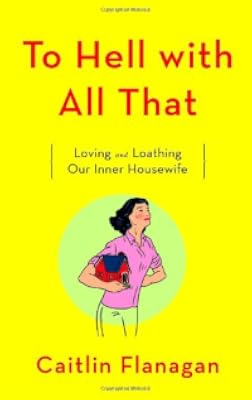
To Hell with All That: Loving and Loathing Our Inner Housewife
by Caitlin Flanagan
On This Page
Description
Family & Relationships. Sociology. Women's Studies. Nonfiction. Presented as a series of essays, it follows the natural course of women's lives.Tags
Recommendations

Member Reviews
Well, ah, I had read and enjoyed some of Flanagan's writing in the New Yorker and the Atlantic, so somewhere along the line I must have seen that she had written and book, and added it to the "gift list" that I share on Google Docs with my parents. So that's why my Dad said, very skeptically, "is this really the book you wanted?" when I opened it.
Well it is the book I wanted, I suppose, and to hell with what anyone thinks. It was funny and thought-provoking, albeit "counter-revolutionary" as I kept saying to my baffled Marxist brother. It is counter-revolutionary, in a sense, though; Flanagan seems to want to roll back the clock to a pre-feminist age. I found myself wondering what the women at Feministing -- whom I admire -- would show more make of these essays, and whether it's possible to agree with both of them, or if that makes you a hypocrite or something. Oh well. A better read than many more highly vaunted pieces of cultural criticism, to be sure. show less
Well it is the book I wanted, I suppose, and to hell with what anyone thinks. It was funny and thought-provoking, albeit "counter-revolutionary" as I kept saying to my baffled Marxist brother. It is counter-revolutionary, in a sense, though; Flanagan seems to want to roll back the clock to a pre-feminist age. I found myself wondering what the women at Feministing -- whom I admire -- would show more make of these essays, and whether it's possible to agree with both of them, or if that makes you a hypocrite or something. Oh well. A better read than many more highly vaunted pieces of cultural criticism, to be sure. show less
Caitlin Flanagan writes about motherhood without the sentimentality. In this book she covers every aspect of modern womanhood from overblown wedding ceremonies to the difficult decision to work outside the home. She writes about her twins' nanny, and she writes about Martha Stewart. She sees through the BS.
And she's funny. She willingly self-deprecates in the name of writing the truth.
It's true that this book is really an essay collection cum memoir, but it's nonetheless super enjoyable. If we're going to figure out the modern family, we need voices like hers.
And she's funny. She willingly self-deprecates in the name of writing the truth.
It's true that this book is really an essay collection cum memoir, but it's nonetheless super enjoyable. If we're going to figure out the modern family, we need voices like hers.
To He** with this Book...What an Irksome Read
The description on Amazon says that "Flanagan's take on why modern mothers are conflicted about their roles is witty and well researched." I can't say that I agree...I'd say that Flannagan's take on why modern mothers are conflicted is, well...conflicted itself. For me, the title: To Hell With All that: Loving and Loathing Our Inner Housewife was about the most interesting and exciting thing about Flannagan's book. It serves to draw you in and makes you think you are in for something different and interesting, sadly this feeling doesn't extend beyond the title page. Hell With All that: Loving and Loathing Our Inner Housewife is ten chapters of loosely related information that sounds show more promising, but never pay off. They ramble along allowing a glimpse into Flanagan's very pampered and privileged version of stay-at-home motherhood that left me shaking my head and wondering what the heck was the point she really wanted to make here.
Originally she quit her teaching gig to write a novel, and when she couldn't successfully do that she decided to have kids instead. The premise here seems to be that since she was failing at writing a novel and couldn't bring herself to just go back to teaching, she'd have kids because that would give her an "excuse" to not have to worry about the novel or deal with the feelings that failure held for her...it'd be OK if she found some measure of success as a parent. She might not have turned out a novel, but she DID squeeze out a kid...the logic is unfathomable. In reading the first few chapters, I didn't get the feeling that she wanted to be a mother, I got the sense that being a mother was a means to the end of continuing to stay at home...an excuse not to go back to work or find something else more meaningful to do with her time. Not all mothers (I might even say MOST) come to the decision to have children like this...it's either planned or it just happens...we don't think to ourselves...hmmmmmmm, I'm bored with my job or I've not been successful enough at what I really wanted to do and rather than admit that and find something else to do with my life, I think I'll have a kid and let my husband support me so I can continue stay at home. Can you tell I was irritated by this book?!
Additionally, she says in several places in the book that she doesn't believe that there is a "better" when it comes to being a stay-at-home mom or a working mother, but the entire book seems to be a pat on the back for her decision to stay at home with her kids, but not REALLY stay at home with them...she's got a nanny to do the boring, menial part of parenting, a maid, a gardener, and even an organizer by the end of the book...she's not really raising those kids herself, she's got an entire support staff (and bully for those who can afford it or know they need it and thus use it)...but I don't feel it's right to pat yourself on the back for being a stay-at-home mom while you spend about as much time with your kids as most working parents do.
I was less than half way through the book when I began to realize that this book wasn't making a point, it was just another well-to-do white woman bemoaning how hard it is to be a wife and mother (either of the working or stay-at-home variety) while going on and on about her nanny, her maid and her organizer and how hard it is to organize the little tikes schedule of activities while still maintaining a sense of self...not all of us can afford those expensive classes and extracurricular activities for our kids. On the one hand she bemoans over scheduling kids but does it herself...she says for her staying at home with the kids is the best choice, but once she's published she spends time mocking other stay-at-home moms with two working mothers (the cool girls of the motherhood world, whom she desperately wanted to be "in" with)...basically she wanted the best of both worlds and luckily for her, her husband (who is rarely mentioned in the book outside of being the provider and wallet in the Flannagan family) can afford to make this a reality for her, so she never has to make those touch choices that most of the rest of us HAVE to make.
Overall, I felt that each chapter would have made a fine stand alone essay without the inclusion of all the personal information and what she perceived as the difficulties of motherhood. Taken as a whole, this book never make a point and I found it to be personally irksome to read, Hell With All that: Loving and Loathing Our Inner Housewife is a jumble of individual points and rambling personal exposition that never coalesces into a cohesive or satisfying whole. I wound up giving it two stars...I just couldn't see my way to three stars. Sure it was humorous and interesting for what it is, but it doesn't really go very far in making a cohesive point about why modern mothers are conflicted about their roles, it's clear that Flannagan IS conflicted herself and is unable to discern WHY that is exactly. In the end, I was more annoyed than entertained or informed. show less
The description on Amazon says that "Flanagan's take on why modern mothers are conflicted about their roles is witty and well researched." I can't say that I agree...I'd say that Flannagan's take on why modern mothers are conflicted is, well...conflicted itself. For me, the title: To Hell With All that: Loving and Loathing Our Inner Housewife was about the most interesting and exciting thing about Flannagan's book. It serves to draw you in and makes you think you are in for something different and interesting, sadly this feeling doesn't extend beyond the title page. Hell With All that: Loving and Loathing Our Inner Housewife is ten chapters of loosely related information that sounds show more promising, but never pay off. They ramble along allowing a glimpse into Flanagan's very pampered and privileged version of stay-at-home motherhood that left me shaking my head and wondering what the heck was the point she really wanted to make here.
Originally she quit her teaching gig to write a novel, and when she couldn't successfully do that she decided to have kids instead. The premise here seems to be that since she was failing at writing a novel and couldn't bring herself to just go back to teaching, she'd have kids because that would give her an "excuse" to not have to worry about the novel or deal with the feelings that failure held for her...it'd be OK if she found some measure of success as a parent. She might not have turned out a novel, but she DID squeeze out a kid...the logic is unfathomable. In reading the first few chapters, I didn't get the feeling that she wanted to be a mother, I got the sense that being a mother was a means to the end of continuing to stay at home...an excuse not to go back to work or find something else more meaningful to do with her time. Not all mothers (I might even say MOST) come to the decision to have children like this...it's either planned or it just happens...we don't think to ourselves...hmmmmmmm, I'm bored with my job or I've not been successful enough at what I really wanted to do and rather than admit that and find something else to do with my life, I think I'll have a kid and let my husband support me so I can continue stay at home. Can you tell I was irritated by this book?!
Additionally, she says in several places in the book that she doesn't believe that there is a "better" when it comes to being a stay-at-home mom or a working mother, but the entire book seems to be a pat on the back for her decision to stay at home with her kids, but not REALLY stay at home with them...she's got a nanny to do the boring, menial part of parenting, a maid, a gardener, and even an organizer by the end of the book...she's not really raising those kids herself, she's got an entire support staff (and bully for those who can afford it or know they need it and thus use it)...but I don't feel it's right to pat yourself on the back for being a stay-at-home mom while you spend about as much time with your kids as most working parents do.
I was less than half way through the book when I began to realize that this book wasn't making a point, it was just another well-to-do white woman bemoaning how hard it is to be a wife and mother (either of the working or stay-at-home variety) while going on and on about her nanny, her maid and her organizer and how hard it is to organize the little tikes schedule of activities while still maintaining a sense of self...not all of us can afford those expensive classes and extracurricular activities for our kids. On the one hand she bemoans over scheduling kids but does it herself...she says for her staying at home with the kids is the best choice, but once she's published she spends time mocking other stay-at-home moms with two working mothers (the cool girls of the motherhood world, whom she desperately wanted to be "in" with)...basically she wanted the best of both worlds and luckily for her, her husband (who is rarely mentioned in the book outside of being the provider and wallet in the Flannagan family) can afford to make this a reality for her, so she never has to make those touch choices that most of the rest of us HAVE to make.
Overall, I felt that each chapter would have made a fine stand alone essay without the inclusion of all the personal information and what she perceived as the difficulties of motherhood. Taken as a whole, this book never make a point and I found it to be personally irksome to read, Hell With All that: Loving and Loathing Our Inner Housewife is a jumble of individual points and rambling personal exposition that never coalesces into a cohesive or satisfying whole. I wound up giving it two stars...I just couldn't see my way to three stars. Sure it was humorous and interesting for what it is, but it doesn't really go very far in making a cohesive point about why modern mothers are conflicted about their roles, it's clear that Flannagan IS conflicted herself and is unable to discern WHY that is exactly. In the end, I was more annoyed than entertained or informed. show less
I struggled with this book immensely. While I agreed with [what I discerned to be] some of her core points - that the housewife decision is not one to be ashamed of, that not all gender roles are oppressive, etc - I found her to be an extremely unlikeable voice. It appeared to me that her opinion was muddled. At times, it was almost hard to figure out what side of the opinion line she stood.
Her writing is not wrought with wit, as the book jacket alluringly enticed me with. She seems a very petty woman, very naive and unappreciative. Particularly about her "servant" [her own words], Paloma. Whom, she says, was a life-saver and deeply meaningful in her life, but who was oddly vacant from her acknowledgments.
I credit Ms. Flanagan for her show more unwavering bluntness and for the audacity to dive into the highly controversial topic that she did, but I truly struggled to not throw this book against a wall and light it on fire. I still (despite my inclination to use it as fire starters) found it to be a worthwhile read, for it raises questions and makes you think. show less
Her writing is not wrought with wit, as the book jacket alluringly enticed me with. She seems a very petty woman, very naive and unappreciative. Particularly about her "servant" [her own words], Paloma. Whom, she says, was a life-saver and deeply meaningful in her life, but who was oddly vacant from her acknowledgments.
I credit Ms. Flanagan for her show more unwavering bluntness and for the audacity to dive into the highly controversial topic that she did, but I truly struggled to not throw this book against a wall and light it on fire. I still (despite my inclination to use it as fire starters) found it to be a worthwhile read, for it raises questions and makes you think. show less
In this book, Flanagan shows herself to be a highly entertaining writer with an uncanny ability to put her finger on and unpack the issues that vex today's wives and mommies. She points out inconvenient truths, such as the reality that something is lost in family life when there's no grown-up at home dedicated to keeping house and keeping the rest of the family running. However, I do feel she has a real credibility issue. I love the book, but oh, how I wish it were coming from a mother who has actually cleaned up her kids' puke herself instead of leaving it to the nanny and housekeeper.
Is it ironic that I listened to this while doing household chores? The author gave me some insights about certain other women, but she really does over-generalize, because the insights didn't apply to me or to other mothers I know. I did like the poignant bit comparing Erma Bombeck to Betty Friedan, though...
Just what is the role of a modern woman in the home? How should the duties of housekeeping and child-rearing be divided? Much has been written about this thorny question. Here's one woman's opinion. Drawn from her research and her experience.
Extremely even-handed, detailed and thought-provoking.
Extremely even-handed, detailed and thought-provoking.
Members
- Recently Added By
Author Information

3+ Works 289 Members
Caitlin Flanagan is a former high school teacher who became a writer; she has been on staff at The Atlantic, The New Yorker; and the Wall Street Journal. A winner of the National Magazine Award, she has also written for Time; O, The Oprah Magazine; the New York Times; and the Los Angeles Times. She lives in Los Angeles with her husband and two show more sons. show less
Classifications
- Genres
- Nonfiction, General Nonfiction, Sexuality and Gender Studies, Biography & Memoir
- DDC/MDS
- 305.43 — Society, government, & culture Social sciences, sociology & anthropology Social group - Age, Gender, Ethnicity Women Women by occupation
- LCC
- HQ759 .F585 — Social sciences The family. Marriage, Women and Sexuality The Family. Marriage. Women The family. Marriage. Home Parents. Parenthood
- BISAC
Statistics
- Members
- 190
- Popularity
- 173,005
- Reviews
- 14
- Rating
- (2.96)
- Languages
- English
- Media
- Paper, Audiobook, Ebook
- ISBNs
- 9
- UPCs
- 1
- ASINs
- 2