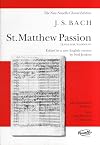
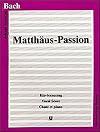
St. Matthew Passion [vocal score]
by Johann Sebastian Bach
On This Page
Description
(Music Sales America). Most of the English-speaking choral singers who make up their country's thriving choirs and choral societies will have sung Bach's great Passions in English at some time or other. This edition is in both English and German, giving the individual choir the option of which language to perform in. This book contains a preface by the editor, Neil Jenkins, and a suggested 'on the day' rehearsal schedule by Sir David Willcocks. St. Matthew Passion was written for solo show more voices, ripieno choir, 2 SATB choirs and 2 orchestras. The vocal score contains all voice parts and a piano accompaniment. show lessTags
Recommendations




















Member Reviews
I'm not going to rate this recording. It will require a lifetime of living with it to approach a decent judgment. My first Matthew Passion was Harnoncourt's first Telefunken production: at the time considered a radical interpretation that eschewed the romantic, traditional performance practices that, theoretically, were typified by Klemperer and his generation. So when I finally got around to listening to Klemperer's famous recording, I had the odd sensation of the 'shock of the new' by encountering the old. It is soooo slow! But that is not a bad thing by any means. There's a funny story about this, actually. Apparently, the soloists were having so much trouble with the slow tempi that they drew straws to determine which of them would show more confront Klemperer with a request to speed things up a little. Dietrich Fischer-Dieskau got lucky. Fully aware of Klemperer's reputation for volatitlity, F-D decided on the indirect approach. 'Dr. Klemperer,' he began, 'I dreamed last night that I met Bach in heaven.' 'Is that so, Herr Fischer? What did he have to say?' 'He said: 'You know, Dr. Klemperer is a genius; but why, please tell me, is everything he conducts so slow?'' 'How interesting, Herr Fischer, how interesting! For, do you know, I, too, dreamed I met Bach last night.' 'That's remarkable, Dr. Klemperer, what did he say to you?' 'He asked me this question: 'Who the devil is this ignoramus Fischer-Dieskau?'?' show less
I have nothing to add to the deep review by USYDArtsMusicLibrary.
Excellent état !
Oct 28, 2017French
Ratings
Members
- Recently Added By
Author Information

8,440+ Works 20,392 Members
Composer, organist, and the most famous of an illustrious family of German musicians, Johann Sebastian Bach was born in 1685. He was a master of polyphonic baroque music-a musical form characterized by the use of multiple parts in harmony and by an ornate, exuberant style. Bach's father, Johann Ambrosius, taught his son to play the violin at a show more very early age. At age 10, after both of his parents died, Bach lived with his brother Johann Christoph, an organist, who taught him to play keyboard instruments. Bach's musical genius, however, soon surpassed his brother's skill. During his lifetime, Bach was known more for his skill as an organist than as a composer. His fame as a composer did not come until years after his death, when his works were discovered by the composers Felix Mendelssohn and Robert Schumann and published in the 1800s. Between 1703 and 1717, Bach served as an organist in the German cities of Arnstadt, Muhlhausen, and Weimar. During that time, he wrote chorales, cantatas, concertos, preludes, and fugues, primarily for the organ. These works fused Italian, French, and German characteristics with a profound mastery of the contrapuntal technique. While serving as music director at the court of a German prince from 1717 to 1723, Bach wrote many compositions for the clavier and instrumental ensembles. These included preludes, fantasies, toccatas, and dance suites that served as both music instruction and entertainment. Of these works, the best known is the Well-Tempered Clavier, a series of preludes and fugues composed in 1722 and Bach's last position as cantor and music director of St. Thomas's Church in Leipzig (1724--50), exerted considerable influence on Lutheran church music. During this period, he composed as many as 300 cantatas, 200 of which have been preserved. After his death at the age of 65, Bach became revered as one of the world's greatest composers, and his compositions are regarded by many as the most sublime music ever composed. (Bowker Author Biography) show less
Some Editions
Series
Belongs to Publisher Series
Common Knowledge
- Canonical title
- St. Matthew Passion [vocal score]
- Original publication date
- 1727; 1749
- Canonical DDC/MDS
- 782.230264
- Disambiguation notice
- A polite request: can members please put [cd] or [sound recording] or something obvious in your title so we can uncombine those from the full scores and vocal scores?
Thank you.
Classifications
- Genres
- Music, Nonfiction
- DDC/MDS
- 782.230264 — Arts & recreation Music Vocal Music, Singing Nondramatic vocal forms {sacred music} Oratorios; passion modified standard subdivisions Miscellany; texts; treatises on music scores and recordings Texts, treatises on opera scores and recordings Performance scores and parts; full scores, conductiing scores, piano-vocal scores
- LCC
- M2000 .B15 .M3 — Music Music Vocal music Sacred vocal music Dramatic music
- BISAC
Statistics
- Members
- 205
- Popularity
- 158,910
- Reviews
- 4
- Rating
- (4.50)
- Languages
- 6 — Dutch, English, French, German, Spanish, Swedish
- Media
- Paper, Audiobook
- ISBNs
- 9
- ASINs
- 13