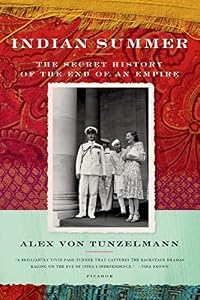
Indian Summer: The Secret History of the End of an Empire
by Alex Von Tunzelmann
On This Page
Description
At midnight on August 15, 1947, 400 million people were liberated from the British Empire. With the loss of India, its greatest colony, Britain ceased to be a superpower. This defining moment was brought about by a handful of people: Jawaharlal Nehru, the fiery Indian prime minister; Mohammed Ali Jinnah, the leader of the new Islamic Republic of Pakistan; Mohandas Gandhi, the mystical figure who enthralled a nation; and Louis and Edwina Mountbatten, the glamorous but unlikely couple sent to show more get Britain out of India. Within hours, their dreams would turn to chaos, bloodshed, and war. Behind the scenes, a secret personal drama was also unfolding, as Edwina Mountbatten and Jawaharlal Nehru began a passionate love affair. Their romance developed alongside Cold War conspiracies, the beginning of a terrible conflict in Kashmir, and an epic sweep of events that saw one million people killed and ten million dispossessed.--From publisher description. show lessTags
Recommendations




Member Reviews
http://nwhyte.livejournal.com/1885608.html
A very readable account of the British withdrawal from India, largely from the point of view of Dickie and Edwina Mountbatten, whose papers are used extensively, though with some effort also made to include the roles of the other key political players. On Lord Mountbatten's responsibility for the horrors of partition, I found it was a useful alternative viewpoint to the hatchet-job by Andrew Roberts which I read several years ago. While I think that von Tunzelmann has become slightly beguiled by her source and gives him more benefit of the doubt than is really justifiable by her own account, though I will agree that mitigating factors include the criminally obstructive attitude of Winston show more Churchill to Indian independence and Mountbatten's success at persuading almost all the princely states to join the new Indian or Pakistani states - Kashmir and Hyderabad are notorious exceptions but there could have been many more. Her account of the love affair between Nehru and Edwina Mountbatten manages to be both entertaining and respectful.
Since I work more or less in the field of international conflict resolution, I am struck by how far the level of understanding of these problems has advanced since 1947. In those days the debate was shaped partly by legal rights established by history (or myth) and partly by the rather one-dimensional discourse of anti-colonialism, with very little reference to the actual wishes and needs of people on the ground. The independence of Montenegro from Serbia was achieved with no bloodshed at all, and while Kosovo and South Sudan may have their problems, they have been handled rather better than India/Pakistan (or indeed Israel/Palestine) sixty years before. The mistake that is more often made these days is wishful thinking, where international officials kid themselves that genocidal leaders like Milošević and Bashir don't really mean it, and then discover that they do; the Indian partition case was a much more straightforward mismanagement of expectations by the political leaders, particularly Mountbatten, to the point that violence became an effective and preferred mode of discourse for many actors.
One should not perhaps blame Mountbatten for failing to implement best practices which had not yet been worked out. And yet... what comes across over and over again is how Mountbatten consistently rated his own political and managerial abilities much higher than did anyone who had actually had to work with him. In the end the misjudgements which made the partition of India so much worse than it needed to have been were his misjudgements and nobody else's. So von Tunzelmann did not quite convince me, but she did entertain me. show less
A very readable account of the British withdrawal from India, largely from the point of view of Dickie and Edwina Mountbatten, whose papers are used extensively, though with some effort also made to include the roles of the other key political players. On Lord Mountbatten's responsibility for the horrors of partition, I found it was a useful alternative viewpoint to the hatchet-job by Andrew Roberts which I read several years ago. While I think that von Tunzelmann has become slightly beguiled by her source and gives him more benefit of the doubt than is really justifiable by her own account, though I will agree that mitigating factors include the criminally obstructive attitude of Winston show more Churchill to Indian independence and Mountbatten's success at persuading almost all the princely states to join the new Indian or Pakistani states - Kashmir and Hyderabad are notorious exceptions but there could have been many more. Her account of the love affair between Nehru and Edwina Mountbatten manages to be both entertaining and respectful.
Since I work more or less in the field of international conflict resolution, I am struck by how far the level of understanding of these problems has advanced since 1947. In those days the debate was shaped partly by legal rights established by history (or myth) and partly by the rather one-dimensional discourse of anti-colonialism, with very little reference to the actual wishes and needs of people on the ground. The independence of Montenegro from Serbia was achieved with no bloodshed at all, and while Kosovo and South Sudan may have their problems, they have been handled rather better than India/Pakistan (or indeed Israel/Palestine) sixty years before. The mistake that is more often made these days is wishful thinking, where international officials kid themselves that genocidal leaders like Milošević and Bashir don't really mean it, and then discover that they do; the Indian partition case was a much more straightforward mismanagement of expectations by the political leaders, particularly Mountbatten, to the point that violence became an effective and preferred mode of discourse for many actors.
One should not perhaps blame Mountbatten for failing to implement best practices which had not yet been worked out. And yet... what comes across over and over again is how Mountbatten consistently rated his own political and managerial abilities much higher than did anyone who had actually had to work with him. In the end the misjudgements which made the partition of India so much worse than it needed to have been were his misjudgements and nobody else's. So von Tunzelmann did not quite convince me, but she did entertain me. show less
An amazing book full of well-written history, personalities, and personal stories. Very engaging. I became quite attached to these people, their contributions, their struggles, and their flaws. In one scene toward the end, I burst into tears and my daughter came in and said, "Mom, what's wrong?" and all I could do was point to the book.
Perhaps next, to fill in more of the story: Midnight's Furies: The Deadly Legacy of India's Partition, by Nisid Hajari.
Highly recommended.
Perhaps next, to fill in more of the story: Midnight's Furies: The Deadly Legacy of India's Partition, by Nisid Hajari.
Highly recommended.
Not so secret, but the history is my favorite kind: broad-stroke politics viewed from the actual lives of participants. Beautifully written.
Alex writes well. The style is taut, and the book reads well. At times, it can almost read like a thriller. She has done a good job of writing about the events of the times. It was a very complex period in India's history, one where truths will be very difficult to analyse.
She seems to be clearly fascinated by Nehru and the Mountbatten's. On the other side, she does not seem to be an admirer of Jinnah or Gandhi. This shows. What is missing from the book, is the analysis of how Jinnah went from being a champion of Hindu-Muslim unity to the Champion of Pakistan. He does seem to have been more sinned against than the sinner.
What slips through, unintentionally, is how the ambitions of the various leaders lead to one of the most bloody show more events in world history. She dwells a lot on the actions of Nehru and Edwina post the events. She does not dwell so much on how much they contributed to this. Certainly, as per her, the relationship between Nehru and Edwina seems to have caused damage to any prospect of India staying as one country. This may have been unintentional, but this is what came through to me.
You can't change history, however. It is done. show less
She seems to be clearly fascinated by Nehru and the Mountbatten's. On the other side, she does not seem to be an admirer of Jinnah or Gandhi. This shows. What is missing from the book, is the analysis of how Jinnah went from being a champion of Hindu-Muslim unity to the Champion of Pakistan. He does seem to have been more sinned against than the sinner.
What slips through, unintentionally, is how the ambitions of the various leaders lead to one of the most bloody show more events in world history. She dwells a lot on the actions of Nehru and Edwina post the events. She does not dwell so much on how much they contributed to this. Certainly, as per her, the relationship between Nehru and Edwina seems to have caused damage to any prospect of India staying as one country. This may have been unintentional, but this is what came through to me.
You can't change history, however. It is done. show less
I have two books on this subject - one is turgid (almost unreadable) but this one is easy to read and very well written.
One of the best opening paragraphs ever we delve into the history, politics and play of the British Raj. Relationship between Gandhi, Nehru, Jinnah and the Mountbattens. Whipped up tensions in those delicate moments leading up to Britain's departure and the doomed carving up of India and Pakistan. Second part are the state of affairs between Muslims, Hindus and Sikhs (quite heavy must revisit). Tremendous research spanning centuries and continents expertly woven to spin a great yarn.
A well researched and readable book written many years after the events of the time and reliant on archival material available to research. Includes Maps, Notes, Bibliography, A useful guide to understanding Indian Names, Glossary, Photographs and Index. If interested in the history of India and of Indian Partition which occurred in 1947, this is a detailed account of the period and events both prior to and after Partition. If interested in the human tale behind these events and the lives of leading players throughout, and particularly if you have a fascination with the lives of Louis and Edwina Mountbatten, and Jawaharlal Nehru, you will not be disappointed.
Members
- Recently Added By
Author Information

9 Works 1,200 Members
Alex von Tunzelmann is the author of two previous books, Indian Summer and Red Heat. She lives in London.
Awards and Honors
Common Knowledge
- People/Characters
- Louis Mountbatten Earl Mountbatten of Burma; Edwina Ashley Mountbatten Countess Mountbatten of Burma; Jawaharlal Nehru; Mohandas Gandhi
- Important places
- British India; India; Pakistan; Bangladesh
- Important events
- British Raj (1857 | 1947); Partition of India
- Related movies
- Indian Summer (2011 | IMDb)
- First words
- On a warm summer night in 1947, the largest empire the world has ever seen did something no empire had done before. It gave up.
Classifications
- Genres
- History, Nonfiction, General Nonfiction
- DDC/MDS
- 954.0359 — History & geography History of Asia India and neighboring south Asian countries 1785–1947 British rule 1858–1947 Control by Crown 1936–1947
- LCC
- DS480.842 .V66 — History of Europe, Asia, Africa and Oceania Asia History of Asia India (Bharat) History
- BISAC
Statistics
- Members
- 703
- Popularity
- 40,279
- Reviews
- 12
- Rating
- (4.01)
- Languages
- English
- Media
- Paper, Audiobook, Ebook
- ISBNs
- 12
- ASINs
- 6