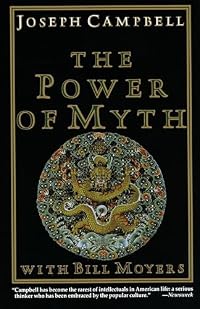
The Power of Myth
by Joseph Campbell, Bill Moyers (Interviewer)
Power of Myth (Collections and Selections — companion book)
On This Page
Description
The complete soundtrack from the phenomenally popular PBS series whose message about myth, ritual, and spiritual potentialities exhilarated millions of people.Contents:Program 1: The Hero's AdventureProgram 2: The Message of the MythProgram 3: The First StorytellersProgram 4: Sacrifice and BlissProgram 5: Love and the GoddessProgram 6: Masks of Eternity.Tags
Recommendations
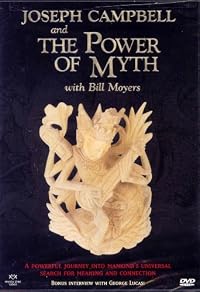







Member Recommendations
Member Reviews
"There's an old romantic idea [...] which says that the ideas and poetry of the traditional cultures come out of the folk. They do not. They come out of an elite experience, the experience of people particularly gifted, whose ears are open to the song of the universe." -Campbell, the Power of Myth
Because "the folk" can never have their ears open to the song of the universe? What kind of unjustified garbage is this? The delight of listening to an old white man make unsupported generalizations about "the elite" and "the folk" palls quickly.
Because "the folk" can never have their ears open to the song of the universe? What kind of unjustified garbage is this? The delight of listening to an old white man make unsupported generalizations about "the elite" and "the folk" palls quickly.
Série muito simpática de entrevistas para televisão, onde Campbell mostra-se a figura midiática do sábio que eu tomo por ser, e certamente faz lembrar-me de meu vô Azauri, que tentou instilar algum amor por mitologia em mim, na infância (ser ateu parece, em ambos os casos, algo que abre para a verdadeira fascinação pela mitologia). De resto, é um conteúdo fácil, mas prazenteiro - há nos mitos representações, mensagens, simbolismos que refletem nossa vida inconsciente, que preparam as sociedades para as belezas e sofrimentos da vida e lidam com os anseios do homem em sua universalidade (na sua estrutura corporal e mental profunda). Nisso, certamente é generalista e provavelmente pouco rigoroso. É o preço que se paga, show more entretanto, pra sorrir com o velhote. show less
As close to self-help as I'll ever get. Sometimes over-serious; I feel like his emphasis on myths as allegory and not entertainment undermines humor as one of our most basic survival mechanisms. Hey man you're live from Skywalker Ranch, live a little. Nice though to think of a time when intellectuals could talk shop on public television in the same tradition as Carl Sagan's Cosmos or John Berger's Ways of Seeing instead of today's 24/7 live stream of retards and failing restaurants.
TL;DR - If you want to pick up some convenient mental models for mythology and storytelling, you'll like this. If you're looking for a rigorous introduction to comparative mythology, you will be disappointed.
Campbell's work has footprints all across popular media and culture. It helped George Lucas shape the mythos of Star Wars, his book The Hero With a Thousand Faces was instrumental in crafting Disney's The Lion King, and his idea of The Monomyth has become Dan Harmon's modus operandi, allowing him to create Community and Rick & Morty. The interviews in this book, conducted by Bill Moyers, are a transcription of the television series by the same name. Two months after this series of interviews, Joseph Campbell passed away at the age show more of 83.
I enjoyed this book. I think what Moyers and Campbell achieved with The Power of Myth is similar to what Carl Sagan achieved with Cosmos, in terms of quality and impact. A lot has already been said about what's great about this book, so I'll concern my review with what wasn't so great.
While Joseph Campbell's erudition is obvious and his conversation engaging, in his discussions he seems more inclined towards philosophy and spirituality instead of empirical social science. This is in part due to Bill Moyers' line of questioning, who's interested in grand questions like "What is the nature of life?" and "Where does life come from?", and in part due to Joseph Campbell's own interest in philosophy (he was greatly influenced by Schopenhauer and Nietzsche). While this serves to ignite the imagination, it takes away from the pedagogical value it may have for those interested in mythological traditions.
A more serious flaw occurs when Campbell's personal beliefs as passed on as scientific ones, and no clear distinction is made between them. Moyers states that Campbell "didn't have an ideology or a theology". That's not entirely true. He was pan-theistic, extremely reductionist, and loved to paint in broad strokes ("the main teaching of Christianity is to love your enemies"). Hearing him talk is like hearing only one side of the story, with little "comparative" to the "mythology". He often employs his significant knowledge of mythology to buttress his spiritual beliefs ("follow your bliss" comes from the Sanskrit "sat-chit-ananda"), which is great. But by the end of the nine chapters I felt the only thing I knew in-depth was Campbell felt about such and such mythical tradition, and what it meant to him. To put it briefly, my issue is that instead of comparative mythology and facts of empirical interest, we're served a salad of Campbell's personal spiritual beliefs and philosophy which leads the viewer to assume that's the whole story, which it definitely isn't.
Furthermore, Campbell play too conveniently into the romantic oriental trope of the wise old guru who holds all the answers to the universe. Moyers prompts him and he obliges, never discouraging Moyers' vague line of questioning ("what is the source of life"), and instead generalizing facts at his own convenience. It gets a bit annoying.
PS: To add an interesting sidenote, the similarity between The Power of Myth and Carl Sagan's Cosmos isn't merely superficial. Both the programs were produced by PBS, televised in the 80s, concerned themselves with grand questions like the origin of life and our place in the universe, and answered these questions through the lens of their respective fields. Both Sagan and Campbell were charismatic, charming, had a flair for communication but often took liberties with scientific rigor, in favour of inspiring awe, speculation, and mystery. It was perhaps due to this they experienced a polarized reputation among their colleagues. Nonetheless, both of these series have left an indelible mark on our culture, and their influence has continued into the new millennium. show less
Campbell's work has footprints all across popular media and culture. It helped George Lucas shape the mythos of Star Wars, his book The Hero With a Thousand Faces was instrumental in crafting Disney's The Lion King, and his idea of The Monomyth has become Dan Harmon's modus operandi, allowing him to create Community and Rick & Morty. The interviews in this book, conducted by Bill Moyers, are a transcription of the television series by the same name. Two months after this series of interviews, Joseph Campbell passed away at the age show more of 83.
I enjoyed this book. I think what Moyers and Campbell achieved with The Power of Myth is similar to what Carl Sagan achieved with Cosmos, in terms of quality and impact. A lot has already been said about what's great about this book, so I'll concern my review with what wasn't so great.
While Joseph Campbell's erudition is obvious and his conversation engaging, in his discussions he seems more inclined towards philosophy and spirituality instead of empirical social science. This is in part due to Bill Moyers' line of questioning, who's interested in grand questions like "What is the nature of life?" and "Where does life come from?", and in part due to Joseph Campbell's own interest in philosophy (he was greatly influenced by Schopenhauer and Nietzsche). While this serves to ignite the imagination, it takes away from the pedagogical value it may have for those interested in mythological traditions.
A more serious flaw occurs when Campbell's personal beliefs as passed on as scientific ones, and no clear distinction is made between them. Moyers states that Campbell "didn't have an ideology or a theology". That's not entirely true. He was pan-theistic, extremely reductionist, and loved to paint in broad strokes ("the main teaching of Christianity is to love your enemies"). Hearing him talk is like hearing only one side of the story, with little "comparative" to the "mythology". He often employs his significant knowledge of mythology to buttress his spiritual beliefs ("follow your bliss" comes from the Sanskrit "sat-chit-ananda"), which is great. But by the end of the nine chapters I felt the only thing I knew in-depth was Campbell felt about such and such mythical tradition, and what it meant to him. To put it briefly, my issue is that instead of comparative mythology and facts of empirical interest, we're served a salad of Campbell's personal spiritual beliefs and philosophy which leads the viewer to assume that's the whole story, which it definitely isn't.
Furthermore, Campbell play too conveniently into the romantic oriental trope of the wise old guru who holds all the answers to the universe. Moyers prompts him and he obliges, never discouraging Moyers' vague line of questioning ("what is the source of life"), and instead generalizing facts at his own convenience. It gets a bit annoying.
PS: To add an interesting sidenote, the similarity between The Power of Myth and Carl Sagan's Cosmos isn't merely superficial. Both the programs were produced by PBS, televised in the 80s, concerned themselves with grand questions like the origin of life and our place in the universe, and answered these questions through the lens of their respective fields. Both Sagan and Campbell were charismatic, charming, had a flair for communication but often took liberties with scientific rigor, in favour of inspiring awe, speculation, and mystery. It was perhaps due to this they experienced a polarized reputation among their colleagues. Nonetheless, both of these series have left an indelible mark on our culture, and their influence has continued into the new millennium. show less
I really like the interesting perspective on much of what Campbell had to say. My one irritation is that he sometimes came across with the attitude that his view was the only non-ludicrous option. It was much like anyone but Melville stating the definitive symbolism of the white whale.
Why do we need our folk tales, anyway? Why can't our religious icons be accepted at face value, instead of lifting them up higher than life? How do phrases like "Son of God" spring so easily and meaningfully from our lips? Why must we idolize our heroes, why do we embrace our rituals?
Journalist Bill Moyers interviews Joseph Campbell to learn why mythology is so important to us. This is sort of a compilation of Campbell's work. Says Campbell, mythology is the "song of the universe, the music of the spheres." It is what turns each little cluster of believers, with their own heritage, into the world's Chosen People. From Dante's Divine Comedy to Native American rituals, Campbell has plenty of opinions. He's an intellectual who is simply show more fun to read...he's got a way of just making sense, like a sort of Feynman for philosophers, that leaves you feeling like maybe you finally understand something.
This isn't a new book, but it's one of those must-reads that we shouldn't forget. I don't think Campbell means to trivialize religion, culture or customs; rather, I dare say, you might even find God in these pages. show less
Journalist Bill Moyers interviews Joseph Campbell to learn why mythology is so important to us. This is sort of a compilation of Campbell's work. Says Campbell, mythology is the "song of the universe, the music of the spheres." It is what turns each little cluster of believers, with their own heritage, into the world's Chosen People. From Dante's Divine Comedy to Native American rituals, Campbell has plenty of opinions. He's an intellectual who is simply show more fun to read...he's got a way of just making sense, like a sort of Feynman for philosophers, that leaves you feeling like maybe you finally understand something.
This isn't a new book, but it's one of those must-reads that we shouldn't forget. I don't think Campbell means to trivialize religion, culture or customs; rather, I dare say, you might even find God in these pages. show less
I had several problems with this book: The interview transcript format did not work for me, there was too much emphasis on Christianity and Star Wars, the illustrations seemed tokenistic, and in some curious way, remarks that should have been timeless seemed dated. But I opened this book with purpose and in some respects, I found the wisdom I was looking for. I had recently returned from an ancient mountain walk in Japan called the Kumano Kodo. I was struck by the number of small shrines to mountain spirits along the way as well as the way sacred space was delineated by gateless tori gates. So I resolved to assemble a shrine to the mountain spirits that surround me, and create a sacred space where I could be open to my feelings of show more mystery, awe, and humility.
The stages of human development are the same today as they were in ancient times. As a child, you are bought up in a world of discipline, of obedience, and you are dependent on others. All this has to be transcended when you come to maturity, so that you can live not in dependence but in self-responsible authority. If you can’t cross that threshold, you have the basis for neurosis. Then comes the one after you have gained your world, of yielding it – the crisis of dismissal, disengagement. (p.70)With this comes an awareness that now, as an old man, I disengage from the from the secular dimensions of the world, I am engaging with the spiritual dimensions of my place in it – in nature. .
Moyers: …What does it Mean to have a sacred space? Campbell: This is an absolute necessity for anybody today…This is a place where you can simply experience and bring forth what you are and what you might be. This is the place of creative incubation. At first you may find that nothing happens there. But if you have a sacred place and use it, something eventually will happen. (p.92)Curiously, Joseph Campbell then asserts that there are no longer any sacred spaces.
Moyers: Where are the sacred places today? Campbell: They don’t exist. (p.94)show less
Members
- Recently Added By
Published Reviews
ThingScore 75
Theology and myth are stepsisters of truth. The one probes with questions, the other spins out tales on gossamer threads. But both serve a common mystery.
I was reminded of this recently in reading Joseph Campbell and Bill Moyer's conversation on The Power of Myth. This wonderful book is filled with pictures of Tibetan and Native American art, photographs of aboriginal initiation rites and show more drawings by William Blake. Adapted from a six-part television series filmed at George Lucas's Skywalker Ranch shortly before Campbell's death, the book moves from the tales of ancient Greece and India to the latest episodes of Rambo and Star Wars. Here the power of story still lives. As Campbell once said, "The latest incarnation of Oedipus, the continued romance of Beauty and the Beast, stands this afternoon on the corner of Forty-second Street and Fifth Avenue, waiting for the traffic light to change." show less
I was reminded of this recently in reading Joseph Campbell and Bill Moyer's conversation on The Power of Myth. This wonderful book is filled with pictures of Tibetan and Native American art, photographs of aboriginal initiation rites and show more drawings by William Blake. Adapted from a six-part television series filmed at George Lucas's Skywalker Ranch shortly before Campbell's death, the book moves from the tales of ancient Greece and India to the latest episodes of Rambo and Star Wars. Here the power of story still lives. As Campbell once said, "The latest incarnation of Oedipus, the continued romance of Beauty and the Beast, stands this afternoon on the corner of Forty-second Street and Fifth Avenue, waiting for the traffic light to change." show less
added by shieldwolf
Lists

TED 2013 Summer Reading List
190 works; 13 members

Unread books
1,063 works; 87 members

Will Durant's 100 Books: An Update
46 works; 4 members

Northern Exposure's Chris in the Morning Reading List
31 works; 1 member

Blue Pyramid 1,276 Best Books of All Time
1,248 works; 32 members

Tonikat reading completed on Librarything journals
329 works; 2 members

Story/Myth Reading List
25 works; 1 member

Mythology
9 works; 2 members
Author Information

201+ Works 41,643 Members
Joseph Campbell was born in White Plains, New York on March 26, 1904. He received a B.A. in English literature in 1925 and an M.A. in Medieval literature in 1927 from Columbia University. He was awarded a Proudfit Traveling Fellowship to continue his studies at the University of Paris. After he had received and rejected an offer to teach at his show more high school alma mater, his Fellowship was renewed, and he traveled to Germany to resume his studies at the University of Munich. During the year he was housemaster of Canterbury School, he sold his first short story, Strictly Platonic, to Liberty magazine. In 1934, he accepted a position in the literature department at Sarah Lawrence College, a post he would retain until retiring in 1972. During his lifetime, he wrote more than 40 books including The Hero with a Thousand Faces, The Mythic Image, the four-volume The Masks of God, and The Power of Myth with Bill Moyers. During the 1940s and 1950s, he collaborated with Swami Nikhilananda on translations of the Upanishads and The Gospel of Sri Ramakrishna. He received several awards including National Institute of Arts and Letters Award for Contributions to Creative Literature and the 1985 National Arts Club Gold Medal of Honor in Literature. He died after a brief struggle with cancer on October 30, 1987. (Bowker Author Biography) show less

Bill Moyers was born in Hugo, Oklahoma, on June 5, 1934. He attended North Texas State College, the University of Texas at Austin, earning his Bachelor's Degree in Journalism in 1956, the University of Edinburgh in Scotland from 1956 to 1957 and the Southwestern Baptist Theological Seminary in Fort Worth, Texas in 1959. After college, Moyers show more joined the staff of Senator Lyndon B. Johnson as his personal assistant, from 1960 to 1961. From 1961 to 1962, Moyers was the associate director of public affairs for the Peace Corps, and deputy director of the Peace Corps in 1963. He later joined Johnson again, this time as special assistant to the President, from 1963 to 1967. He became the Press Secretary, in 1965 until 1967. That same year, he began as publisher of Newsday, holding the position until 1970. He then became producer and editor of the Bill Moyers' Journal for PBS from 1971-76, and an anchor for USA: People and Politics from 1978 till 1981. In 1976 he joined CBS as chief correspondent for CBS Reports for two years. He was the senior news analyst for CBS News from 1981 to 1986 and has been executive editor of Public Affairs Programming Inc. since 1986. Over the course of his many years in journalism, Bill Moyers has earned and received many awards and honors, among them, an Honorary doctorate, from the American Film Institute; numerous Emmy Awards; the Ralph Lowell medal for contribution to public television; George Peabody awards, 1976, 1980, 1985-86, 1988-90; DuPont/Columbia Silver Baton award, 1979, 1986, 1988; Gold Baton award, 1991; and the George Polk awards, 1981, 1986. (Bowker Author Biography) show less
All Editions
Some Editions
Awards and Honors
Series

Power of Myth (Collections and Selections — companion book)
Work Relationships
Is expanded in
Reference guide/companion to
Is a commentary on the text of
Common Knowledge
- Canonical title
- The Power of Myth
- Original title
- The Power of Myth
- Alternate titles*
- Mythen & bewustzijn : de kracht van de mythologische verbeelding; Mythen en bewustzijn
- Original publication date
- 1988
- People/Characters
- Joseph Campbell; Bill Moyers; Jesus Christ; Buddha
- Important events
- American Revolution; Genesis creation narrative
- Related movies
- Joseph Campbell and the Power of Myth (1988 | IMDb)
- Dedication
- To Judith, who has long heard the music
- First words
- MOYERS: Why myths?
EDITOR'S NOTE
This conversation between Bill Moyers and Joseph Campbell took place in 1985 and 1986 at George Lucas's SKywalker Ranch and later at the Museum of Natural History in New York.
INTRODUCTION (by Bill Moyers)
For weeks after Joseph Campbell died, I was reminded of him just about everywhere I turned. - Quotations
- MOYERS: What happens when a society no longer embraces a powerful mythology?
CAMPBELL: What we’ve got on our hands. If you want to find out what it means to have a society without any rituals, read the New York T... (show all)imes.
MOYERS: And you’d find?
CAMPBELL: The news of the day, including destructive and violent acts by young people who don’t know how to behave in a civilized society.
MOYERS: Society has provided them no rituals by which they become members of the tribe, of the community. All children need to be twice born, to learn to function rationally in the present world, leaving childhood behind. I think of that passage in the first book of Corinthians: “When I was a child, I spake as a child, I understood as a child, I thought as a child: but when I became a man, I put away childish things.”
CAMPBELL: That’s exactly it. That’s the significance of the puberty rites. In primal societies, there are teeth knocked out, there are scarifications, there are circumcisions, there are all kinds of things done. So you don’t have your little baby body anymore, you’re something else entirely.
When I was a kid, we wore short trousers, you know, knee pants. And then there was a great moment when you put on long pants. Boys now don’t get that. I see even five-year-olds walking around with long trousers. When are they going to know that they’re now men and must put aside childish things?
MOYERS: Where do the kids growing up in the city—on 125th and Broadway, for example—where do these kids get their myths today?
CAMPBELL: They make them up themselves. This is why we have graffiti all over the city. These kids have their own gangs and their own initiations and their own morality, and they’re doing the best they can. But they’re dangerous because their own laws are not those of the city. They have not been initiated into our society.
MOYERS: Well, I have often wondered, what would a member of a hunting tribe on the North American plains think, gazing up on Michelangelo’s creation!
CAMPBELL: That is certainly not the god of other traditions. In t... (show all)he other mythologies, one puts oneself in accord with the world, with the mixture of good and evil. But in the religious system of the Near East, you identify with the good and fight against the evil. The biblical traditions of Judaism, Christianity, and Islam all speak with derogation of the so-called nature religions.
The shift from a nature religion to a sociological religion makes it difficult for us to link back to nature. But actually all of those cultural symbols are perfectly susceptible to interpretation in terms of the psychological and cosmological systems, if you choose to look at them that way.
Every religion is true one way or another. It is true when understood metaphorically. But when it gets stuck to its own metaphors, interpreting them as facts, then you are in trouble.
MOYERS: What is the metaphor?
CAMPBELL: A metaphor is an image that suggests something else. For instance, if I say to a person, “You are a nut,” I’m not suggesting that I think the person is literally a nut. “Nut” is a metaphor. The reference of the metaphor in religious traditions is to something transcendent that is not literally any thing. If you think that the metaphor is itself the reference, it would be like going to a restaurant, asking for the menu, seeing beefsteak written there, and starting to eat the menu.
For example, Jesus ascended to heaven. The denotation would seem to be that somebody ascended to the sky. That’s literally what is being said. But if that were really the meaning of the message, then we have to throw it away, because there would have been no such place for Jesus literally to go. We know that Jesus could not have ascended to heaven because there is no physical heaven anywhere in the universe. Even ascending at the speed of light, Jesus would still be in the galaxy. Astronomy and physics have simply eliminated that as a literal, physical possibility. But if you read “Jesus ascended to heaven” in terms of its metaphoric connotation, you see that he has gone inward—not into outer space but into inward space, to the place from which all being comes, into the consciousness that is the source of all things, the kingdom of heaven within. The images are outward, bur their reflection is inward. The point is that we should ascend with him by going inward. It is a metaphor of returning to the source, alpha and omega, of leaving the fixation on the body behind and going to the body’s dynamic source.
MOYERS: Aren’t you undermining one of the great traditional doctrines of the classic Christian faith—that the burial and the resurrection of Jesus prefigures our own?
CAMPBELL : That would be a mistake in the reading of the symbol. That is reading the words in terms of prose instead of in terms of poetry, reading the metaphor in terms of the denoration instead of the connotation.
MOYERS: In classic Christian doctrine the material world is to be despised, and life is to be redeemed in the hereafter, in heaven, where our rewards come. But you say that if you affirm that which you deplore, you are affirm... (show all)ing the very world which is our eternity at the moment.
CAMPBELL: Yes, that is what I’m saying. Eternity isn’t some later time. Eternity isn’t even a long time. Eternity has nothing to do with time. Eternity is that dimension of here and now that all thinking in temporal terms cuts off. And if you don’t get it here, you won’t get it anywhere. The problem with heaven is that you will be having such a good time there, you won’t even think of eternity. You’ll just have this unending delight in the beatific vision of God. But the experience of eternity right here and now, in all things, whether thought of as good or as evil, is the function of life.
MOYERS: This is it.
CAMPBELL: This is it.
Fairy tales are for children. Very often they’re about a little girl who doesn’t want to grow up to be a woman. At the crisis of that threshold crossing she’s balking. So she goes to sleep until the prince comes through... (show all) all the barriers and gives her a reason to think it might be nice on the other side after all. Many of the Grimm tales represent the little girl who is stuck. All of these dragon killings and threshold crossings have to do with getting past being stuck.
The rituals of primitive initiation ceremonies are all mythologically grounded and have to do with killing the infantile ego and bringing forth an adult, whether it's the girl or the boy. It’s harder for the boy than for the girl, because life overtakes the girl. She becomes a woman whether she intends it or not, but the little boy has to intend to be a man. At the first menstruation, the girl is a woman. The next thing she knows, she’s pregnant, she’s a mother. The boy first has to disengage himself from his mother, get his energy into himself, and then start forth. That’s what the myth of “Young man, go find your father” is all about. In the Odyssey, Telemachus lives with his mother. When he’s twenty years old, Athena comes and says, “Go find your father.” That is the theme all through the stories. Sometimes it’s a mystical father, but sometimes, as here in the Odyssey, it’s the physical father. - Last words
- (Click to show. Warning: May contain spoilers.)CAMPBELL: That's right, and that's why it is a peak experience to break past all that, every now and then, and to realize, "Oh...ah...."
- Original language
- English
- Disambiguation notice
- This is the book. Do not combine with any video edition.
*Some information comes from Common Knowledge in other languages. Click "Edit" for more information.
Classifications
- Genres
- Anthropology, Philosophy, Religion & Spirituality, General Nonfiction, Nonfiction, History
- DDC/MDS
- 291.13 — Religion Other religions [Formerly: General Religious Topics] [formerly: Religious mythology, general classes of religion, interreligious relations and attitudes, social theology. Relocated to 201] Archetypal Mythology
- LCC
- BL304 .C36 — Philosophy, Psychology and Religion Religions. Mythology. Rationalism Religions. Mythology. Rationalism The myth. Comparative mythology
- BISAC
Statistics
- Members
- 8,672
- Popularity
- 1,251
- Reviews
- 72
- Rating
- (4.17)
- Languages
- 11 — Chinese, Dutch, English, French, German, Italian, Japanese, Polish, Spanish, Swedish, Portuguese (Portugal)
- Media
- Paper, Audiobook, Ebook
- ISBNs
- 44
- UPCs
- 7
- ASINs
- 17