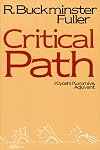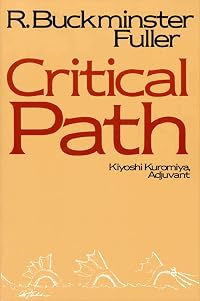
Critical Path
by R. Buckminster Fuller
On This Page
Description
R. Buckminster Fuller is regarded as one of the most important figures of the 20th century, renowned for his achievements as an inventor, designer, architect, philosopher, mathematician, and dogged individualist. Perhaps best remembered for the Geodesic Dome and the term "Spaceship Earth," his work and his writings have had a profound impact on modern life and thought. Critical Path is Fuller's master work-the summing up of a lifetime's thought and concern-as urgent and relevant as it was show more upon its first publication in 1981. Critical Path details how humanity found itself in its current situation-at the limits of the planet's natural resources and facing political, economic, environmental, and ethical crises. The crowning achievement of an extraordinary career, Critical Path offers the reader the excitement of understanding the essential dilemmas of our time and how responsible citizens can rise to meet this ultimate challenge to our future. show lessTags
Recommendations













Member Reviews
The title of Buckminster Fuller's classic late-life book Critical Path is inspired by the Apollo Project. Bucky estimated that in order for Apollo 11 to successfully launch, land on the moon, and return to Earth, the engineers had to follow a "critical path" of approximately 2,000,000 tasks that had to be completed in correct sequence. Bucky felt that humanity has its own "critical path" program that must be followed to avoid war, and to create a peaceful and sustainable existence on Spaceship Earth.
I'm a huge Bucky Fuller fan, and feel that Critical Path is probably his capstone, career-summing book.
However, it is far from a perfect book.
Let's do a "pros and cons" analysis of Critical Path:
Pros
• Bucky does a good job of making show more himself accessible to a wide audience. The sentences are short and readable. Anyone who complains about "indecipherable" writing has clearly not tried reading his unforgiving tome Synergetics.
• At age 85, Bucky seems to know he is near the end of his life. He does his best to summarise his life's achievements, and to leave a blueprint for future generations to follow.
• Bucky is an imaginative thinker, regularly adding his deft reversals of conventional logic ("wind doesn't blow, it sucks"; advocating that "upstairs" and "downstairs" be replaced with the more planet-centrically accurate "outstairs" and "instairs")
• It is inspiring to read Chapter 4, where Bucky personally reflects on his decision to transform his life as a 33 year old. Instead of suicide, he decided to eschew traditional employment, and focus on improving the well-being of all of humanity. His in an inspirational story, and it is great to read his deliberately-planned work methods.
Cons:
• Quite simply, there is a lot of good material in the book. But it really needed an editor. For example, Bucky includes verbatim a 30-page report to the Brazilian government about how to industrialise their economy. It is unclear what relevance this 1943 (mid-World War II) report had to readers in 1981. In 2015, this section had almost zero resonance with me.
• After an inspiring 'introduction' section, Bucky's first chapter is quite embarrassing. It is titled "Speculative Prehistory of Humanity", and indeed there is an abundance of speculation included.
• For example, Bucky claims that humans were teleported to Earth from a galactic headquarters. And that instead of humans evolving from primates, the other primates de-evolved from us. Bucky even claims that porpoises and whales evolved from Polynesians with large lungs.
• Many Bucky-fans seem to gloss-over these wild theories by simply not mentioning them; I think it is important to hold your heroes to account.
• Quite simply, Bucky's claims about evolution are in contraction to all known evidence, and his flimsy "arguments" are easily demolished. Luckily they are not central to his main arguments about technology and innovation.
• Bucky gets very carried away by his futuristic visions of a high-tech society. Chapter 8, in particular has aged badly in the 30+ years since it was written. Bucky claims that we should close all schools, and that children given free access to TV and computers. Given these tools, the kids will spontaneously choose to educate themselves to standards unachievable through human teachers. Bucky also describes the lives of leisure we will live in an automated world with few necessary "jobs". I wonder if Bucky imagined all the necessary new jobs that would be created by such a transformation to a leisure-culture (e.g. chefs, waiters, delivery drivers, etc). Anyway, it hasn't happened.
In summary, I really like Buckminster Fuller, and I like Critical Path. But I rate it overall as a 3.5 star mixed-bag.
My recommendation is to dip your toe in the water with books about Bucky, before reading his own books. My recommended starting-point is Buckminster Fuller's Universe (1989), which remains the best book I have read about Bucky. If you like that one, read New Views on R. Buckminster Fuller, and then snake your way towards Critical Path. show less
I'm a huge Bucky Fuller fan, and feel that Critical Path is probably his capstone, career-summing book.
However, it is far from a perfect book.
Let's do a "pros and cons" analysis of Critical Path:
Pros
• Bucky does a good job of making show more himself accessible to a wide audience. The sentences are short and readable. Anyone who complains about "indecipherable" writing has clearly not tried reading his unforgiving tome Synergetics.
• At age 85, Bucky seems to know he is near the end of his life. He does his best to summarise his life's achievements, and to leave a blueprint for future generations to follow.
• Bucky is an imaginative thinker, regularly adding his deft reversals of conventional logic ("wind doesn't blow, it sucks"; advocating that "upstairs" and "downstairs" be replaced with the more planet-centrically accurate "outstairs" and "instairs")
• It is inspiring to read Chapter 4, where Bucky personally reflects on his decision to transform his life as a 33 year old. Instead of suicide, he decided to eschew traditional employment, and focus on improving the well-being of all of humanity. His in an inspirational story, and it is great to read his deliberately-planned work methods.
Cons:
• Quite simply, there is a lot of good material in the book. But it really needed an editor. For example, Bucky includes verbatim a 30-page report to the Brazilian government about how to industrialise their economy. It is unclear what relevance this 1943 (mid-World War II) report had to readers in 1981. In 2015, this section had almost zero resonance with me.
• After an inspiring 'introduction' section, Bucky's first chapter is quite embarrassing. It is titled "Speculative Prehistory of Humanity", and indeed there is an abundance of speculation included.
• For example, Bucky claims that humans were teleported to Earth from a galactic headquarters. And that instead of humans evolving from primates, the other primates de-evolved from us. Bucky even claims that porpoises and whales evolved from Polynesians with large lungs.
• Many Bucky-fans seem to gloss-over these wild theories by simply not mentioning them; I think it is important to hold your heroes to account.
• Quite simply, Bucky's claims about evolution are in contraction to all known evidence, and his flimsy "arguments" are easily demolished. Luckily they are not central to his main arguments about technology and innovation.
• Bucky gets very carried away by his futuristic visions of a high-tech society. Chapter 8, in particular has aged badly in the 30+ years since it was written. Bucky claims that we should close all schools, and that children given free access to TV and computers. Given these tools, the kids will spontaneously choose to educate themselves to standards unachievable through human teachers. Bucky also describes the lives of leisure we will live in an automated world with few necessary "jobs". I wonder if Bucky imagined all the necessary new jobs that would be created by such a transformation to a leisure-culture (e.g. chefs, waiters, delivery drivers, etc). Anyway, it hasn't happened.
In summary, I really like Buckminster Fuller, and I like Critical Path. But I rate it overall as a 3.5 star mixed-bag.
My recommendation is to dip your toe in the water with books about Bucky, before reading his own books. My recommended starting-point is Buckminster Fuller's Universe (1989), which remains the best book I have read about Bucky. If you like that one, read New Views on R. Buckminster Fuller, and then snake your way towards Critical Path. show less
Overall, not bad...great to get inside this guy's mind for a bit..love how he came to the logical conclusion that because he had a failed business where he lost his friends' / investors' money he should dedicate his life to the service of humanity (i'm paraphrasing).
A lot to chew on here. I first read this book as a student in 1981 or ‘82 and it did shape my thoughts on Governmental and Social Power Structures. Easier to read this volume than to sit through one of Mr. Buckminster Fullers long-winded Lectures (as I did...)!
Quite the book. It's Fuller's attempt to convince humanity of the importance of fundamental change. Fuller's ideas are solid and practical, but perhaps a bit too rational and weird for mainstream adoption. I just don't see widespread use of geodesic domes in the next hundred years or so.
Still, I'm very glad I read it; his history of the events surrounding the two World Wars uncovered many surprises. I do like his view that rapidly improving technology allows us to do more with less, invalidating the old idea that we're going to run out of resources eventually. (For example, there's enough metal in the scrapyards to completely replace many existing new metal needs.)
Still, I'm very glad I read it; his history of the events surrounding the two World Wars uncovered many surprises. I do like his view that rapidly improving technology allows us to do more with less, invalidating the old idea that we're going to run out of resources eventually. (For example, there's enough metal in the scrapyards to completely replace many existing new metal needs.)
R. Buckminster Fuller is regarded as one of the most important figures of the 20th century, renowned for his achievements as an inventor, designer, architect, philosopher, mathematician, and dogged individualist. Perhaps best remembered for the Geodesic Dome and the term Spaceship Earth, his work and his writings have had a profound impact on modern life and thought. Critical Path is Fuller's master work--the summing up of a lifetime's thought and concern--as urgent and relevant as it was upon its first publication in 1981. Critical Path details how humanity found itself in its current situation—at the limits of the planet's natural resources and facing political, economic, environmental, and ethical crises. The crowning achievement show more of an extraordinary career, Critical Path offers the reader the excitement of understanding the essential dilemmas of our time and how responsible citizens can rise to meet this ultimate challenge to our future. show less
Ratings
Members
- Recently Added By
Lists

The Joe Rogan Experience Library
254 works; 3 members

Mustich's 1000 Books to Read Before You Die: A Life Changing List
1,001 works; 19 members
Author Information

74+ Works 4,429 Members
Richard Buckminster "Bucky" Fuller, the innovative thinker, engineer, and inventor, was born July 12, 1895 in Milton, Massachusetts. Despite early failures and tragedies, including his being expelled from Harvard University twice and the death of his four-year-old daughter, Fuller went on to achieve many successes. He is best known for inventing show more the geodesic dome; his design has been used in structures all over the world. Besides Harvard, Fuller also attended the U.S. Naval Academy, and was a professor at Southern Illinois University. He is the author of Synergetics: Explanations in the Geometry of Thinking, a book that discusses the utopic role technology will play in the future. Critical Path is the book Fuller felt was his most important. It outlined his plan to rejuvenate earth through the use of technology. His last book, Grunch of Giants, summarizes his most important ideas. Fuller was awarded 28 United States patents and many honorary doctorates. In 1968 he was elected into the National Academy of Design as an Associate member. In 1970 he received the Gold Medal award from the American Institute of Architects. He also received the Presidential Medal of Freedom presented to him on February 23, 1983 by President Ronald Reagan. (Bowker Author Biography) show less
All Editions
Awards and Honors
Notable Lists
Common Knowledge
- Original title
- Critical path
- Original publication date
- 1981
- Epigraph
- Conventional Critical-path conceptioning is linear and self-under-informative. Only spherically expanding and contracting, spinning, polarly involuting and evoluting orbital-system feedbacks are both comprehensively and inc... (show all)isively informative. Spherical-orbital critical-feedback circuits are pulsative, tidal, importing and exporting. Critical-path elements are not overlapping linear modules in a plane: they are systemically interspiraling complexes of omni-interrelevant regenerative feedback circuits.>br?
-Synergetics 2 [revised] - Dedication
- "Those whom God hath joined together let no one put asunder."
To Ann Hewlett Fuller on this, our 63rd Wedding Anniversary and my 85th Birthday -- July 12, 1980 - First words
- The Dymaxion World Map shows one world island in one world ocean with no breaks in the continental contours and with no visible distortion of the relative size or shape of any of the cartographic patterning.
- Last words
- (Click to show. Warning: May contain spoilers.)The effective decisions can only be made by the independently thinking and adequately informed human individuals and their telepathically intercommunicated wisdom--the wisdom of the majority of all such human individuals--qualifying for continuance in Universe as local cosmic problem-solvers--in love with the truth and in individually spontaneous self-commitment to absolute faith in the wisdom, integrity, and love of God, who seems to wish Earthian humans to survive.
Classifications
Statistics
- Members
- 739
- Popularity
- 38,184
- Reviews
- 5
- Rating
- (3.81)
- Languages
- English
- Media
- Paper, Audiobook, Ebook
- ISBNs
- 7
- ASINs
- 5