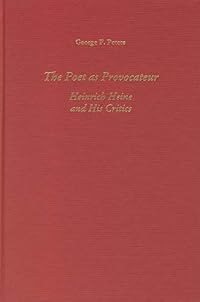
The Poet as Provocateur: Heinrich Heine and His Critics
by George Peters
On This Page
Description
Heinrich Heine (1797-1856), one of the best known and most controversial German writers of the nineteenth century, has been the subject of intense critical debate. Heine's lyric poetry ranks second only to Goethe's in popularity and is known world wide in musical settings. He is also known for his stories and travel sketches, his writings on political, social, and cultural developments in Europe, and for essays on literature, religion, and philosophy. Peters's study records the stormy show more development of Heine's critical reception from his own time down to the present. As a Jew living in Paris, an outspoken critic of both repressive political policies in Germany and the stifling influence of the Catholic church, and the author of the most famous satirical poem in the German language, Deuschland. Ein Wintermärchen, Heine engendered the wrath of the conservative critics of his day, while progressive critics, particularly those supportive of his emancipatory ideals, came to his defense. Since his death, Heine criticism has continued to be partisan in tone. Twentieth-century Heine criticism has mirrored Germany's historical development, from the nationalistic fervor of the Wilhelminian era, through the tolerance of Weimar, the anti-Semitic frenzy of the Third Reich, the postwar period of competing critical views in East and West, to the final decade of the century and a period of renewed and intense critical interest. George F. Peters is professor of German and Chair of the Department of Languages and Linguistics at Michigan State University. e criticism has continued to be partisan in tone. Twentieth-century Heine criticism has mirrored Germany's historical development, from the nationalistic fervor of the Wilhelminian era, through the tolerance of Weimar, the anti-Semitic frenzy of the Third Reich, the postwar period of competing critical views in East and West, to the final decade of the century and a period of renewed and intense critical interest. George F. Peters is professor of German and Chair of the Department of Languages and Linguistics at Michigan State University. e criticism has continued to be partisan in tone. Twentieth-century Heine criticism has mirrored Germany's historical development, from the nationalistic fervor of the Wilhelminian era, through the tolerance of Weimar, the anti-Semitic frenzy of the Third Reich, the postwar period of competing critical views in East and West, to the final decade of the century and a period of renewed and intense critical interest. George F. Peters is professor of German and Chair of the Department of Languages and Linguistics at Michigan State University. e criticism has continued to be partisan in tone. Twentieth-century Heine criticism has mirrored Germany's historical development, from the nationalistic fervor of the Wilhelminian era, through the tolerance of Weimar, the anti-Semitic frenzy of the Third Reich, the postwar period of competing critical views in East and West, to the final decade of the century and a period of renewed and intense critical interest. George F. Peters is professor of German and Chair of the Department of Languages and Linguistics at Michigan State University. nd Chair of the Department of Languages and Linguistics at Michigan State University. show lessMembers
- Recently Added By
Author Information
1 Work 6 Members
Series
Belongs to Publisher Series
Common Knowledge
- Canonical title
- The Poet as Provocateur: Heinrich Heine and His Critics
Classifications
- Genres
- Fiction and Literature, Literature Studies and Criticism
- DDC/MDS
- 831.7 — Literature & rhetoric German & related literatures German poetry 1832-1856 : 19th century
- LCC
- PT2339 .A2 .P48 — Language and Literature German, Dutch and Scandinavian literatures German literature Individual authors or works 1700-ca. 1860/70
- BISAC
Statistics
- Members
- 2
- Popularity
- 6,008,506
- Languages
- English
- Media
- Paper
- ISBNs
- 1