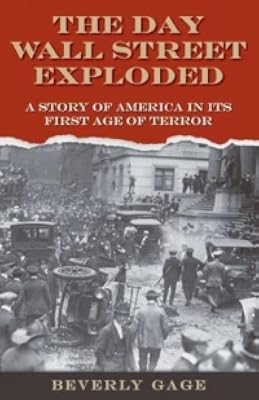
The Day Wall Street Exploded: A Story of America in Its First Age of Terror
by Beverly Gage
On This Page
Description
Just after noon on September 16, 1920, as hundreds of workers poured onto Wall Street for their lunchtime break, a horse-drawn cart packed with dynamite exploded in a spray of metal and fire, turning the busiest corner of the financial center into a war zone. Thirty-nine people died and hundreds more lay wounded, making the Wall Street explosion the worst terrorist attack to that point in U.S. history. In The Day Wall Street Exploded, Beverly Gage tells the story of that once infamous but show more now largely forgotten event. Based on thousands of pages of Bureau of Investigation reports, this historic show lessTags
Recommendations


Member Reviews
On a mid-September day an explosion rips through the financial district of Manhattan in the most devastating terrorist attack in American history up to that point. The attack is attributed to people who come from outside the country and subscribe to an ideology that its critics say is anti-American. This all sounds very familiar, but the story here takes place on September 16th, 1920 when an explosion at the corner of Wall Street and Broad Street rocked the House of Morgan and the New York Stock Exchange. The day Wall Street exploded : a story of America in its first age of terror (2009) by Beverly Gage captures the events of that day as well as the events leading up to that day and its repercussions.
The explosion, graphically detailed show more in this work, was part of a series of violent acts with Anarchists, Socialists, & labor activists on one side and industrialists, police and private detectives on the other side. Gage summarizes the history of radical violence dating to the Haymarket affair in 1886 and the subsequent execution of numerous radicals not actually proven to have anything to do with the bombings. Subsequent events include the Homestead strike, the Ludlow Massacre, assassination attempts on Henry Frick, John D. Rockefeller and Jack Morgan, the successful murder of President McKinley by an anarchist, bombing of the Los Angeles Times office, and the Red Scare. The cast of characters include proponent of violence Johann Most, anarchists Emma Goldman and Alexander Berkman, labor activist Bill Haywood and socialist Eugene Debs. The story of Nicolo Sacco and Bartolemo Vanzetti also ties into the Wall Street Bombing with some theorists today believing they had a direct involvement.
The investigation of the bombing is presented as something of mystery with FBI agents, private detectives, and New York City police all attempting to be the first to solve the crime with none succeeding. Many anarchists, socialists, and immigrants are rounded up with a good portion deported, but the bomber is never found. Some wonder if there really was a bomb or if it was an accidental explosion of dynamite destined for a construction site.
This is is an excellent and informative history of an overlooked period in American history. Gage writes that the ultimate demise of the radical movement in the 1920s as well as the House of Morgan/NYSE "business as usual" approach in the aftermath of the bombing have contributed to the absence of this era from many history books. show less
The explosion, graphically detailed show more in this work, was part of a series of violent acts with Anarchists, Socialists, & labor activists on one side and industrialists, police and private detectives on the other side. Gage summarizes the history of radical violence dating to the Haymarket affair in 1886 and the subsequent execution of numerous radicals not actually proven to have anything to do with the bombings. Subsequent events include the Homestead strike, the Ludlow Massacre, assassination attempts on Henry Frick, John D. Rockefeller and Jack Morgan, the successful murder of President McKinley by an anarchist, bombing of the Los Angeles Times office, and the Red Scare. The cast of characters include proponent of violence Johann Most, anarchists Emma Goldman and Alexander Berkman, labor activist Bill Haywood and socialist Eugene Debs. The story of Nicolo Sacco and Bartolemo Vanzetti also ties into the Wall Street Bombing with some theorists today believing they had a direct involvement.
The investigation of the bombing is presented as something of mystery with FBI agents, private detectives, and New York City police all attempting to be the first to solve the crime with none succeeding. Many anarchists, socialists, and immigrants are rounded up with a good portion deported, but the bomber is never found. Some wonder if there really was a bomb or if it was an accidental explosion of dynamite destined for a construction site.
This is is an excellent and informative history of an overlooked period in American history. Gage writes that the ultimate demise of the radical movement in the 1920s as well as the House of Morgan/NYSE "business as usual" approach in the aftermath of the bombing have contributed to the absence of this era from many history books. show less
The month of September seems to bring bad luck to New York City. On September 16, 1920, a bomb exploded on Wall Street, outside the J. P. Morgan bank. Thirty-eight people were killed, making it the largest terrorist death toll in the US until Oklahoma City in 1995. The case was never solved; “anarchists” or “Bolsheviks” were usually blamed, although some leftist publications thought it was an explosives transport accident, and there was even a sort of “9/16 Truther” movement, claiming that the bomb had been planted by the government to give an excuse to crack down on the labor movement or by a detective agency to get publicity.
The Day Wall Street Exploded author Beverly Gage is a Yale history professor; her approach focuses show more on the personalities involved. These include the Morgan banking family, particularly Junius Spencer Morgan, who was actually present at the bank when the bombing occurred; American radicals Johann Most, Emma Goldman, Alexander Berkman, and William “Big Bill” Heywood; and government officials William Flynn (head of the Bureau of Investigation, not yet called the FBI, under the Wilson administration), Wilson’s Attorney General Alexander Mitchell Palmer, New York City police commissioners Arthur Woods and Richard Enright, and William J. Burns, head of the Burns Detective Agency when the bombing occurred and later Bureau of Investigation chief during the Harding administration, and a relatively minor but diligent BOI employee named J. Edgar Hoover.
None of the people profiled by Gage come across as particularly appealing. The New York City police department seems to have been the most competent of the agencies involved, piecing together the fragments of the horse-drawn wagon that had carried the bomb and identifying the farrier who had last shoed the now fragmented horse (but they also allowed the street to be cleaned quickly, flushing potential clues into the sewers). The Bureau of Investigation initially took jurisdiction because the bombing had damaged the US Customs Office across the street from the Morgan bank; BOI heads Flynn and, latter, Burns seem to have quickly concluded that Italian anarchists (Flynn) or Russian Bolsheviks (Burns) were responsible and focused investigations there, without any success. The BOI was handicapped in that it didn’t have any Italian- or Russian-speaking agents and therefore had to depend on hired informants, one of whom (William Linde) “gamed” Burns into believing he was making progress. The Bureau sometimes showed a level of cluelessness reminiscent of later attempts to infiltrate antiwar groups in the Vietnam era; Bureau agents thought an appropriate disguise for going to labor meetings was brand new overalls. The various labor radicals come across as being perfectly willing to advocate “direct action” in speeches but disavowing it when confronted with the results. Amusingly enough, they also showed a degree of disassociation from reality, choosing a rural location for a meeting presumably under the impression that the yokels wouldn’t find a few dozen urbanites with foreign accents showing up in town at all unusual. And, if the bombing was intended as a strike against American capitalists, it was a dismal failure; the victims were mostly clerks and stenographers and messenger boys, not bankers.
Gage herself doesn’t commit to any theory about responsibility for the bombing, which is frustrating; then again she’s a historian studying the event rather than someone trying to make a case for a particular perpetrator. She doesn’t give any credence to the government provocation idea, other than noting that various radical publications advocated it (although she does note that one of the people who benefit most from the bombing was J. Edgar Hoover). The accident theory gets a little more attention; she’s located various claims that explosive suppliers routinely moved cargoes through New York City (which was illegal during daylight hours) and comments that blasting for construction was going on nearby – without making any further suggestions. The initial reports of the bombing suggested the wagon had been loaded with cut-up sash weights as shrapnel; backers of the “accident” theory claimed these were just miscellaneous metal debris, perhaps from the wagon.
Her last chapter mentions the theory of historian Paul Avrich, who identified the attack as a terrorist bombing, the bomber as Italian anarchist Mario Buda, and the motive as revenge for the arrest of Nicola Sacco and Bartolomeo Vanzetti for murder. Avrich noted that case against Buda is circumstantial; he was known to be an anarchist bomb maker, he was known to have used sash weights in bombs, he was in New York City at the time of the bombing, and he was an associate of Sacco and Vanzetti.
Gage comments that the bombing faded surprisingly quickly from American memory. There’s no historical marker at the site, although the stone façade of the bank still has jagged scars. She reports considerable difficulty gathering material for her book; the New York Police Department historical files had no useful information, and while FBI records were voluminous they were heavily redacted and photocopies of faded originals were difficult to read.
The book is interesting, but it’s an academic work, not a thrilling page-turner. The lack of a conclusion or even a summary of the evidence for and against each theory is frustrating. Extensive endnotes and bibliography; photographs of the scene and the interested parties. show less
The Day Wall Street Exploded author Beverly Gage is a Yale history professor; her approach focuses show more on the personalities involved. These include the Morgan banking family, particularly Junius Spencer Morgan, who was actually present at the bank when the bombing occurred; American radicals Johann Most, Emma Goldman, Alexander Berkman, and William “Big Bill” Heywood; and government officials William Flynn (head of the Bureau of Investigation, not yet called the FBI, under the Wilson administration), Wilson’s Attorney General Alexander Mitchell Palmer, New York City police commissioners Arthur Woods and Richard Enright, and William J. Burns, head of the Burns Detective Agency when the bombing occurred and later Bureau of Investigation chief during the Harding administration, and a relatively minor but diligent BOI employee named J. Edgar Hoover.
None of the people profiled by Gage come across as particularly appealing. The New York City police department seems to have been the most competent of the agencies involved, piecing together the fragments of the horse-drawn wagon that had carried the bomb and identifying the farrier who had last shoed the now fragmented horse (but they also allowed the street to be cleaned quickly, flushing potential clues into the sewers). The Bureau of Investigation initially took jurisdiction because the bombing had damaged the US Customs Office across the street from the Morgan bank; BOI heads Flynn and, latter, Burns seem to have quickly concluded that Italian anarchists (Flynn) or Russian Bolsheviks (Burns) were responsible and focused investigations there, without any success. The BOI was handicapped in that it didn’t have any Italian- or Russian-speaking agents and therefore had to depend on hired informants, one of whom (William Linde) “gamed” Burns into believing he was making progress. The Bureau sometimes showed a level of cluelessness reminiscent of later attempts to infiltrate antiwar groups in the Vietnam era; Bureau agents thought an appropriate disguise for going to labor meetings was brand new overalls. The various labor radicals come across as being perfectly willing to advocate “direct action” in speeches but disavowing it when confronted with the results. Amusingly enough, they also showed a degree of disassociation from reality, choosing a rural location for a meeting presumably under the impression that the yokels wouldn’t find a few dozen urbanites with foreign accents showing up in town at all unusual. And, if the bombing was intended as a strike against American capitalists, it was a dismal failure; the victims were mostly clerks and stenographers and messenger boys, not bankers.
Gage herself doesn’t commit to any theory about responsibility for the bombing, which is frustrating; then again she’s a historian studying the event rather than someone trying to make a case for a particular perpetrator. She doesn’t give any credence to the government provocation idea, other than noting that various radical publications advocated it (although she does note that one of the people who benefit most from the bombing was J. Edgar Hoover). The accident theory gets a little more attention; she’s located various claims that explosive suppliers routinely moved cargoes through New York City (which was illegal during daylight hours) and comments that blasting for construction was going on nearby – without making any further suggestions. The initial reports of the bombing suggested the wagon had been loaded with cut-up sash weights as shrapnel; backers of the “accident” theory claimed these were just miscellaneous metal debris, perhaps from the wagon.
Her last chapter mentions the theory of historian Paul Avrich, who identified the attack as a terrorist bombing, the bomber as Italian anarchist Mario Buda, and the motive as revenge for the arrest of Nicola Sacco and Bartolomeo Vanzetti for murder. Avrich noted that case against Buda is circumstantial; he was known to be an anarchist bomb maker, he was known to have used sash weights in bombs, he was in New York City at the time of the bombing, and he was an associate of Sacco and Vanzetti.
Gage comments that the bombing faded surprisingly quickly from American memory. There’s no historical marker at the site, although the stone façade of the bank still has jagged scars. She reports considerable difficulty gathering material for her book; the New York Police Department historical files had no useful information, and while FBI records were voluminous they were heavily redacted and photocopies of faded originals were difficult to read.
The book is interesting, but it’s an academic work, not a thrilling page-turner. The lack of a conclusion or even a summary of the evidence for and against each theory is frustrating. Extensive endnotes and bibliography; photographs of the scene and the interested parties. show less
Anarchists, Terror, and Class Warfare
This is a highly readable, thoroughly engaging book about one of the more important movements and suppressed memories in US history. Class warfare is usually relegated to the European context, but as Beverly Gage shows, it was comprehensive and pervasive in the first quarter of the 20th century.
Free of academic jargon and social science babble, Gage is a great story-teller chronologically detailing the events that lead up to the bombing, the investigation, and the aftermath. Throughout, are wonderful anecdotes about the McNamara affair in Los Angeles, wobblies in the pacific northwest, and the follies of investigators who made a mockery of the justice system.
If you enjoyed Mike Davis's book "Buda's show more Wagon", you'll enjoy this more in-depth well-researched thesis turned book about one of the lesser known events in US history. show less
This is a highly readable, thoroughly engaging book about one of the more important movements and suppressed memories in US history. Class warfare is usually relegated to the European context, but as Beverly Gage shows, it was comprehensive and pervasive in the first quarter of the 20th century.
Free of academic jargon and social science babble, Gage is a great story-teller chronologically detailing the events that lead up to the bombing, the investigation, and the aftermath. Throughout, are wonderful anecdotes about the McNamara affair in Los Angeles, wobblies in the pacific northwest, and the follies of investigators who made a mockery of the justice system.
If you enjoyed Mike Davis's book "Buda's show more Wagon", you'll enjoy this more in-depth well-researched thesis turned book about one of the lesser known events in US history. show less
September 11, 2001 is a day no American will forget, especially if you lived in the city of New York. That is what we all say and believe when these horrible acts happen. But how many remember the terrorist bombing on Wall Street that happened in 1920. It is in our nature to forget the bad and put it out of our mind, even if it takes a century to do so. Since the invention of dynamite there has always been acts of terror by anarchist that have done great damage to large amounts of people and property. Of course terrorism in one form or another has always existed in every situation, but dynamite allowed a "common man" to do a great deal of damage.
So yes we do forget these horrible events and are forced too relive history. Though this show more book starts off with the 1920 Wall Street Bombing and the not so thorough investigation of the bombing is an ongoing theme for the book. The author has really chosen to use this large bombing to write social structure of the anarchist against every government in the world and communist parties against the U.S Government all with the socialist trying to not be associated with there violent actions and stay a viable political party. And shows how most of the anarchist where originally deported from Russia and Europe to the Land of the Free through New York.
New York then as now is considered the heart, even if symbolically, of Capitalism. So that seems to always be the target of terrorist when they feel they want to strike at the U.S.A. Regardless of year. It shows then as now politicians tried to use this tragedy where we have the loss of innocent lives for political gain.
Gage does a very thorough job on relating the history of terrorism in the United States that occurred in the late 1800's that that lead up to the 1920 Wall Street bombing. I feel I should tell you I love reading history books and found this one quite compelling. Though she is writing about a complex event that took place almost a century ago it read as if we were following the events in real time. She goes into some great detail though I am sorry to say many references had to come from News paper clippings; and as we know all papers have their own agenda. As is needed in this kind of book, the author has gone to great extent to document her book with footnotes. I would expect no less from any history book from Oxford Press.
I enjoyed reading this work of good scholarly writing. But if you are not use to reading books by historians you may find it a little hard to read. And though the book is about the bombing and the investigation, it could be subtitled 'A Study of the Socialist and Anarchist movement in the early part of the 20th century'. All in all I enjoyed the book and its attention to detail. show less
So yes we do forget these horrible events and are forced too relive history. Though this show more book starts off with the 1920 Wall Street Bombing and the not so thorough investigation of the bombing is an ongoing theme for the book. The author has really chosen to use this large bombing to write social structure of the anarchist against every government in the world and communist parties against the U.S Government all with the socialist trying to not be associated with there violent actions and stay a viable political party. And shows how most of the anarchist where originally deported from Russia and Europe to the Land of the Free through New York.
New York then as now is considered the heart, even if symbolically, of Capitalism. So that seems to always be the target of terrorist when they feel they want to strike at the U.S.A. Regardless of year. It shows then as now politicians tried to use this tragedy where we have the loss of innocent lives for political gain.
Gage does a very thorough job on relating the history of terrorism in the United States that occurred in the late 1800's that that lead up to the 1920 Wall Street bombing. I feel I should tell you I love reading history books and found this one quite compelling. Though she is writing about a complex event that took place almost a century ago it read as if we were following the events in real time. She goes into some great detail though I am sorry to say many references had to come from News paper clippings; and as we know all papers have their own agenda. As is needed in this kind of book, the author has gone to great extent to document her book with footnotes. I would expect no less from any history book from Oxford Press.
I enjoyed reading this work of good scholarly writing. But if you are not use to reading books by historians you may find it a little hard to read. And though the book is about the bombing and the investigation, it could be subtitled 'A Study of the Socialist and Anarchist movement in the early part of the 20th century'. All in all I enjoyed the book and its attention to detail. show less
5824. The Day Wall Street Exploded A Story of America in its First Age of Terror, by Beverly Gage (read 15 Dec 2023) This carefully compiled book, published in 2009, tells, in good detail, of the explosion on 16 Sept 1920, of a device on a wagon pulled by a horse, which killed 36 people, and set off a hunt for who put the horse and explosive at that location. The book is thorough and fascinating
Arrived Lausanne
Ratings
Members
- Recently Added By
Lists

Good Nonfiction about New York City
62 works; 10 members
Author Information

5+ Works 736 Members
Beverly Gage teaches U.S. history at Yale University. Her writing has appeared in the New York Times. The Chicago Tribune. Slate.com, The Nation, and the Washington Post. She has been featured as a guest commentator on the NewsHour with Jim Lebrer and in Time magazine.
Awards and Honors
Common Knowledge
- Original publication date
- 2009-01-28
- People/Characters
- J. Edgar Hoover; Johann Most; Emma Goldman; Alexander Berkman; Bill Haywood; Eugene V. Debs (show all 10); William J. Flynn; Arthur Hale Woods; Richard Edward Enright; William J. Burns
- Important places
- Wall Street, New York, New York, USA
- Important events
- Wall Street Bombing (1920-09-16)
- Dedication
- To Dan and Nicholas, for their patience and love
- First words
- At the corner of Wall and Broad streets in lower Manhattan, there is a memorial to the victims of terrorism.
Junius Spencer Morgan never seemed quite at home on Wall Street. - Last words
- (Click to show. Warning: May contain spoilers.)According to the Times, a financial district rumor suggested that they planned to hire a few extra guards. Just in case.
- Blurbers
- Davis, Mike; Nasaw, David; Wallace, Mike
- Original language
- English US
Classifications
- Genres
- History, Nonfiction, General Nonfiction
- DDC/MDS
- 974.7 — History & geography History of North America Northeastern United States (New England and Middle Atlantic states) New York
- LCC
- HV6432.44 .N7 .G34 — Social sciences Social pathology. Social and public welfare. Criminology Social pathology. Social and public welfare. Criminology Crimes and offenses
- BISAC
Statistics
- Members
- 186
- Popularity
- 175,524
- Reviews
- 6
- Rating
- (3.77)
- Languages
- English
- Media
- Paper, Audiobook, Ebook
- ISBNs
- 8
- ASINs
- 3