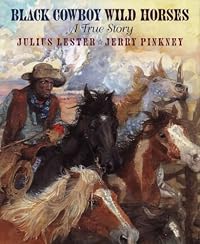
Black Cowboy, Wild Horses
by Julius Lester
On This Page
Description
A black cowboy is so in tune with wild mustangs that they accept him into the herd, thus enabling him singlehandedly to take them to the corral.Tags
Recommendations







Member Reviews
Based off the true life of Bob Lemmons who was famous for his ability to track wild horses. He rides his horse, Warrior, picks up the trail of mustangs, Bob then approaches the herd of horses, and tries to make himself look only like a horse by laying down and trying to mask his smell. Bob runs with the wild horses day and night until they accept his presence. Bob and Warrior then challenge the stallion for leadership of the wild herd. Bob leads the mustangs across the wide plains and for one last spectacular run before guiding them into the corral. Bob's job is done, but he dreams of galloping with Warrior forever to where the sky and land meet.
Classroom:
I thought this was a great story depicting how wild the west was at that time. show more The illustrations were amazing, I think that this book could be used to help students to illustrate their own wild west. How did the West look when there weren't all the buildings here? What animals were grazing the plains?
I also think that it could be used for teaching stereotypes. A Black cowboy is not popular thinking when you discuss cowboys. I think this would be a great lesson for kids to think of other stereotypes that are not true. Critical thinking: why do these stereo types still exist? show less
Classroom:
I thought this was a great story depicting how wild the west was at that time. show more The illustrations were amazing, I think that this book could be used to help students to illustrate their own wild west. How did the West look when there weren't all the buildings here? What animals were grazing the plains?
I also think that it could be used for teaching stereotypes. A Black cowboy is not popular thinking when you discuss cowboys. I think this would be a great lesson for kids to think of other stereotypes that are not true. Critical thinking: why do these stereo types still exist? show less
At first I didn't like the illustrations, but after looking at them more, I noticed there were a lot of really interesting details (cicadas that almost blended into the grass, horse shapes in the clouds) and cool textures in the paintings (wavy watercolor tree bark that was almost reminiscent of art deco-ish wallpaper, texture of the dappled horses)
However, the writing is cliched and sentimental:
"Maybe someday they would ride with the mustangs, ride to that forever place where the land and sky kissed."
I did like that it focused on a black cowboy. It's a common misconception in historical fiction that black people or other people of color weren't around, especially in westerns (where if people of color are portrayed, they are often show more portrayed in stereotypical or racist ways, esp. in older cowboy books with "Indians" in them)
One thing I noticed was that the cowboy got the wild mustangs to trust him and then rounded them up and sold them at the market. This is really what cowboys did but it seems kind of messed up to me. A lot of children's books do talk about freedom of animals and "caged birds" etc., and this book didn't get into that at all really. Maybe because it doesn't, it would be good to put in with a collection about capturing animals where the animals were unhappy about being captured, and then students would be able to identify this different portrayal of it and realize what is going on in this book with that frame of mind. show less
However, the writing is cliched and sentimental:
"Maybe someday they would ride with the mustangs, ride to that forever place where the land and sky kissed."
I did like that it focused on a black cowboy. It's a common misconception in historical fiction that black people or other people of color weren't around, especially in westerns (where if people of color are portrayed, they are often show more portrayed in stereotypical or racist ways, esp. in older cowboy books with "Indians" in them)
One thing I noticed was that the cowboy got the wild mustangs to trust him and then rounded them up and sold them at the market. This is really what cowboys did but it seems kind of messed up to me. A lot of children's books do talk about freedom of animals and "caged birds" etc., and this book didn't get into that at all really. Maybe because it doesn't, it would be good to put in with a collection about capturing animals where the animals were unhappy about being captured, and then students would be able to identify this different portrayal of it and realize what is going on in this book with that frame of mind. show less
The true story of Bob Lemmins is a tale of passion and perseverance. The language is most appropriate for older children as it is extremely poetic, uses higher level vocabulary and explores some issues that some may find inappropriate for younger children. Bob is a black cowboy that has the ability to wrangle wild horses that most did not at the time. He was able to do this by making the horses feel as if he was one of them. With incredible patience, often taking days, Bob would build a relationship with the herd of horses. There are so many opportunities to build critical thinking skills utilizing this book.
This historical fiction picture book shares the true story of a black cowboy named Bob Lemmons. Bob, who was once a slave and never learned from books, learns from the animals around him. He learns to read their movements and guesses their next moves. He has a special job: He is a cowboy. And in this story, his job is to get a group of mustangs back in the corral. The art featured by Jerry Pinkney are these beautiful watercolor paintings that really highlight the action of herding horses. The words are sufficient to telling the story but its the art that is truly the highlight!
Black Cowboys Wild Horses: A True Story by Julius Lester and illustrated by Jerry Pinkney is the true story of Bob Lemmons a black cowboy. According to the biography in the back of the book Black Cowboys Wild Horses is one of three books written by Lester on the role of men of color in the West. I am very excited to read this book to my students as we continual our Social Studies thematic unit on the United States. In preparation, I read Black Cowboys Wild Horses to my sons, who, although are seventeen and nineteen, found the story of Lemmons interesting and informational. They especially appreciated the additional information in the back of the book, which inspired them to find out more about cowboys of color. While reading the book, I show more found the illustrations captivating and strong and the author’s word choice and story writing was outstanding. I plan to check out the other books written by Lester, and read all three to my class and then compare and contrast them after whole group discussion. show less
Bob Lemmon, a black cowboy and former slave, and his horse Warrior set off to bring in a herd of mustangs. No one has ever brought in mustangs by themselves, but Bob is one with the horses. He watched for tracks on the ground and found some, he was able to tell what left them and when. Bob and Warrior caught up with the mustangs right before a storm, and the mustangs ran from the thunder. They caught up again at a river, Bob and Warrior slowly closed in on the mustangs, and the stallion sniffed at them, and accepted Bob. They lived as a herd for a few days, until a colt was bit by a rattle snake and died; Bob took this chance to take over the herd by having a confrontation with the stallion. Bob and Warrior won and the herd followed show more them to the corral.
I believe that this is an excellent book to teach the roles that African Americans played in the old West. I enjoyed this book and I think that children will as well, because there is some action in this historical story. This would make a good read aloud as well as a book for children to read on their own.
1.) Children will look at several different animal tracks and decide what animal made the track. Class will discuss tracks in nature and whether they could spot an animal track in nature.
2.) Have each child tell what they appreciate most about nature and draw a picture of it as Bob appreciated every part of nature. show less
I believe that this is an excellent book to teach the roles that African Americans played in the old West. I enjoyed this book and I think that children will as well, because there is some action in this historical story. This would make a good read aloud as well as a book for children to read on their own.
1.) Children will look at several different animal tracks and decide what animal made the track. Class will discuss tracks in nature and whether they could spot an animal track in nature.
2.) Have each child tell what they appreciate most about nature and draw a picture of it as Bob appreciated every part of nature. show less
'Black Cowboy Wild Horses' is written by Julius Lester and illustrated by Jerry Pinkney. This is a true story about a former black slave who became a cowboy named Bob Simmons. The book shows how the cowboy was one of the best of the best at tracking herds of horses, having them accept him and his horse, Warrior, and take over them as leader. Lester and Jerry have us go on one of these journeys, tracking down a herd. They show us how he tracks a herd down, how long he will follow them, and what he will do to have them see him as one of them. That is how Bob Simmons sees himself out in the frontier as well; as one of the horses who love to move so fast the sky and earth blur past his eyes.
Members
- Recently Added By
Lists

Honey For a Child's Heart
1,152 works; 25 members

Horse Books for Kids
376 works; 6 members
Author Information

56+ Works 11,004 Members
Julius Bernard Lester was born in St. Louis, Missouri on January 27, 1939. He received a bachelor's degree in English from Fisk University in 1960. He moved to New York to become a folk singer. He performed on the coffeehouse circuit as a singer and guitarist. He released two albums entitled Julius Lester in 1965 and Departures in 1967. His first show more published book, The Folksinger's Guide to the 12-String Guitar as Played by Leadbelly written with Pete Seeger, was published in 1965. In the 1960s, Lester was closely involved as a writer and photographer with the Student Nonviolent Coordinating Committee. He traveled to the South to document the civil rights movement and to North Vietnam to photograph the effects of American bombardment. He also hosted radio and television talk shows in New York City. He wrote more than four dozen nonfiction and fiction books for adults and children. His books for adults included Look Out, Whitey!: Black Power's Gon' Get Your Mama, Revolutionary Notes, All Is Well, Lovesong: Becoming a Jew, and The Autobiography of God. His children's books included To Be a Slave, Sam and the Tigers, and Day of Tears: A Novel in Dialogue, which won the American Library Association's Coretta Scott King Award in 2006. He also wrote reviews and essays for numerous publications including The New York Times Book Review, The Boston Globe, The Village Voice, Dissent, The New Republic, and the Los Angeles Times Book Review. After teaching for two years at the New School for Social Research in New York, Lester joined the faculty of the University of Massachusetts, Amherst in 1971. He originally taught in the Afro-American studies department, but transferred to the Judaic and Near Eastern studies department when Lester criticized the novelist James Baldwin for what he felt were anti-Semitic remarks. He died from complications of chronic obstructive pulmonary disease on January 18, 2018 at the age of 78. (Bowker Author Biography) show less
All Editions
Awards and Honors
Awards
Common Knowledge
- People/Characters
- Bob Lemmons
Classifications
Statistics
- Members
- 349
- Popularity
- 90,073
- Reviews
- 10
- Rating
- (3.96)
- Languages
- English
- Media
- Paper
- ISBNs
- 4
- ASINs
- 1