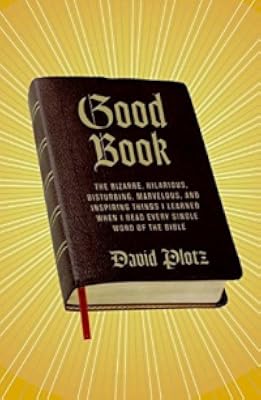
Good Book: The Bizarre, Hilarious, Disturbing, Marvelous, and Inspiring Things I Learned When I Read Every Single Word of the Bible
by David Plotz
On This Page
Description
"Good Book" is what happens when a regular guy actually reads the whole book on which his religion, his culture, and his world are based. The result is an irreverent, enthralling journey through the world's most important work of literature--the Bible.Tags
Recommendations




Member Reviews
This book arose from a column/blog that David Plotz wrote for Slate.com, in which he took his first trip through all of the (Hebrew) bible. I found Plotz an amiable and relatable tour guide -- he and I are secular people, although Plotz identifies culturally as Jewish.
The author doesn't take the bible too seriously, doesn't gloss over the boring or barbaric parts, and therefore it's easy to believe him when he rhapsodizes about the chapters and really impress or please him. Plotz firmly believes that we should all read the "good book," if only so we can recognize the many ways in which is saturates our lives. (Also, what we think we know about the bible is often wrong: for instance, Job is not patient, his comforters are no such show more thing, and although God may speak to him out of a whirlwind, Job beats Yahweh at argument.)
All in all, an engaging read and a fine way to learn what's in the bible without choking on a list of "begat"s. My favorite Plotz joke: he notes that just as any fortune cookie can be made amusing by adding the words "in bed," any verse of Isaiah can be upgraded by ending it with the words "You idiots!" show less
The author doesn't take the bible too seriously, doesn't gloss over the boring or barbaric parts, and therefore it's easy to believe him when he rhapsodizes about the chapters and really impress or please him. Plotz firmly believes that we should all read the "good book," if only so we can recognize the many ways in which is saturates our lives. (Also, what we think we know about the bible is often wrong: for instance, Job is not patient, his comforters are no such show more thing, and although God may speak to him out of a whirlwind, Job beats Yahweh at argument.)
All in all, an engaging read and a fine way to learn what's in the bible without choking on a list of "begat"s. My favorite Plotz joke: he notes that just as any fortune cookie can be made amusing by adding the words "in bed," any verse of Isaiah can be upgraded by ending it with the words "You idiots!" show less
They should replace the hotel bibles with this version, maybe put it in the john--it's great for a quick dip into old stories, ones you heard as a kid in bible school, but here with the real scoop, nothing dumbed down. Plotz is continually amazed that God could be so blood-thirsty, unjust, and down right nasty. Also, that he (Yep he's a guy) is a John Wayne style meat eater; you can cut the carbos in your sacrifices to him. You might start paying attention to his never-ending rules (food, sex, rituals) after you hear how many folks he does in for non-violent offences.
David Plotz's take on his first complete reading of the Old Testament is both entertaining and thought provoking. Like myself most people probably have not read the Bible in this way and as Plotz points out we all should, to get our own impression of what guides so much in the world to this day.
From hilarity to disgust all emotions are laid out in his reading and looking at it both critically and whimsically we come face to face with what boils down to some amazing absurdities of life as we experience it. Each of us will make a choice as to how much of what is here will guide or influence our own lives. For the most part what I read in this book validates my own skepticism. Yet as much as Plotz pokes fun and holes into the work he makes show more one telling conclusion on his read at the end. He states that as much as he dismisses in the writings he does experience a sense of his own heritage handed down over the ages as his forefathers reading the same passages. And there you have the power of religion and its grip. show less
From hilarity to disgust all emotions are laid out in his reading and looking at it both critically and whimsically we come face to face with what boils down to some amazing absurdities of life as we experience it. Each of us will make a choice as to how much of what is here will guide or influence our own lives. For the most part what I read in this book validates my own skepticism. Yet as much as Plotz pokes fun and holes into the work he makes show more one telling conclusion on his read at the end. He states that as much as he dismisses in the writings he does experience a sense of his own heritage handed down over the ages as his forefathers reading the same passages. And there you have the power of religion and its grip. show less
David Plotz reads the Old Testament so you don't have to. He goes through every book in the Hebrew bible, discussing all the stories, themes, etc. that come up. He knows what he's talking about, but he's not too academic or serious about the thing, but reacts to it much as anyone reading it the same way would do. He's funny, a bit appalled and more at times, but no unrespectful (as I would be). If you've tried to read the thing and gotten frustrated and can't stay with it, this is a good place to start.
100% recommended! This romp through the Hebrew Bible is much more than just fascinating and funny. It’s also engrossing, mildly irreverent, thought-provoking, disturbing--you'll love the Good Book whether you’re a believer or not. This is the Bible unveiled in all its grime and greatness. The characters in Genesis are especially unforgettable, from the story of Abimalech lusting after a 90-year-old woman (Sarah, Abraham's wife) to a diabolical mother-and-son plot to rob the simple-minded Esau of his blessing from an over-trusting father.
Book by book, Plotz takes us through the scripture. If Genesis is the best part, then the appendix runs a close second. There you'll learn the Bible's twelve best pick-up lines, the thirteen most show more spectacular murders, the nine best parties, the best prostitutes, the most hellacious divine punishment, the trippiest dreams, and more.
This is for all you skeptics who think reading the Bible is a waste of time. Plotz apparently thought the same thing before taking on this project. After thirty-nine books, 929 chapters, more than 600,000 words, and just over a year, Plotz admits he's become "a full-on Bible thumper. Everyone should read it--all of it! In fact, the less you believe, the more you should read."
Start with this book as an introduction to get the juices flowing. Plotz is more than a good researcher, he's a great writer. I'm in awe. I could enthusiastically read anything he writes, I'm sure of it. So, when he tackles a topic already fascinating to me (the Bible) it's pure delight. He's also unfortunately a Jew, which means we only get the Old Testament in his Good Book. Please, David, can't you give Billy Graham a listen? show less
Book by book, Plotz takes us through the scripture. If Genesis is the best part, then the appendix runs a close second. There you'll learn the Bible's twelve best pick-up lines, the thirteen most show more spectacular murders, the nine best parties, the best prostitutes, the most hellacious divine punishment, the trippiest dreams, and more.
This is for all you skeptics who think reading the Bible is a waste of time. Plotz apparently thought the same thing before taking on this project. After thirty-nine books, 929 chapters, more than 600,000 words, and just over a year, Plotz admits he's become "a full-on Bible thumper. Everyone should read it--all of it! In fact, the less you believe, the more you should read."
Start with this book as an introduction to get the juices flowing. Plotz is more than a good researcher, he's a great writer. I'm in awe. I could enthusiastically read anything he writes, I'm sure of it. So, when he tackles a topic already fascinating to me (the Bible) it's pure delight. He's also unfortunately a Jew, which means we only get the Old Testament in his Good Book. Please, David, can't you give Billy Graham a listen? show less
David Plotz started his bible-reading project when he came to the conclusion one day that he really didn't know much about what was in it. He knew the stories that nearly all of us had been taught, but really only the watered-down child-friendly versions. Most of the grit and grime and blood and sex of the bible was unknown to him, as it's unknown to most people.
So he sets out to read the entirety of the Old Testament, and to record his commentary on it. In doing so, not only did he discover some interesting stories and fascinating pieces of trivia, but he also got to connect with his heritage and culture.
Even through sections of commentary that I would normally find boring, Plotz livens up the book with a wonderful sense of humour with show more good timing, being sarcastic one moment and witty the next. He's also not afraid of letting the reader know when the stories he's reading fills him with a sense of almost childlike wonder, and tries to recount for us exactly why. He lets us share his little thoughts, his revelations, and even when I disagreed with his conclusions, I could appreciate how and why he arrived at them.
Plotz's journey was a very personal one, which is why I disagree with him in regard to his surprise that high school students are not required to read the bible the way they are required to read Shakespeare. For one thing, most high school students don't read every play of Shakespeare's, so to do the equivalent study to the bible would essentially be picking the stories that are best known and just telling them again.
But while the bible helped a great deal to shape western society as we know it today, the fact that it's a religious book means it doesn't actually have a place in some lives. That attitude reminds me much of something my father said once, that he thinks every religion should incorporate the bible into its teachings. It has good morals, after all.
It also has a religious history that may not be applicable for some, and a doctrine of conversion that frankly shouldn't be applied to secular schools. The Qur'an and the Bhagavad Gita have good lessons in them too, but people don't tend to study those in high school or insist that Christianity and Judaism incorporate them into their religious teachings.
Aside from that little nitpick of a single sentence, I thoroughly enjoyed reading this book, and recommend it to anybody who's interested in the bible but doesn't feel that they can sit down and slog their way through it. Good Book gives you the meat of the stories and meanings behind them without throwing in all the begats and dietary laws. show less
So he sets out to read the entirety of the Old Testament, and to record his commentary on it. In doing so, not only did he discover some interesting stories and fascinating pieces of trivia, but he also got to connect with his heritage and culture.
Even through sections of commentary that I would normally find boring, Plotz livens up the book with a wonderful sense of humour with show more good timing, being sarcastic one moment and witty the next. He's also not afraid of letting the reader know when the stories he's reading fills him with a sense of almost childlike wonder, and tries to recount for us exactly why. He lets us share his little thoughts, his revelations, and even when I disagreed with his conclusions, I could appreciate how and why he arrived at them.
Plotz's journey was a very personal one, which is why I disagree with him in regard to his surprise that high school students are not required to read the bible the way they are required to read Shakespeare. For one thing, most high school students don't read every play of Shakespeare's, so to do the equivalent study to the bible would essentially be picking the stories that are best known and just telling them again.
But while the bible helped a great deal to shape western society as we know it today, the fact that it's a religious book means it doesn't actually have a place in some lives. That attitude reminds me much of something my father said once, that he thinks every religion should incorporate the bible into its teachings. It has good morals, after all.
It also has a religious history that may not be applicable for some, and a doctrine of conversion that frankly shouldn't be applied to secular schools. The Qur'an and the Bhagavad Gita have good lessons in them too, but people don't tend to study those in high school or insist that Christianity and Judaism incorporate them into their religious teachings.
Aside from that little nitpick of a single sentence, I thoroughly enjoyed reading this book, and recommend it to anybody who's interested in the bible but doesn't feel that they can sit down and slog their way through it. Good Book gives you the meat of the stories and meanings behind them without throwing in all the begats and dietary laws. show less
Imagine if a Jerry Seinfeld like character read the Bible and then shared his thoughts on everthing he found odd and disturbing. That is the best way I can describe this book. I found it refreshing, even though I didn't agree with some of the author's interpretations. He was at least very candid about this thoughts and an honest wrestler with the Biblical text. His observations--being that they were made with fresh eyes--often brought to my attention details I had never noticed about the Old Testament. (The author is of Jewish background, BTW, so the 'Bible' for him is just the Old Testament books). Much of the book reads like a Readers Digest condensed version of the Bible stories, with his witty commentary thrown in. Christians, show more non-Christians, and Jews alike will enjoy it--as long as you have a sense of humor! show less
Members
- Recently Added By
Author Information

5+ Works 865 Members
David Plotz is the editor of State. He has written for The New York Times Magazine, Harper's, Rolling Stone, The New Republic, The Washington Post, and GQ, and is the author of The Genius Factory: The Curious History of the Nobel Prize Sperm Bank. He won the National Press Club's Hume Award for political journalism and has been a National Magazine show more Award finalist. He lives with his wife, the journalist Hanna Rosin, and their children in Washington, D.C. show less
Common Knowledge
- Canonical title
- Good Book: The Bizarre, Hilarious, Disturbing, Marvelous, and Inspiring Things I Learned When I Read Every Single Word of the Bible
- Original title
- Good Book: The Bizarre, Hilarious, Disturbing, Marvelous, and Inspiring Things I Learned When I Read Every Single Word of the Bible
- Original publication date
- 2009-03-03
- Dedication
- For my parents, the best argument
in the world for the Fifth Commandment - First words
- Introduction
In the Beginning
I've always been a proud Jew, but never a very observant one. I believe in God, but only in a please-please-desperation-prayer kind of way. I say the Lord's name only to take it in v... (show all)ain. I don't have any other gods before Him, but mostly because I haven't looked for any. I rarely remember the Sabbath day, and never keep it holy. I go to the synagogue about as often—and with about as much pleasure—as I go to the DMV.
One
The Book of Genesis
God's First Try
In which God created Earth and pretty much everything else, including Adam and Eve; Adam and Eve are expelled from the Garden of Eden; Cain kills Abel; God floods the sinfu... (show all)l Earth; Noah survives; God chooses Abram, renames him Abraham, and promises him the Holy Land; God incinerates the sin cities of Sodom and Gomorrah; Abraham almost sacrifices his son Isaac; Isaac's son Jacob tricks his older twin brother, Esau, out of their father's blessing; Jacob wrestles an angel, is renamed Israel, and has twelves sons; the older sons sell Joseph into slavery; Joseph becomes prime minister of Egypt, saves his brothers during a famine, and reconciles with them; all the Israelites settle in Egypt and fail to live happily ever after.
Chapter I
You'd think God would know exactly what He's doing at the Creation. But He doesn't. He's a tinkerer. He tries something out: What happens if I move all the water around so there's room for dry land?" He checks it out. Yes, "this was good." Then He moves on to His next experiment: How about plants? I'll try plants. - Last words
- (Click to show. Warning: May contain spoilers.)The Bible has brought me no closer to God, if God means either belief in a deity acting in the world, or an experience of the transcendent. But perhaps I'm closer to God in the sense that the Bible has put me on high alert. As I read the book, I realized that the Bible's greatest heroes are not those who are most faithful, but those who are most contentious and doubtful: Moses negotiating with God at the burning bush, Gideon demanding divine proof before going to war, Job questioning God's own justice, Abraham demanding that God be merciful to the innocent of Sodom. They challenge God for his capriciousness, and demand justice, order, and morality, even when God refuses to provide any of these. Reading the Bible has given me a chance to start an argument with God about the most improtant questions there are, an argument that can last a lifetime.
- Blurbers
- Jacobs, A. J.; Meacham, Jon; Borowitz, Andy; Foer, Franklin
Classifications
Statistics
- Members
- 419
- Popularity
- 73,816
- Reviews
- 17
- Rating
- (3.70)
- Languages
- English
- Media
- Paper, Audiobook, Ebook
- ISBNs
- 7
- ASINs
- 9