Tsunami!
by Kimiko Kajikawa
On This Page
Description
A wealthy man in a Japanese village, who everyone calls Ojiisan, which means grandfather, sets fire to his rice fields to warn the innocent people of an approaching tsunami.Tags
Recommendations






























Member Reviews
This is a great story, especially with disasters becoming such a great occurrence in recent years. The story showing bravery in these times and can inspire youth to help when they see disasters occur and not feel that it is not their responsibilities. Ed Young’s collage illustration is very strong and a great medium for something like disaster when everything seems to be collaged in the world.
Ojiisan, the oldest and wealthiest man in the village, doesn't join the others at the rice ceremony. Instead he watches from his balcony. He feels something is coming; something he can't describe. When he sees the monster wave pulling away from the beach, he knows. Tsunami! But the villagers below can't see the danger. Will Ojiisan risk everything he has to save them? Can he? Illustrated in stunning collage by Caldecott winner Ed Young, this is the unforgettable story of how one man's simple sacrifice saved hundreds of lives.
This is the true story of one older, wealthy villager who saves the 400 people of his village from the ravages of a tsunami by setting fire to his own rice fields. Amidst confusion about a rapidly growing beachfront the people marveling at the sight on the beach race to the top of the hill to put out the field fire and are saved. The dramatic collage illustrations perfectly shape the visuals for this powerful story of the wise and generous man who saved his neighbors at his own expense.
Tsunami is about a rich man named Ojiisan who lived at the top of the mountain and everyone would seek him for advice. The village was having a rice harvest celebration but Ojiisan gad a bad feeling and stayed home with his grandson. Ojiisan's feeling was right and they had an earthquake. The shock wasn't so bad to the villagers so they continued their celebration, but once again, Ojiisan knew something strange was going on. Then he noticed THE SEA WAS RUNNING AWAY FROM THE LAND. He goes down to warn the village and everything was swept away. No one died, Ojiisan's house away still standing and he said there was plenty room for everyone. They were forever grateful. I think this book is a lovely example of being selfless. Ojiisan show more could've tried to only save himself but he went down to the bottom of the mountain, knowing a tsunami was coming, to warn the to others and risking his life. This can teach students to care for others when in need. It's a great book and the main theme to me is: some things are worth sacrificing. The illustrations in the book are very strange but definitely jump off the page and it is very colorful. show less
This is a powerful Japanese folktale about how one person's sacrifice can save many. Wealthy rice farmer Ojiisan sacrificed his rice fields in order to save his villagers from a deadly tsunami. The illustrations are also beautiful and full of texture and interesting detail. This would be a good read aloud to spark a discussion of selflessness and helping others and could also be used in a unit on different types of folktales.
I really enjoyed this book for a few reason. First off it had really unique illustrations. They were very textured and collage like. I also liked the plot of the book. I thought it was a very different story. I felt like story that you would hear some tell around a family gathering as you learn about your family history. It was very easy to read. It was one of those books where things start to make more sense the more you read. The way it was written in order to find out why the wisest man in the village set his rice fields on fire you just have to keep reading. The title does kind of give it away, but I wouldn't have thought to set the crops on fire as a warning. This book does make me curious to think if this is a common practice when show more tsunamis come in, or if they have come up with a better system now that technology is more available. On another note,I think that the main message that children will get from this is that sacrifices are sometimes necessary in order to better the group. show less
The main idea of this text was a village was celebrating a festival when an earthquake occurred. Only the old man understood that the earthquake was a warning to an impending tsunami. He saved the village by setting fire to his rice fields. I enjoyed this text for three reasons. First, the illustrations were intricate and textured. The illustrations through the book looked as if they were paper maché; he was able to create moment with different pieces of paper and layering. The second reason I enjoyed this was the story line itself. The author went into depth by telling the back story of the grandfather and the respect the village had for him. This helped with the story because when the rice field set aflame everyone came to his aid. show more If the backstory was left out then, it would not make sense for people to come to his aid so quickly. Lastly, the story give a hidden meaning for the children to understand. The grandfather even though he was the wealthiest man in the village he lived in a humble home. He then set aflame his wealth to save everyone. It showed how wealth is not always about money and saving a life is worth a fortune. show less
Members
- Recently Added By
Published Reviews
ThingScore 100
Deborah Stevenson (The Bulletin of the Center for Children’s Books, January 2009 (Vol. 62, No. 5))
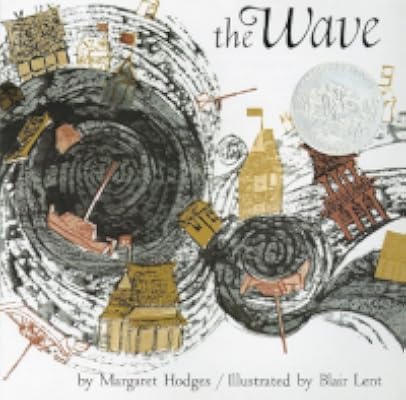
This adaptation of Lafcadio Hearn’s “A Living God” features “a wise old rice farmer who lived near the sea.” Known as Ojiisan, “grandfather,” he’s respected by his fellow villagers, who come to seek his counsel at his mountaintop cottage. When it’s time to celebrate the autumn show more harvest down in the village, Ojiisan and his grandson, Tada, stay behind. A mild earthquake precedes a massive ebb in the tide, and Ojiisan, recalling his own grandfather’s wisdom, realizes that such events herald a tsunami, and that he and Tada must find a way to warn the people below. The story could be a little more tightly told (Ojiisan’s grandfather-imparted advice turns up rather abruptly), but it has both immediacy and folkloric resonance. There’s considerable drama in the mountaintop warning—Ojiisan and his grandson set fire to the ricefields that provide the old man with his livelihood in order to draw the villagers to the mountain to help douse the fire—and it’s high action from that moment until the satisfying ending. Collage dominates Young’s illustrations, with occasional touches of paint enhancing the already varied textures ranging from sharp-edged photographs to soft, fibrous rag. The intensity of the patterning moves the art into near-abstraction at times, held together by strongly rhythmic composition, that makes the art likely to appeal most to visually sophisticated viewers. This could work as an interesting pairing with accounts of the 2004 tsunami such as Kroll’s Selvakumar Knew Better (BCCB 9/06) or other retellings of the tale such as Hodges’ The Wave, illustrated by Blair Lent (BCCB 9/64), or just as an eventful tale of disaster and heroism in its own right. The copyright page includes a source note Review Code: R -- Recommended. (c) Copyright 2006, The Board of Trustees of the University of Illinois. 2009, Philomel, 32p.; Reviewed from galleys, $16.99. Ages 5-9 yrs. show less
This adaptation of Lafcadio Hearn’s “A Living God” features “a wise old rice farmer who lived near the sea.” Known as Ojiisan, “grandfather,” he’s respected by his fellow villagers, who come to seek his counsel at his mountaintop cottage. When it’s time to celebrate the autumn show more harvest down in the village, Ojiisan and his grandson, Tada, stay behind. A mild earthquake precedes a massive ebb in the tide, and Ojiisan, recalling his own grandfather’s wisdom, realizes that such events herald a tsunami, and that he and Tada must find a way to warn the people below. The story could be a little more tightly told (Ojiisan’s grandfather-imparted advice turns up rather abruptly), but it has both immediacy and folkloric resonance. There’s considerable drama in the mountaintop warning—Ojiisan and his grandson set fire to the ricefields that provide the old man with his livelihood in order to draw the villagers to the mountain to help douse the fire—and it’s high action from that moment until the satisfying ending. Collage dominates Young’s illustrations, with occasional touches of paint enhancing the already varied textures ranging from sharp-edged photographs to soft, fibrous rag. The intensity of the patterning moves the art into near-abstraction at times, held together by strongly rhythmic composition, that makes the art likely to appeal most to visually sophisticated viewers. This could work as an interesting pairing with accounts of the 2004 tsunami such as Kroll’s Selvakumar Knew Better (BCCB 9/06) or other retellings of the tale such as Hodges’ The Wave, illustrated by Blair Lent (BCCB 9/64), or just as an eventful tale of disaster and heroism in its own right. The copyright page includes a source note Review Code: R -- Recommended. (c) Copyright 2006, The Board of Trustees of the University of Illinois. 2009, Philomel, 32p.; Reviewed from galleys, $16.99. Ages 5-9 yrs. show less
added by kthomp25
CCBC (Cooperative Children's Book Center Choices 2010)
Ojiisan is watching from his home on the mountain as residents of his village celebrate the rice harvest when he feels a rumbling beneath his feet: it’s an earthquake. Ojiisan watches 400 villagers far below rush toward the unusual sight of the sea rushing away from the land. They are unaware of what it means: tsunami! Frantic to warn show more them of the danger, Ojiisan sets his crops on fire, knowing that the villagers will rush up the mountain to help extinguish the blaze. And they do. Their village is devoured by the waves, but 400 lives are saved. Kimiko Kajikawa’s story is based on a real man named Hamaguchi Goryou who saved his village when a tsunami hit Japan in 1896. In a spare, dramatic account, the tension builds slowly and then explodes like the fury of the wave. Ed Young’s remarkable collage art is at once abstract—swaths of red-orange and pink for the flames, chaotic tears of white for the violent sea—and detailed, with facial expressions reflecting the confusion and terror, and authentic period clothing. CCBC Category: Historical People, Places, and Events. 2009, Philomel, 32 pages, $16.99. Ages 6-9. show less
Ojiisan is watching from his home on the mountain as residents of his village celebrate the rice harvest when he feels a rumbling beneath his feet: it’s an earthquake. Ojiisan watches 400 villagers far below rush toward the unusual sight of the sea rushing away from the land. They are unaware of what it means: tsunami! Frantic to warn show more them of the danger, Ojiisan sets his crops on fire, knowing that the villagers will rush up the mountain to help extinguish the blaze. And they do. Their village is devoured by the waves, but 400 lives are saved. Kimiko Kajikawa’s story is based on a real man named Hamaguchi Goryou who saved his village when a tsunami hit Japan in 1896. In a spare, dramatic account, the tension builds slowly and then explodes like the fury of the wave. Ed Young’s remarkable collage art is at once abstract—swaths of red-orange and pink for the flames, chaotic tears of white for the violent sea—and detailed, with facial expressions reflecting the confusion and terror, and authentic period clothing. CCBC Category: Historical People, Places, and Events. 2009, Philomel, 32 pages, $16.99. Ages 6-9. show less
added by kthomp25
Ken Marantz and Sylvia Marantz (Children's Literature)
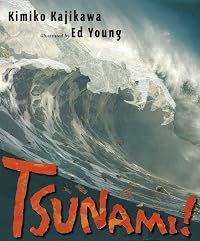
The destructive power of a tsunami was in the news not long ago. But Kajikawa has gone back to a legendary story by Lafcadio Hearn for this tale of the tsunami’s terror, and of the courage and sacrifice of a wise old rice farmer. On the day of the celebration of the autumn rice festival down in the village, Ojiisan and his grandson Tada show more stay home atop the mountain, because Ojiisan feels that something is not right. There is an earthquake, but not severe enough to concern them. But then Ojiisan sees the sea running away from the land, and remembers what his father told him about tsunamis. With Tada’s help he sets fire to his rice crop to draw the people away from the shore. The villagers are puzzled at his sacrifice, until they hear and see the tsunami. The village is swept away, but the people are saved. Years later, “villagers still give thanks to the good farmer who burned his rice fields to save the people.” The terrifying wave on the jacket with bits of broken huts scattered on the surface of the dark water predicts the emotional turmoil of the story within. The visual tale occupies most of each double-page spread with the few lines of text in white on framed black running along the bottom. Young uses gouache, pastel, and torn paper collage to create gripping melodramatic scenes. Some include tiny figures, while others sweep across the double pages in wide areas of color. The title in torn gray and white paper stands out from the double page of black. The orange end papers give an emotional lift to the darkness within. 2009, Philomel Books/Penguin Young Readers Group, $16.99. Ages 5 to 9. show less
The destructive power of a tsunami was in the news not long ago. But Kajikawa has gone back to a legendary story by Lafcadio Hearn for this tale of the tsunami’s terror, and of the courage and sacrifice of a wise old rice farmer. On the day of the celebration of the autumn rice festival down in the village, Ojiisan and his grandson Tada show more stay home atop the mountain, because Ojiisan feels that something is not right. There is an earthquake, but not severe enough to concern them. But then Ojiisan sees the sea running away from the land, and remembers what his father told him about tsunamis. With Tada’s help he sets fire to his rice crop to draw the people away from the shore. The villagers are puzzled at his sacrifice, until they hear and see the tsunami. The village is swept away, but the people are saved. Years later, “villagers still give thanks to the good farmer who burned his rice fields to save the people.” The terrifying wave on the jacket with bits of broken huts scattered on the surface of the dark water predicts the emotional turmoil of the story within. The visual tale occupies most of each double-page spread with the few lines of text in white on framed black running along the bottom. Young uses gouache, pastel, and torn paper collage to create gripping melodramatic scenes. Some include tiny figures, while others sweep across the double pages in wide areas of color. The title in torn gray and white paper stands out from the double page of black. The orange end papers give an emotional lift to the darkness within. 2009, Philomel Books/Penguin Young Readers Group, $16.99. Ages 5 to 9. show less
added by kthomp25
Lists

A Child's Book Tour of Japan
58 works; 4 members
Author Information
12 Works 1,119 Members
Awards and Honors
Awards
Distinctions
Notable Lists
Classifications
- Genre
- Children's Books
- DDC/MDS
- 398.20952 — Society, government, & culture Customs, etiquette & folklore Folklore & Folktales Folk literature History, geographic treatment, biography Asian folktales Japanese folklore
- LCC
- PZ8.1 .K1274 .T — Language and Literature Fiction and juvenile belles lettres Fiction and juvenile belles lettres Juvenile belles lettres
- BISAC
Statistics
- Members
- 582
- Popularity
- 50,496
- Reviews
- 71
- Rating
- (4.10)
- Languages
- English
- Media
- Paper
- ISBNs
- 4
- ASINs
- 2