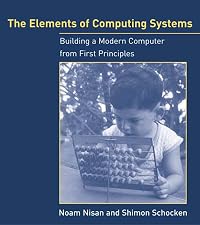
The Elements of Computing Systems: Building a Modern Computer from First Principles
by Noam Nisan
On This Page
Description
"Unlike other texts that cover only one aspect of the field, The Elements of Computing Systems gives students an integrated and rigorous picture of applied computer science, as it comes to play in the construction of a simple yet powerful computer systems.". "Indeed, the best way to understand how computers work is to build one from scratch, and this textbook leads students through twelve chapters and projects that gradually build a basic hardware platform and a modern software hierarchy show more from the ground up. In the process, the students gain hands-on knowledge of hardware architecture, operating systems, programming languages, compilers, data structures, algorithms, and software engineering. Using this constructive approach, the book exposes a significant body of computer science knowledge and demonstrates how theoretical and applied techniques taught in other courses fit into the overall picture.". "Designed to support one- or two-semester courses, the book is based on an abstraction-implementation paradigm; each chapter presents a key hardware or software abstraction, a proposed implementation that makes it concrete, and an actual project."--BOOK JACKET. show lessTags
Recommendations




Member Reviews
The five stars are really for the textbook plus the course materials, including video lectures and projects. This filled a ton of gaps in my understanding. Since I was a math major, I'd never had architecture, compilers, programming language design, systems, etc. Just the basics of application programming and computer graphics. Bought this a few years ago after reading about it on HackerNews. Read the first couple of chapters right away, set it down, forgot about it. Rediscovered it when I moved recently. Put it on my desk for months, then while searching Coursera for something completely unrelated, stumbled across the authors' class, which has split the material into two sections, roughly into a hardware stack and a software stack. For show more having no knowledge of hardware, I found the first section surprisingly doable with a reasonable time commitment. I spent way more time and effort on the software stack, including a ridiculous amount of time hunting down a jump-less-than which should have been a jump-not-equal in my assembler. But, I've now written an assembler, not to mention a compiler.
Which error I made because I didn't read closely enough. The book rewards close reading. In that sense, it takes after K&R C, being about the same thickness and directness. show less
Which error I made because I didn't read closely enough. The book rewards close reading. In that sense, it takes after K&R C, being about the same thickness and directness. show less
I worked carefully through the hardware half of the book. I finally understand the elements of digital logic, the design of an ALU, instruction decoding, the design of a CPU. I skimmed the second half, on software, because I'm already familiar with those topics. It seemed equally clear but I'm not the target audience for the software topics so I cannot say if they succeeded as brilliantly as they did with the hardware half.
I have used this book in my computer organization class and I must admit that it brought a very fresh perspective to second year computer science students. For the first time they were able to see the process of designing a computer from the ground up.
The book is very suitable for self-study or classroom use: it has an excellent website, all the required HDL simulator, assembler, CPU and VM emulator and compiler are freely available and easy to run on any platform (they are all coded in Java).
Of course there are simplifications such as the lack of interrupts and multhithreading but this book prepares the students very well for 3rd and 4th year courses. Every chapter has very well and clearly defined goals and projects that are %100 show more self-contained. That means even if you skip a chapter you can work out the next project without any loss in implementation.
If you or your students want to have a grasp what it means to build a computer starting from logic gates, hardware definition languages, up to the ALU, RAM, CPU, assembler, virtual machine and compilation of an object oriented high level language, then this book is the best choice. It is one of the most hands-on book I've ever seen in this subject matter and at that intermediate level. show less
The book is very suitable for self-study or classroom use: it has an excellent website, all the required HDL simulator, assembler, CPU and VM emulator and compiler are freely available and easy to run on any platform (they are all coded in Java).
Of course there are simplifications such as the lack of interrupts and multhithreading but this book prepares the students very well for 3rd and 4th year courses. Every chapter has very well and clearly defined goals and projects that are %100 show more self-contained. That means even if you skip a chapter you can work out the next project without any loss in implementation.
If you or your students want to have a grasp what it means to build a computer starting from logic gates, hardware definition languages, up to the ALU, RAM, CPU, assembler, virtual machine and compilation of an object oriented high level language, then this book is the best choice. It is one of the most hands-on book I've ever seen in this subject matter and at that intermediate level. show less
The first part of the book describes the logic which is necessary to construct a simplistic computer from NAND gates, data-flip-flops, a clock, and IO-interfaces. The second part describes how to write (in a given higher-level language, like C++) a simplistic compiler which generates machine code for the computer from part one.
The book is well-written and very understandable. The exercises, which are are nicely integrated into the text, are insightful.
The authors do not get tired to say that the book teaches to build a computer from NAND gates, but I find this somewhat boastful because (a) as mentioned above also data-flip-flops, ... are taken for granted and (b) you are only simulating the logic in an emulator which means you are not show more building anything. show less
The book is well-written and very understandable. The exercises, which are are nicely integrated into the text, are insightful.
The authors do not get tired to say that the book teaches to build a computer from NAND gates, but I find this somewhat boastful because (a) as mentioned above also data-flip-flops, ... are taken for granted and (b) you are only simulating the logic in an emulator which means you are not show more building anything. show less
Useful curriculum, implemented through CPU/RAM.
It would be better with actual explanation instead of purely instructional content.
Will look elsewhere for machine language and operating systems.
It would be better with actual explanation instead of purely instructional content.
Will look elsewhere for machine language and operating systems.
Ratings
Members
- Recently Added By
Lists

Dan Luu's Programming book list
46 works; 1 member
Author Information
7 Works 538 Members
Noam Nisan is Dean of the School of Computer Science and Engineering at the Hebrew University of Jerusalem. Shimon Shocken is Professor of Computer Science, and Founding Dean of the Efi Arazi School of Computer Science at IDC Herzliya, Israel.
Classifications
- Genres
- Technology, Nonfiction, General Nonfiction
- DDC/MDS
- 004.16 — Computer science, information & general works Computer science, knowledge & systems Computer science General works on specific types of computers Personal Computers
- LCC
- TK7888.3 .N57 — Technology Electrical engineering. Electronics. Nuclear engineering Electrical engineering. Electronics. Nuclear Electronics Computer engineering. Computer hardware
- BISAC
Statistics
- Members
- 383
- Popularity
- 81,731
- Reviews
- 5
- Rating
- (4.65)
- Languages
- English
- Media
- Paper, Ebook
- ISBNs
- 7
- UPCs
- 1
- ASINs
- 4