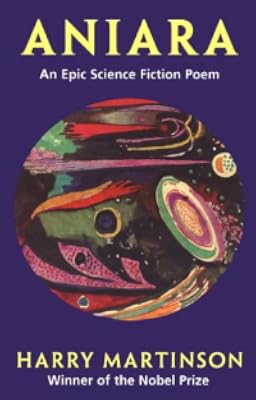
Aniara
by Harry Martinson
On This Page
Description
Eight thousand people aboard the space ship Aniara are diverted off course and plunge headlong in to the "void" where they must create a world in which they will be irretrievably trapped.Tags
Recommendations






















Member Reviews
A spaceship hurtles towards a distant constellation, going faster than anything in human history but essentially standing still from a relative point of view.
That wasn't the point, of course. They were just supposed to be temporarily evacuated to Mars and Venus while Earth "recovers". All of humanity being shipped out on spaceships - each one just making a routine trip, just on a much grander scale. Except for the Aniara which gets hit by a meteor shower. Her steering gets knocked out, her SOSs go unanswered, her AI kills itself after it sees Earth be destroyed in a nuclear holocaust, and the Aniara and her thousands of passengers are sent hurling on a 15,000 year journey towards Vega, with only their memories for company.
It's staring. show more It's staring cold outside.
It sounds like a potentially cheap sci-fi movie, it is actually a pretty fucking great sci-fi story except told in verse. Martinson tells it through the eyes of the AI operator whose job it is to keep the systems running as the years pass, the systems fail, and all the distractions - virtual reality and social media (yes, in 1957), religion, sex, music, science, even suicide - lose their allure and only the impossible vastness of space remains. He switches style from canto to canto, examining different characters, different aspects, different ways of trying to cope with the uncopeable.
Myself I questioned, but gave no reply.
I dreamt myself a life, then lived a lie.
I ranged the universe but passed it by -
For captive on Aniara here was I.
This book is 50 years old this year. It's lost absolutely none of its power. show less
That wasn't the point, of course. They were just supposed to be temporarily evacuated to Mars and Venus while Earth "recovers". All of humanity being shipped out on spaceships - each one just making a routine trip, just on a much grander scale. Except for the Aniara which gets hit by a meteor shower. Her steering gets knocked out, her SOSs go unanswered, her AI kills itself after it sees Earth be destroyed in a nuclear holocaust, and the Aniara and her thousands of passengers are sent hurling on a 15,000 year journey towards Vega, with only their memories for company.
It's staring. show more It's staring cold outside.
It sounds like a potentially cheap sci-fi movie, it is actually a pretty fucking great sci-fi story except told in verse. Martinson tells it through the eyes of the AI operator whose job it is to keep the systems running as the years pass, the systems fail, and all the distractions - virtual reality and social media (yes, in 1957), religion, sex, music, science, even suicide - lose their allure and only the impossible vastness of space remains. He switches style from canto to canto, examining different characters, different aspects, different ways of trying to cope with the uncopeable.
Myself I questioned, but gave no reply.
I dreamt myself a life, then lived a lie.
I ranged the universe but passed it by -
For captive on Aniara here was I.
This book is 50 years old this year. It's lost absolutely none of its power. show less
I cannot help noticing a strong resemblance between Aniara and an old Russian novel of the twenties (Aelita) and the Canadian popera that appeared later in the seventies (Starmania). These mixes of science fiction, lyricism and ecological connotations are almost always fascinating. In 1956, Martinson published a complete volume of poems, Aniara, which was turned into an opera in 1959 by Karl-Biger Blomdahl. The story line is simple enough. A future war is raging on Earth, and people are fleeing to Mars. One of the space ships, Aniara, carries 8,000 emigrants. The ship encounters an asteroid and has to make an evasive manoeuvre. This puts it on a hyperbolic trajectory out of the solar system, with no hope of return. The book describes show more the attempts of the emigrants to cope with their fate: hedonism, religion, science, etc., interspersed with reminiscences from the war and earlier, happy, times. A central role is played by the ship's computer, the Mima, which is not just intellectually superior to any human - it also harbours deep emotions and dies from grief when it witnesses the Earth's destruction. - After 20 years, the ship has traveled just 16 lighthours (and is still on the outskirts of the solar system). There are no children. The last passenger dies after some 25 years. The ship is destined to travel for another 15,000 years before reaching the vicinity of another star. Martinson memorably compares the spaceship to "a bubble in the glass of God's spirit", referring to the glacial movement of bubbles in glass, understood as a liquid with very high viscosity. Epic AND odd!!! show less
"That was how the solar system closed
its vaulted gateway of the purest crystal
and severed spaceship Aniara’s company
from all the bonds and pledges of the sun.
Thus given over to the shock-stiff void
we spread the call-sign Aniara wide
in glass-clear boundlessness, but picked up nothing.
Though space-vibrations faithfully bore round
our proud Aniara’s last communiqué
on widening rings, in spheres and cupolas
it moved through empty space, thrown away.
In anguish sent by us in Aniara
our call-sigh faded till it failed: Aniara"
Such is the fate of the spaceship Aniara, as chronicled in Nobel Prize-winner Harry Martinson’s epic poem. After being thrown off course its 8,000 souls are left to live what remains of their lives in a vast spaceship show more hurtling into the unknown emptiness of space, with no hope of ever returning to Earth.
This epic poem is everything a work of science fiction should be, providing a fantastic situation that nevertheless resonates with us, and using that situation to explore mankind. Here Martinson chooses as his topic how mankind comes to terms with hopeless, pointlessness, and the inevitability of death. Being trapped on Aniara renders life meaningless for all the passengers on board- if they make scientific discoveries they can’t send them back to Earth so no use will ever come of them, they can write poems and songs but they will be trapped within the confines of the ship, and everyone knows that eventually Aniara will reach its limits on this unending journey and everyone aboard her will die. This is a fantastic situation, yes, but is it really so different from our lives? The passengers of the spaceship Aniara are making, after all,
“A lifelong journey onward to an end
which would have come in any case, and comes.”
The struggle with whether our actions in life have meaning, and the struggle to come to terms with our eventual demise are not challenges that require space travel to be a reality. Martinson explores how people deal with these challenges by presenting us with the microcosm of the ship. At first the passengers keep the hopelessness of the situation at bay with mima, “a filter of truth, with no stains of her own.” Mima presents the passengers with images of far off planets and with recordings of terrible events happening back on Earth, providing a Plato’s cave that people are all too happy to flock to. Mima is more than a computer, she’s a conscious thing that has desires of her own, and she eventually welcomes death to avoid seeing the horrors of Earth dying behind them. With the loss of mima the mirror-world she created is lost as well, and thus the passengers turn to religion, whether the old ones of Earth, or factions worshipping the lost mima, or sex cults. As the journey gets longer and the ship strikes further into the emptiness of space the religion gets more extreme as the hopelessness becomes harder to bear: a cult featuring human sacrifice has a surplus of volunteers. People retreat into memories of their life before entering the ship, even if the worlds left behind seem hellish. The bearers of these memories aren’t the usual archetypes found in science fiction but interesting characters in their own right, from a female pilot (about whom the narrator notes “she wounds you in the way that roses wound”), to a blind poetess,
“with songs so beautiful they lifted us
beyond ourselves, on high to spirit’s day.
She blazoned our confinement gold with fire
and sent the heavens to the heart’s abode,
changing every word from smoke to splendor.”
Despite a few events that rejuvenate the excitement of the passengers there are no long-term victories on Aniara. Being on the ship forces an acknowledgment of the inevitability of death, strips the passengers of the normal pantheon of reasons life isn’t pointless, and the passengers are powerless to invent new reasons that satisfy them; even the religious cults are abandoned in time, with only some small symbolic gestures remaining. Nihilism conquers this microcosm, as the numbers of insane and suicides multiply. Eventually the ship breaks down too severely to be repaired and death comes for all who remain. Having read The Death of Ivan Ilyich recently I can say with certainty that I found Aniara more affecting. The events of the poem are hopeless, yes, but the warning rings through clear: for all its flaws Earth is a paradise, and mankind, “a king with an ashen crown,” must maintain it or face the vast emptiness of space.
This work essentially won Martinson his Nobel Prize in literature, and despite the controversy the win was well deserved. It’s a travesty that this work is out of print, and so rare that used copies cost hundreds of dollars. It’s beautifully written, the characters are usually not drawn with much detail but still manage to be interesting, and the setting it presents is masterfully constructed. Best of all, these virtues exist to actually explore ideas worth exploring and to say something worth saying, which you would expect to be commonplace in science fiction but which, sadly, is not. Why is this work so little known in the genre of science fiction when far, far lesser works like Heinlein’s Stranger in a Strange Land, Clarke’s Childhood’s End, and Neuromancer by Gibson are not only still widely read, but held up as some of the best works of science fiction to ever be put to paper? Aniara is better than any of those works by an order of magnitude, and yet it’s been all but forgotten. It speaks poorly of the genre’s fans, and sadly is justifies some of the lack of respect shown to science fiction. Aniara lives up to the potential of science fiction, and you should read it unless you absolutely can’t stand that genre.
One minor complaint: in Aniara Martinson makes up a plethora of words, both used to identify technology and used in normal conversation. Especially in the few stanzas that make heavy use of the slang of old Earth I found it just too much. I wish he had pulled a Gene Wolfe and only used existing but rare or archaic words, but it’s impossible for me to criticize Martinson for this too severely when he effectively addresses this exact point:
“The galaxy swings around
like a wheel of lighted smoke,
and the smoke is made of stars.
It is sunsmoke.
For lack of other words we call it sunsmoke,
do you see.
I don’t feel languages are equal
to what that vision comprehends.
The riches of the languages we know,
Xinombric, has three million words,
but then the galaxy you’re gazing into now
has more than ninety billion suns.
Has there ever been a brain that mastered all the words
in the Xinombric language?
Not a one.
Now you see.
And do not see.” show less
its vaulted gateway of the purest crystal
and severed spaceship Aniara’s company
from all the bonds and pledges of the sun.
Thus given over to the shock-stiff void
we spread the call-sign Aniara wide
in glass-clear boundlessness, but picked up nothing.
Though space-vibrations faithfully bore round
our proud Aniara’s last communiqué
on widening rings, in spheres and cupolas
it moved through empty space, thrown away.
In anguish sent by us in Aniara
our call-sigh faded till it failed: Aniara"
Such is the fate of the spaceship Aniara, as chronicled in Nobel Prize-winner Harry Martinson’s epic poem. After being thrown off course its 8,000 souls are left to live what remains of their lives in a vast spaceship show more hurtling into the unknown emptiness of space, with no hope of ever returning to Earth.
This epic poem is everything a work of science fiction should be, providing a fantastic situation that nevertheless resonates with us, and using that situation to explore mankind. Here Martinson chooses as his topic how mankind comes to terms with hopeless, pointlessness, and the inevitability of death. Being trapped on Aniara renders life meaningless for all the passengers on board- if they make scientific discoveries they can’t send them back to Earth so no use will ever come of them, they can write poems and songs but they will be trapped within the confines of the ship, and everyone knows that eventually Aniara will reach its limits on this unending journey and everyone aboard her will die. This is a fantastic situation, yes, but is it really so different from our lives? The passengers of the spaceship Aniara are making, after all,
“A lifelong journey onward to an end
which would have come in any case, and comes.”
The struggle with whether our actions in life have meaning, and the struggle to come to terms with our eventual demise are not challenges that require space travel to be a reality. Martinson explores how people deal with these challenges by presenting us with the microcosm of the ship. At first the passengers keep the hopelessness of the situation at bay with mima, “a filter of truth, with no stains of her own.” Mima presents the passengers with images of far off planets and with recordings of terrible events happening back on Earth, providing a Plato’s cave that people are all too happy to flock to. Mima is more than a computer, she’s a conscious thing that has desires of her own, and she eventually welcomes death to avoid seeing the horrors of Earth dying behind them. With the loss of mima the mirror-world she created is lost as well, and thus the passengers turn to religion, whether the old ones of Earth, or factions worshipping the lost mima, or sex cults. As the journey gets longer and the ship strikes further into the emptiness of space the religion gets more extreme as the hopelessness becomes harder to bear: a cult featuring human sacrifice has a surplus of volunteers. People retreat into memories of their life before entering the ship, even if the worlds left behind seem hellish. The bearers of these memories aren’t the usual archetypes found in science fiction but interesting characters in their own right, from a female pilot (about whom the narrator notes “she wounds you in the way that roses wound”), to a blind poetess,
“with songs so beautiful they lifted us
beyond ourselves, on high to spirit’s day.
She blazoned our confinement gold with fire
and sent the heavens to the heart’s abode,
changing every word from smoke to splendor.”
Despite a few events that rejuvenate the excitement of the passengers there are no long-term victories on Aniara. Being on the ship forces an acknowledgment of the inevitability of death, strips the passengers of the normal pantheon of reasons life isn’t pointless, and the passengers are powerless to invent new reasons that satisfy them; even the religious cults are abandoned in time, with only some small symbolic gestures remaining. Nihilism conquers this microcosm, as the numbers of insane and suicides multiply. Eventually the ship breaks down too severely to be repaired and death comes for all who remain. Having read The Death of Ivan Ilyich recently I can say with certainty that I found Aniara more affecting. The events of the poem are hopeless, yes, but the warning rings through clear: for all its flaws Earth is a paradise, and mankind, “a king with an ashen crown,” must maintain it or face the vast emptiness of space.
This work essentially won Martinson his Nobel Prize in literature, and despite the controversy the win was well deserved. It’s a travesty that this work is out of print, and so rare that used copies cost hundreds of dollars. It’s beautifully written, the characters are usually not drawn with much detail but still manage to be interesting, and the setting it presents is masterfully constructed. Best of all, these virtues exist to actually explore ideas worth exploring and to say something worth saying, which you would expect to be commonplace in science fiction but which, sadly, is not. Why is this work so little known in the genre of science fiction when far, far lesser works like Heinlein’s Stranger in a Strange Land, Clarke’s Childhood’s End, and Neuromancer by Gibson are not only still widely read, but held up as some of the best works of science fiction to ever be put to paper? Aniara is better than any of those works by an order of magnitude, and yet it’s been all but forgotten. It speaks poorly of the genre’s fans, and sadly is justifies some of the lack of respect shown to science fiction. Aniara lives up to the potential of science fiction, and you should read it unless you absolutely can’t stand that genre.
One minor complaint: in Aniara Martinson makes up a plethora of words, both used to identify technology and used in normal conversation. Especially in the few stanzas that make heavy use of the slang of old Earth I found it just too much. I wish he had pulled a Gene Wolfe and only used existing but rare or archaic words, but it’s impossible for me to criticize Martinson for this too severely when he effectively addresses this exact point:
“The galaxy swings around
like a wheel of lighted smoke,
and the smoke is made of stars.
It is sunsmoke.
For lack of other words we call it sunsmoke,
do you see.
I don’t feel languages are equal
to what that vision comprehends.
The riches of the languages we know,
Xinombric, has three million words,
but then the galaxy you’re gazing into now
has more than ninety billion suns.
Has there ever been a brain that mastered all the words
in the Xinombric language?
Not a one.
Now you see.
And do not see.” show less
An immense spaceship drifts deeper into space, away from an Earth ravaged by nuclear holocaust. Wonderfully melancholic and at times painfully tragic, reading Harry Martinson's sci-fi poem (here in the original Swedish) is a great but uneven experience. I found the first third or so, as well as the finale, to be the most powerful, while the middle part failed to hold my interest in the same way. Some parts are excellent, but at other times the text feels confusing and contrived. I'm also not crazy about Martinson's way of using invented words (this is not a principled objection, it just didn't work that well for me here). To be fair though, my expectations may have been unreasonably high. Overall, I wanted to like "Aniara" more than I show more actually did; for me, the premise is better than the execution. I will probably give it another shot in a year or so, however, as I got the feeling it will improve on a second reading. show less
DNF somewhere in the outer solar system.
I'm sure it's better in the original, but this translation of the epic Swedish science fiction poem left me colder than the interstellar vacuum. Not a patch on the 2018 film adaptation.
I'm sure it's better in the original, but this translation of the epic Swedish science fiction poem left me colder than the interstellar vacuum. Not a patch on the 2018 film adaptation.
Es una pasada cómo está escrito, y la traducción es una pasada, pero... La historia en sí no me ha atraído especialmente. Se me hacía algo pesado (y suerte que es un libro que se lee rápido...)
Good introduction to poetry for the science nerd and scifi geek who doesn't 'get' poetry. I still don't get most poetry, but read Aniara again every now and then.
Members
- Recently Added By
Published Reviews
ThingScore 100
Something that I love about poetry and science fiction both is their ability to defamiliarize—to make the familiar strange, so that we might freshly look upon it and gain new perspective. To accomplish this, poetry often stranges language, while science fiction uses alien worlds and futuristic settings which ultimately lead us to reexamine our own beliefs (and our politics, customs, show more biological makeup, surroundings). To see ourselves as if for the first time. Martinson uses the powers of both poetry and science fiction to reach his readers. show less
added by elenchus
Lists

Best Science Fiction Originally Published in a Language Other Than English
449 works; 34 members

Read the book and saw the movie
1,170 works; 195 members
SF & Fantasy in Translation
95 works; 18 members

Narrative verse for pleasure
75 works; 8 members

Nobel Price Winners
222 works; 20 members
Author Information

Harry Martinson was born in Jämshög, Sweden on May 6, 1904. When he was six his father died and then his mother immigrated to America, leaving him and his sisters as parish orphans, fostered out to various families. He ran away from his foster parents and went to sea from 1920 to 1927. After returning to Sweden, ill with tuberculosis and show more destitute, he came under the care of his future wife, Moa Swartz, who became a well-known author in her own right. His first book of poetry, Spökskepp (Ghost Ship), was published in 1929. He also wrote a collection of poetry entitled Passad (Trade Wind) and an epic poem about space travel entitled Aniara. His novels include Nässlorna Blomma (Flowering Nettle), Vägen Ut (The Way Out), Kap Farväl (Cape Farewell), and Vägen till Klockrike (The Road). He was elected to the Swedish Academy in 1949, a notable achievement for a writer with no formal education. He shared the 1974 Nobel Prize for Literature with novelist Eyvind Johnson. Their honors were considered controversial, since they were close friends and both had been long-time members of the Swedish Academy. He was offended by the insinuation of corruption and withdrew into depression. He committed suicide on February 11, 1978. (Bowker Author Biography) show less
Some Editions
Awards and Honors
Series
Belongs to Publisher Series
Work Relationships
Is contained in
Has the adaptation
Common Knowledge
- Canonical title
- Aniara
- Original title
- Aniara
- Original publication date
- 1956-10-13
- People/Characters
- The Mimarobe (narrator); Mima; Daisi Doody; Chefone; Isagel; Rind
- Important places
- space; Aniara
- Related movies
- Aniara (2018 | IMDb); Aniara (1960 | IMDb)
- First words
- My first meeting with my Doris shines
with light adding loveliness to light itself.
But the simple truth is that my first
and just as simple meeting with my Doris
is now a scene that anyone can see
every day in... (show all) front of him in every hall
funneling the refugees to lift-off zones —
on forced migrations to the tundra globe,
in these years when Earth has come to such a pass
that for her toxic radiation she's prescribed
rest and quiet under quarantine. - Quotations
- We are compelled to seek out other words
which can shrink all and shrivel all to comfort us.
The word for Star has now become indecent,
the low names high for loins and woman's breast.
The brain is now a shameful ... (show all)body-part,
for Hades harvests us at its behest.
I shall relate what I have heard of glass
and then you'll understand. In any glass
that stands untouched for a sufficient time
gradually a bubble in the glass will move
infinitely slowly to a different point
in... (show all) the body of the glass, and in a thousand years
the bubble makes a journey in its glass.
Similarly, in an infinite space
a gulf of light years' depth throws a vault
round bubble Aniara as she goes.
For though the rate she travels at is great
and much more rapid than a rushing planet's,
her speed as seen against the scale of space
exactly corresponds to that we know
the bubble makes inside this bowl of glass.
There is protection from almost everything,
from fire and damage due to storms and frosts,
add whatever blows may come to mind —
but there is no protection from mankind.
And many stood unspeaking.
But suddenly someone said
a light-year is a grave.
Those twenty years of journey
are sixteen hours of light-path
on the sea of the light-year grave.
Then there was no one laughing.... (show all)
Then nearly all were crying.
A light-year is a grave. - Last words
- (Click to show. Warning: May contain spoilers.)Around the mima's grave we sprawled in rings,
fallen and to guiltless ashes changed,
delivered from the stars' embittered stings.
And through us all Nirvana's currents ranged.
Classifications
- Genres
- Poetry, Fiction and Literature, Science Fiction
- DDC/MDS
- 839.71 — Literature & rhetoric German & related literatures Other Germanic literatures Swedish literature Swedish poetry
- LCC
- PT9875 .M35 .A666213 — Language and Literature German, Dutch and Scandinavian literatures Swedish literature Individual authors or works 1900-1960
- BISAC
Statistics
- Members
- 534
- Popularity
- 55,804
- Reviews
- 16
- Rating
- (3.81)
- Languages
- 14 — Chinese, Dutch, English, Esperanto, Finnish, French, German, Italian, Japanese, Norwegian (Bokmål), Norwegian, Russian, Spanish, Swedish
- Media
- Paper, Audiobook, Ebook
- ISBNs
- 32
- ASINs
- 7