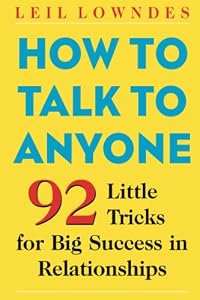
How to Talk to Anyone: 92 Little Tricks for Big Success in Relationships
by Leil Lowndes
On This Page
Description
Self-Improvement. Nonfiction. Offers 62 time-tested hints, tips, and techniques for confidently communicating with others. Best-selling author and renowned communications consultant Leil Lowndes, focuses on ice-breaking skills and communication techniques that are proven successful when making a positive first impression, establishing instant rapport and credibility, and more. Packed with basic, no-nonsense advice and solid research evidence about which techniques work best in which areas, show more How To Talk To Anyone show readers how to: * Make small talk not so small * Use body language to captivate an audience * Look like you know what you're talking about--even when you don't How To Talk To Anyone is brimming with helpful hints, tips, and ideas for approaching, attracting and communicating with just about anyone. Whether you're a shy guy or gal or you're just looking for ways to improve your social skills. show lessTags
Recommendations






















Member Reviews
Fairly standard business-self-help book in a fairly standard format: a series of personal stories each with its tidy little moral. 92 of them, apparently. The stories each follow their own formats: generally either a friend is super-successful and deigns to share the secret of success, or is doing something super-cringe and the author deigns to suggest they go about things differently. Some of the stories come with little before/after comparisons, while others are satisfied with showcasing such a dismal "before" that the reader can only shake their head sadly as the person refuses to learn.
At the end of the book the author sums up how the loser friends who didn't take good advice are still losers which rams home the moral so hard that I show more have to wonder if any of these people are really friends or, indeed, are any of these friends really people: even assuming you've changed names and other details would anyone with a modicum of social skills *really* burn relationship bridges by publicly dissing people in a book like that?
Some of the advice feels like treating all interactions with people as points-gaining opportunities, which seems a bit exhausting and soulless. Some of it feels potentially useful - though I'm not sure if the parts that seem useful to me would be the same as the parts that would seem useful to other people. Among 92 tips it seems statistically likely that anyone likely to be reading it will find *some* that are potentially useful. show less
At the end of the book the author sums up how the loser friends who didn't take good advice are still losers which rams home the moral so hard that I show more have to wonder if any of these people are really friends or, indeed, are any of these friends really people: even assuming you've changed names and other details would anyone with a modicum of social skills *really* burn relationship bridges by publicly dissing people in a book like that?
Some of the advice feels like treating all interactions with people as points-gaining opportunities, which seems a bit exhausting and soulless. Some of it feels potentially useful - though I'm not sure if the parts that seem useful to me would be the same as the parts that would seem useful to other people. Among 92 tips it seems statistically likely that anyone likely to be reading it will find *some* that are potentially useful. show less
This was an interesting listen! I’m challenging myself to read more books that can help me better myself and my life this year, and this is the first!
I really enjoyed Leil Lowndes voice, she does a great job on narration.
I’ve read a couple books in the last couple years related to self help, and they all preach self confidence and self actualization. These things are great in theory, but I’m always left asking “How though?” Maybe this stuff comes easier to others, maybe it’s my neurodivergence, but I just can’t figure out how to enact these concepts in life. This book goes against that grain and actually gives you real tips that you can test out in your social interactions. And I can see myself actually using some of show more them!
There is a bit of stuff that’s out of date, considering this was published in the early 2000s, but a lot of it still stands today.
I’m interested in checking out some of Lowndes other work, and would recommend this to anyone looking for some help with their social life. And imagine, a physical copy has over 90 tips! show less
I really enjoyed Leil Lowndes voice, she does a great job on narration.
I’ve read a couple books in the last couple years related to self help, and they all preach self confidence and self actualization. These things are great in theory, but I’m always left asking “How though?” Maybe this stuff comes easier to others, maybe it’s my neurodivergence, but I just can’t figure out how to enact these concepts in life. This book goes against that grain and actually gives you real tips that you can test out in your social interactions. And I can see myself actually using some of show more them!
There is a bit of stuff that’s out of date, considering this was published in the early 2000s, but a lot of it still stands today.
I’m interested in checking out some of Lowndes other work, and would recommend this to anyone looking for some help with their social life. And imagine, a physical copy has over 90 tips! show less
Lowndes is writing a more contemporary update of Dale Carnegie's classic How to Win Friends and Influence People , with more contemporary being a relative term since this book is very 1990s, full of travel agents and desk phones and with nary a mention of that new-fangled internet thing, which is probably just for hopeless geeks.
While a lot of other reviews have criticized this book for being insincere, I disagree. While there are 92 tricks, they fall into three big categories. The first is that everyone appreciates sustained attention, which you can signal that you are giving through sustained eye contact, slow and large smiles, and noticing and recalling little details about a person. Give people a chance to shine, and they'll like show more you.
Although I worry I'm coming across more like this
The second category is to be considerate of people's time and emotions. Make sure that this is actually a good time to talk and sympathize with people's difficulties. One "oh duh" moment is that if you need someone to do something for you, let them empty their mind of complaints and problems first, and frame your offer as a solution to a problem they have.
The third category is how to act high-status. According to Lowndes, Big Cats are assured and confident; little pusses are hurried and worried. Don't put others down, ever. Don't jump to business before the end of a meal. Wait a decent interval before calling in a favor, and leave it unspoken that this is a tit-for-tat favor. Remember celebrities are people too so don't over-intrude, and be appreciative of recent work. And if someone abuses your trust, don't call it out, just never give them a second chance.
I really should go back and do a more systematic summary. show less
While a lot of other reviews have criticized this book for being insincere, I disagree. While there are 92 tricks, they fall into three big categories. The first is that everyone appreciates sustained attention, which you can signal that you are giving through sustained eye contact, slow and large smiles, and noticing and recalling little details about a person. Give people a chance to shine, and they'll like show more you.
Although I worry I'm coming across more like this
The second category is to be considerate of people's time and emotions. Make sure that this is actually a good time to talk and sympathize with people's difficulties. One "oh duh" moment is that if you need someone to do something for you, let them empty their mind of complaints and problems first, and frame your offer as a solution to a problem they have.
The third category is how to act high-status. According to Lowndes, Big Cats are assured and confident; little pusses are hurried and worried. Don't put others down, ever. Don't jump to business before the end of a meal. Wait a decent interval before calling in a favor, and leave it unspoken that this is a tit-for-tat favor. Remember celebrities are people too so don't over-intrude, and be appreciative of recent work. And if someone abuses your trust, don't call it out, just never give them a second chance.
I really should go back and do a more systematic summary. show less
...originally published in '99? I expected 80s at the latest. Some of this stuff sounds more dated than Carnegie. But common-sense-reinforcing and a good reminder.
(P.s. Heterocentric as fuck. Only mention of LGBT is like fellas, don't use this technique on another guy, he may want to sock you! Boo.)
(P.s. Heterocentric as fuck. Only mention of LGBT is like fellas, don't use this technique on another guy, he may want to sock you! Boo.)
Book Extracts Blinkist: How to talk to anybody
First impressions matter, so remember to smile and use welcoming body language.
Make sure you smile when you meet new people? You may have found it annoying at the time, but a smile can make a big difference in whether or not you win someone over......a natural-looking smile is even more important among women.
It has been proven [we obviously lose something here with the book summary. When I’m told that “it’s been proven” I look to see by whom and how it was proven....and this is missing. Maybe it was effectively established in the full book...or maybe it’s just a wild claim or somebody’s idea] that establishing steady eye contact will help you gain both respect and affection. [And show more anyway, there is a cultural dimension to eye contact. In some societies it’s regarded as aggressive or flirtatious to make eye contact and not something you would do with those higher in rank].
When greeting someone for the first time, do so as if she were an old friend. Along with a warm smile, turn your body fully toward her so she can see you’re giving her your undivided attention. [I get a sense of déjà vu here...and it takes me back 60 years to when I first read “How to win friends and influence People”, by Dale Carnegie. In fact most of this book seems to be a re-run of Carnegie’s original....as are many similar books in the self-help genre].
And keep your hand gestures under control. [Very annoying to the Japanese for example]
Smooth introductions and familiar gestures lead to good conversations.
One classic technique for getting others to come talk to you is to have an icebreaker, or conversation starter, that you can bring with you, such as a vintage pocket watch, or one-of-a-kind purse....Pay close attention to how they are speaking and responding. Try to match their mood and tone of voice, and the chances are everyone will be attentive and engaged.
When you spot your chance to enter a conversation, the best thing to do is be confident in what you say and engage with a positive attitude.
Master the art of small talk by opening conversational doors and keeping people talking.
What questions always come up when getting to know someone? Chances are, it’s things like, “Where are you from,” or, “What do you do?” Instead of giving one-word answers like “London” and “Marketing,” be prepared to elaborate. Keep the conversation flowing by leading into an interesting fact or anecdote that opens the door for another topic.
Another winning tip is to focus on being a good listener, and knowing how to keep your partner talking. One of the best ways is to say very little and keep the spotlight on your partner. This way, they’ll be too busy talking and being flattered by your interest to notice that you aren’t saying much. Use their pauses as an opportunity to take the last thing they said and repeat it in such a way that it puts the ball back in their court.
As host think who in the group has a great story and then to give that person a proper introduction. And avoid saying things that will make you look bad. When people are getting to know each other better, they often feel the impulse to confess something personal or reveal a weakness. This is a mistake.
Build rapport through imitating, empathizing and acting like a close friend.
When you reflect a person’s movements, they’ll tend to feel more comfortable around you, even if they’re not exactly sure why. If you’re talking to someone who says they work for an ad agency, notice that they didn’t call it a company or a firm, and do likewise yourself. And drop the “ums” and use empathizers instead. Use full sentences that show your partner that you’re truly listening, like, “That was the right thing to do,” or, “I see why you did that.”
adopting two powerful words: “we” and “us.”
So rather than saying, “What do you think about this new mayor?” try saying, “How do you think we’ll do with the new mayor?”
If you want to quickly form a bond, remember when funny remarks and shared laughs occur, and cleverly bring them up again later on......“Chemistry, charisma, and confidence are three characteristics shared by Big Winners in all walks of life.”
Be delicate, sparing and immediate with your praise.
Give praise indirectly. One way of doing this is to pass along any nice words via a mutual acquaintance. And if you’re ever approached by someone to pass along a good word, be sure to follow through on it. Everyone feels they do good work that goes largely unnoticed. By simply telling someone that they did a good job, you’ll be making their day!
speak up right when the good deed happens. Immediate praise can be especially good when someone’s just given a presentation For giving a dazzling compliment to that special someone in your life, just highlight one specific trait that you really admire.
Always be considerate in your relationships, especially when it comes to giving and receiving favors.
One easy way to improve your relationships is to be more considerate. Sometimes there are distractions but once the distraction has been dealt with, don’t forget to return to your friend and have her pick up where she left off.
Sometimes things are best left unsaid.
If you do someone a favour, don’t immediately ask for something in return.
Sounding professional is crucial for career success.
When talking with your boss, cut to the chase and be direct. Important people don’t have time to dance around the topic. By starting your sentences with “you,” the listener is bound to pay more attention to the words that follow. If you think they’ll be happy to hear the news, deliver it with a smile. If it’s disappointing news, tell them with a compassionate sigh.
Also, think about what the listener might be interested in......don’t just tell them your job title–tell them what you do for people. If you’re an accountant, say, “I arrange people’s finances and find new ways for them to save money.”
Don’t ask people, “What do you do?” Instead, ask them something like “How do you spend most of your time?”
Professionals don’t tease or embarrass other people, or make jokes at their expense.
Stay in charge by separating business and leisure, and by always being honest.
Even if you’re at a business lunch, don’t start talking shop until you’re done with the dessert, especially if the topic is a tough one. After all, no one wants to have their appetite ruined by an unpleasant business conversation.
When doing deals be transparent and upfront about how both the client, and yourself, will benefit. This way, they won’t think that you’re trying to pull a fast one.
And, if you make a mistake, like sending out the wrong product, be apologetic and go the extra mile by making a gesture of goodwill, such as offering a gift card or free shipping on their next order.
One final tip that’s sure to impress is to always be the first one to applaud or speak up.
Preparing for meetings pays off.
Studies show that people with a deep and plentiful vocabulary are seen as more intelligent and creative......Preparation can be especially useful if you focus on the people you’re meeting with. If you’re attending a trade conference or similar event, brush up on your business jargon by leafing through trade magazines or websites.....The same holds true when you’re a tourist or traveling on business. Familiarity with local customs and history will mean you’ll be less likely to put your foot in your mouth, or otherwise embarrass yourself.
Effective phone skills can make up for a lack of visual cues.
When you answer the phone, do so in a crisp and professional manner. When the caller identifies himself, greet him like you would a long-lost friend. This way, they’ll feel warm and welcome, and you’ll already be off to a great start. People tend to perk up when they hear their own name, so you can keep someone’s attention by using their name more frequently than you would otherwise. Instead of asking to talk to Ms. Smith, just ask, “Is she in today?” This implies familiarity and suggests you’re a close friend who deserves to be put at the top of the call-back queue.
Get the most out of every party by making a strong entrance and taking the initiative.
The technique for a dramatic entrance is simple: Before entering, pause at the doorway and give the room a scan. Once you’ve surveyed the premises and deemed them satisfactory, you can smile and step inside....[This assumes that everybody is focused on the door].
Once inside, you should take the initiative and immediately gravitate toward the most interesting person in the room. Adopt an open and inviting posture, with your palms facing outward.....Remember to listen, and take mental notes of what the other person is saying, as it will likely prove useful later.
Final summary
With some basic understanding of human nature and people’s habits, anyone can learn how to be a better communicator and improve their relationships. Everyone should know the importance of making a good first impression, how to use non-threatening and positive body language, giving effective praise and how to come to meetings prepared with valuable information. With knowledge and good technique, you'll not only feel more comfortable and confident in your conversations but also gain more friends and quickly move up the ladder of success.
Remember the valuable information people reveal about themselves. One helpful trick is to jot down interesting facts on the back of a person’s business card as soon as you finish talking to them. Then, the next time you meet, you can impress them by mentioning one or two personal details.
Actually, I thought this was a pretty good summary about how to talk to anybody. Though she clearly hasn’t been present at the Canadian National Day in Mexico (with very limited Spanish) and tried to speak to the Chinese First secretary in Spanish, then English and be faced by total non-comprehension and non-interest and then they just walked away. That sort of thing is “challenging”. The key lesson being to improve your Spanish. Yes, she does cover a lot of what Dale Carnegie said but it stands repeating. Four stars from me. show less
First impressions matter, so remember to smile and use welcoming body language.
Make sure you smile when you meet new people? You may have found it annoying at the time, but a smile can make a big difference in whether or not you win someone over......a natural-looking smile is even more important among women.
It has been proven [we obviously lose something here with the book summary. When I’m told that “it’s been proven” I look to see by whom and how it was proven....and this is missing. Maybe it was effectively established in the full book...or maybe it’s just a wild claim or somebody’s idea] that establishing steady eye contact will help you gain both respect and affection. [And show more anyway, there is a cultural dimension to eye contact. In some societies it’s regarded as aggressive or flirtatious to make eye contact and not something you would do with those higher in rank].
When greeting someone for the first time, do so as if she were an old friend. Along with a warm smile, turn your body fully toward her so she can see you’re giving her your undivided attention. [I get a sense of déjà vu here...and it takes me back 60 years to when I first read “How to win friends and influence People”, by Dale Carnegie. In fact most of this book seems to be a re-run of Carnegie’s original....as are many similar books in the self-help genre].
And keep your hand gestures under control. [Very annoying to the Japanese for example]
Smooth introductions and familiar gestures lead to good conversations.
One classic technique for getting others to come talk to you is to have an icebreaker, or conversation starter, that you can bring with you, such as a vintage pocket watch, or one-of-a-kind purse....Pay close attention to how they are speaking and responding. Try to match their mood and tone of voice, and the chances are everyone will be attentive and engaged.
When you spot your chance to enter a conversation, the best thing to do is be confident in what you say and engage with a positive attitude.
Master the art of small talk by opening conversational doors and keeping people talking.
What questions always come up when getting to know someone? Chances are, it’s things like, “Where are you from,” or, “What do you do?” Instead of giving one-word answers like “London” and “Marketing,” be prepared to elaborate. Keep the conversation flowing by leading into an interesting fact or anecdote that opens the door for another topic.
Another winning tip is to focus on being a good listener, and knowing how to keep your partner talking. One of the best ways is to say very little and keep the spotlight on your partner. This way, they’ll be too busy talking and being flattered by your interest to notice that you aren’t saying much. Use their pauses as an opportunity to take the last thing they said and repeat it in such a way that it puts the ball back in their court.
As host think who in the group has a great story and then to give that person a proper introduction. And avoid saying things that will make you look bad. When people are getting to know each other better, they often feel the impulse to confess something personal or reveal a weakness. This is a mistake.
Build rapport through imitating, empathizing and acting like a close friend.
When you reflect a person’s movements, they’ll tend to feel more comfortable around you, even if they’re not exactly sure why. If you’re talking to someone who says they work for an ad agency, notice that they didn’t call it a company or a firm, and do likewise yourself. And drop the “ums” and use empathizers instead. Use full sentences that show your partner that you’re truly listening, like, “That was the right thing to do,” or, “I see why you did that.”
adopting two powerful words: “we” and “us.”
So rather than saying, “What do you think about this new mayor?” try saying, “How do you think we’ll do with the new mayor?”
If you want to quickly form a bond, remember when funny remarks and shared laughs occur, and cleverly bring them up again later on......“Chemistry, charisma, and confidence are three characteristics shared by Big Winners in all walks of life.”
Be delicate, sparing and immediate with your praise.
Give praise indirectly. One way of doing this is to pass along any nice words via a mutual acquaintance. And if you’re ever approached by someone to pass along a good word, be sure to follow through on it. Everyone feels they do good work that goes largely unnoticed. By simply telling someone that they did a good job, you’ll be making their day!
speak up right when the good deed happens. Immediate praise can be especially good when someone’s just given a presentation For giving a dazzling compliment to that special someone in your life, just highlight one specific trait that you really admire.
Always be considerate in your relationships, especially when it comes to giving and receiving favors.
One easy way to improve your relationships is to be more considerate. Sometimes there are distractions but once the distraction has been dealt with, don’t forget to return to your friend and have her pick up where she left off.
Sometimes things are best left unsaid.
If you do someone a favour, don’t immediately ask for something in return.
Sounding professional is crucial for career success.
When talking with your boss, cut to the chase and be direct. Important people don’t have time to dance around the topic. By starting your sentences with “you,” the listener is bound to pay more attention to the words that follow. If you think they’ll be happy to hear the news, deliver it with a smile. If it’s disappointing news, tell them with a compassionate sigh.
Also, think about what the listener might be interested in......don’t just tell them your job title–tell them what you do for people. If you’re an accountant, say, “I arrange people’s finances and find new ways for them to save money.”
Don’t ask people, “What do you do?” Instead, ask them something like “How do you spend most of your time?”
Professionals don’t tease or embarrass other people, or make jokes at their expense.
Stay in charge by separating business and leisure, and by always being honest.
Even if you’re at a business lunch, don’t start talking shop until you’re done with the dessert, especially if the topic is a tough one. After all, no one wants to have their appetite ruined by an unpleasant business conversation.
When doing deals be transparent and upfront about how both the client, and yourself, will benefit. This way, they won’t think that you’re trying to pull a fast one.
And, if you make a mistake, like sending out the wrong product, be apologetic and go the extra mile by making a gesture of goodwill, such as offering a gift card or free shipping on their next order.
One final tip that’s sure to impress is to always be the first one to applaud or speak up.
Preparing for meetings pays off.
Studies show that people with a deep and plentiful vocabulary are seen as more intelligent and creative......Preparation can be especially useful if you focus on the people you’re meeting with. If you’re attending a trade conference or similar event, brush up on your business jargon by leafing through trade magazines or websites.....The same holds true when you’re a tourist or traveling on business. Familiarity with local customs and history will mean you’ll be less likely to put your foot in your mouth, or otherwise embarrass yourself.
Effective phone skills can make up for a lack of visual cues.
When you answer the phone, do so in a crisp and professional manner. When the caller identifies himself, greet him like you would a long-lost friend. This way, they’ll feel warm and welcome, and you’ll already be off to a great start. People tend to perk up when they hear their own name, so you can keep someone’s attention by using their name more frequently than you would otherwise. Instead of asking to talk to Ms. Smith, just ask, “Is she in today?” This implies familiarity and suggests you’re a close friend who deserves to be put at the top of the call-back queue.
Get the most out of every party by making a strong entrance and taking the initiative.
The technique for a dramatic entrance is simple: Before entering, pause at the doorway and give the room a scan. Once you’ve surveyed the premises and deemed them satisfactory, you can smile and step inside....[This assumes that everybody is focused on the door].
Once inside, you should take the initiative and immediately gravitate toward the most interesting person in the room. Adopt an open and inviting posture, with your palms facing outward.....Remember to listen, and take mental notes of what the other person is saying, as it will likely prove useful later.
Final summary
With some basic understanding of human nature and people’s habits, anyone can learn how to be a better communicator and improve their relationships. Everyone should know the importance of making a good first impression, how to use non-threatening and positive body language, giving effective praise and how to come to meetings prepared with valuable information. With knowledge and good technique, you'll not only feel more comfortable and confident in your conversations but also gain more friends and quickly move up the ladder of success.
Remember the valuable information people reveal about themselves. One helpful trick is to jot down interesting facts on the back of a person’s business card as soon as you finish talking to them. Then, the next time you meet, you can impress them by mentioning one or two personal details.
Actually, I thought this was a pretty good summary about how to talk to anybody. Though she clearly hasn’t been present at the Canadian National Day in Mexico (with very limited Spanish) and tried to speak to the Chinese First secretary in Spanish, then English and be faced by total non-comprehension and non-interest and then they just walked away. That sort of thing is “challenging”. The key lesson being to improve your Spanish. Yes, she does cover a lot of what Dale Carnegie said but it stands repeating. Four stars from me. show less
Sweet and succinct. With clever devices and memorable anecdotes, Lowndes assembles a quick and easy guidebook for those searching to make better impressions.
Short read, good material for public speaking as well as conversations. There are a lot of legitimately good tips (like read sections of the paper you don’t normally so you have background for other people’s interests, use analogies from their background or that are related to the situation, etc) but there’s a number of strangely worded tips (how your smile is like a gun, for example).
Members
- Recently Added By
Lists

How to Make and Keep Friends
5 works; 1 member
Author Information

44+ Works 2,552 Members
Leil Lowndes is an internationally recognized communications expert who has addressed audiences of up to 10,000. She has spoken and conducted seminars for hundreds of major corporations and associations. Leil is the author of 10 top selling books, including How to Talk to Anyone, and her work has been translated into 27 languages.
Work Relationships
Is contained in
Common Knowledge
- Original publication date
- 1999
- First words
- Preface
Have you ever admired those successful people who seem to have it all?
The moment two humans lay eyes on each other has awesome potency. - Last words
- (Click to show. Warning: May contain spoilers.)May success be your destiny.
- Canonical DDC/MDS
- 302.2; 302
Classifications
- Genres
- Nonfiction, General Nonfiction, Business
- DDC/MDS
- 302.2 — Society, government, & culture Social sciences, sociology & anthropology Mass Communication & Media Communication
- LCC
- HM1166 .L68 — Social sciences Sociology (General) Sociology Social psychology Interpersonal relations. Social behavior
- BISAC
Statistics
- Members
- 1,685
- Popularity
- 13,172
- Reviews
- 30
- Rating
- (3.42)
- Languages
- English, French, German
- Media
- Paper, Audiobook, Ebook
- ISBNs
- 20
- UPCs
- 2
- ASINs
- 9