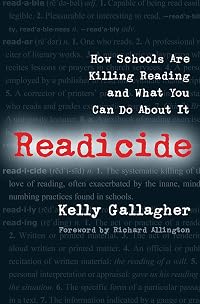
Readicide: How Schools Are Killing Reading and What You Can Do About It
by Kelly Gallagher
On This Page
Description
From the Publisher: Read-i-cide n: The systematic killing of the love of reading, often exacerbated by the inane, mind-numbing practices found in schools. Reading is dying in our schools. Educators are familiar with many of the factors that have contributed to the decline-poverty, second-language issues, and the ever-expanding choices of electronic entertainment. In this provocative new book, Kelly Gallagher suggests, however, that it is time to recognize a new and significant contributor to show more the death of reading: our schools. In Readicide, Kelly argues that American schools are actively (though unwittingly) furthering the decline of reading. Specifically, he contends that the standard instructional practices used in most schools are killing reading by: valuing the development of test-takers over the development of lifelong readers; mandating breadth over depth in instruction; requiring students to read difficult texts without proper instructional support; insisting that students focus solely on academic texts; drowning great books with sticky notes, double-entry journals, and marginalia; ignoring the importance of developing recreational reading; and losing sight of authentic instruction in the shadow of political pressures. Kelly doesn't settle for only identifying the problems. Readicide provides teachers, literacy coaches, and administrators with specific steps to reverse the downward spiral in reading-steps that will help prevent the loss of another generation of readers. show lessTags
Recommendations
Member Reviews
This slim but powerful volume minces no words—Gallagher believes that our obsession with standardized testing is killing our students’ ability to read critically. His argument relies on both research-based empirical evidence and his personal experience as a high school language arts teacher.
While Gallagher’s blunt writing style (some might even call him melodramatic) could alienate some more genteel readers, he pours his passion onto the page, and there’s no denying his sincerity. But this is no mere polemic; Gallagher offers practical suggestions for improving reading instruction in meaningful and authentic ways. For example, he recommends that fully half of all reading that students do should be recreational—unassigned, show more unassessed, and chosen by the student him/herself. He acknowledges the value of fostering in students a sheer love of reading. Indeed, he insists that transforming students into independent readers—who actually ENJOY reading—is the only strategy that will help them succeed (a concept that is exquisite in its simplicity). Forget worksheets, standardized reading programs, isolated skill instruction, and decontextualized teaching. As Gallagher would say—be a teacher, not an assigner.
I’m eager to use this text the next time I teach my course in urban literacy. show less
While Gallagher’s blunt writing style (some might even call him melodramatic) could alienate some more genteel readers, he pours his passion onto the page, and there’s no denying his sincerity. But this is no mere polemic; Gallagher offers practical suggestions for improving reading instruction in meaningful and authentic ways. For example, he recommends that fully half of all reading that students do should be recreational—unassigned, show more unassessed, and chosen by the student him/herself. He acknowledges the value of fostering in students a sheer love of reading. Indeed, he insists that transforming students into independent readers—who actually ENJOY reading—is the only strategy that will help them succeed (a concept that is exquisite in its simplicity). Forget worksheets, standardized reading programs, isolated skill instruction, and decontextualized teaching. As Gallagher would say—be a teacher, not an assigner.
I’m eager to use this text the next time I teach my course in urban literacy. show less
The tl;dr version: Students need to have dedicated time during school (e.g. SSR) to read books of their own choosing in order to build a lifelong habit of reading and a positive identity as readers. Recreational reading is equally important as academic reading. With more difficult academic texts, teachers need to find the "sweet spot" between under- and over-teaching; "chopping" books up into too-small parts doesn't allow for reading "flow" to develop, but some guidance (e.g. framing) is necessary. Poorly designed tests with multiple choice questions elicit only shallow learning and don't encourage deep reading or the development of critical thinking and literary analysis skills.
Notes/quotes
Introduction
Readicide (noun): the systemic show more killing of the love of reading, often exacerbated by the inane, mind-numbing practices found in schools (p. 2)
Chapter 1
We are developing test-takers at the expense of readers. (7)
Multiple-choice test prep drives shallow teaching and learning (8)
Teaching to the test is not the problem. The problem occurs when we spend most of our time teaching to a shallow test. (12)
Skills that would make our students "expert citizens": creativity, common sense, wisdom, ethics, dedication, teamwork, honesty, hard work, knowing how to win and how to lose, a sense of fair play, and lifelong learning. (13)
Chapter 2
3 factors that contribute to readicide: (1) dearth of interesting reading materials in schools, (2) many schools have removed novels and other longer challenging works to provide teachers and students with more test prep time, (3) students are not doing enough reading in school. (29)
Reading consists of two factors: (1) being able to decode words on the page and (2) being able to connect the words you are reading with the prior knowledge you bring to the page. (34)
One of the casualties of this testing era seems to be the death of sustained silent reading (SSR)...eliminating SSR is wrong for three reasons: (1) SSR is actually a valuable investment in test prep, (2) SSR is necessary to allow students an opportunity to build their prior knowledge and background, (3) SSR provides many students with their only opportunity to develop a recreational reading habit. (42-44)
Do your students have access to interesting books? Do they have time to read? [Raise awareness with other faculty and admin of the importance of SSR; be the "discussion director" and bring it up at every meeting.] (51)
Instead of taking the students to the library, it is often much more effective to bring the library to the students [and create a "book flood" in the classroom]. (53)
Chapter 3 (Overteaching)
...we don't have students stop the films they watch every five minutes so they can discuss foreshadowing, developing themes, and the director's tone. Could it be that our students are turning off to great books because teachers are chopping the books up so much that achieving reading flow is impossible? Would you stay in a movie theater if the projectionist stopped the film 22 times? (61)
Setting test scores aside for a moment, isn't it our overall, long-term goal to produce graduates who become lifelong readers? (75)
Numerous studies have found the most powerful motivator that schools can offer to build lifelong readers is to provide students with time in the school day for free and voluntary reading (FVR). (75)
...the real value in reading literature is that it provides our students with imaginative rehearsals for the real world (Kenneth Burke, 1968) (79)
3 ingredients to building a reader: (1) they must have interesting books to read, (2) they must have time to read the books inside of school, (3) they must have a place to read their books. (84)
Chapter 4 (Underteaching)
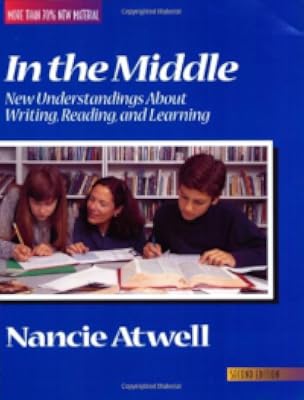
Nancie Atwell, In the Middle: the teacher is the best reader/writer in the classroom and should be a mentor, a mediator, and a model. (90)
My job [as a teacher] is twofold: (1) to introduce my students to books that are a shade too hard for them and (2) use my expertise to help them navigate these texts in a way that brings value to their reading experience. (94)
To prevent readicide: recognize the importance of framing, remember the value found in second- and third-draft reading, adopt a "big chunk/little chunk" philosophy, find the metacognitive sweet spot (strategies good readers use, e.g. skim, slow down and reread, ask questions, use context clues, etc.). Don't lose sight of the 50/50 approach (half recreational reading, half academic)
Appendix A: 101 books my reluctant readers love to read
Appendix B: Book of the month form
Appendix C: One-pagers
References
Resources
http://edresearch.info/
https://nces.ed.gov/nationsreportcard/
Nancie Atwell, The Reading Zone, In the Middle show less
Notes/quotes
Introduction
Readicide (noun): the systemic show more killing of the love of reading, often exacerbated by the inane, mind-numbing practices found in schools (p. 2)
Chapter 1
We are developing test-takers at the expense of readers. (7)
Multiple-choice test prep drives shallow teaching and learning (8)
Teaching to the test is not the problem. The problem occurs when we spend most of our time teaching to a shallow test. (12)
Skills that would make our students "expert citizens": creativity, common sense, wisdom, ethics, dedication, teamwork, honesty, hard work, knowing how to win and how to lose, a sense of fair play, and lifelong learning. (13)
Chapter 2
3 factors that contribute to readicide: (1) dearth of interesting reading materials in schools, (2) many schools have removed novels and other longer challenging works to provide teachers and students with more test prep time, (3) students are not doing enough reading in school. (29)
Reading consists of two factors: (1) being able to decode words on the page and (2) being able to connect the words you are reading with the prior knowledge you bring to the page. (34)
One of the casualties of this testing era seems to be the death of sustained silent reading (SSR)...eliminating SSR is wrong for three reasons: (1) SSR is actually a valuable investment in test prep, (2) SSR is necessary to allow students an opportunity to build their prior knowledge and background, (3) SSR provides many students with their only opportunity to develop a recreational reading habit. (42-44)
Do your students have access to interesting books? Do they have time to read? [Raise awareness with other faculty and admin of the importance of SSR; be the "discussion director" and bring it up at every meeting.] (51)
Instead of taking the students to the library, it is often much more effective to bring the library to the students [and create a "book flood" in the classroom]. (53)
Chapter 3 (Overteaching)
...we don't have students stop the films they watch every five minutes so they can discuss foreshadowing, developing themes, and the director's tone. Could it be that our students are turning off to great books because teachers are chopping the books up so much that achieving reading flow is impossible? Would you stay in a movie theater if the projectionist stopped the film 22 times? (61)
Setting test scores aside for a moment, isn't it our overall, long-term goal to produce graduates who become lifelong readers? (75)
Numerous studies have found the most powerful motivator that schools can offer to build lifelong readers is to provide students with time in the school day for free and voluntary reading (FVR). (75)
...the real value in reading literature is that it provides our students with imaginative rehearsals for the real world (Kenneth Burke, 1968) (79)
3 ingredients to building a reader: (1) they must have interesting books to read, (2) they must have time to read the books inside of school, (3) they must have a place to read their books. (84)
Chapter 4 (Underteaching)
Nancie Atwell, In the Middle: the teacher is the best reader/writer in the classroom and should be a mentor, a mediator, and a model. (90)
My job [as a teacher] is twofold: (1) to introduce my students to books that are a shade too hard for them and (2) use my expertise to help them navigate these texts in a way that brings value to their reading experience. (94)
To prevent readicide: recognize the importance of framing, remember the value found in second- and third-draft reading, adopt a "big chunk/little chunk" philosophy, find the metacognitive sweet spot (strategies good readers use, e.g. skim, slow down and reread, ask questions, use context clues, etc.). Don't lose sight of the 50/50 approach (half recreational reading, half academic)
Appendix A: 101 books my reluctant readers love to read
Appendix B: Book of the month form
Appendix C: One-pagers
References
Resources
http://edresearch.info/
https://nces.ed.gov/nationsreportcard/
Nancie Atwell, The Reading Zone, In the Middle show less
This book has changed the way I think about teaching literature, which has drastically altered my overall philosophy about teaching English. Some of the ideas are radical, especially if you have a traditional view of what high school English should look like. But, like I tell my students at the end of the year: when I was a junior in high school, I didn't read a single book that was assigned. The books weren't interesting and the accompanying work was a joke. That was 20 years ago, AND I'd always been a strong reader. If I hadn't been a strong reader, I probably would have stopped reading for fun that year.
Books written about research in education tend to follow the pattern of describing a major issue that everyone is already talking about, presenting some statistics that make the problem seem worse, and then describing ways that teachers can, in the classroom, deal with said problem. Gallagher does not stray from this pattern in even the slightest way.
I like that he presents clear classroom practices that promise to increase students' frequency and quality of independent reading. I also like that these methods are all things that used to be more common in public schools and that he explains why we have gotten away from them and why we need to go back to them. I've been talking to teachers in my school about the research Gallagher show more presents, and will be trying many of his suggestions in the coming school year.
Unfortunately the world needs more than that.
I do not like that this book is written for an audience of only teachers. If we believe that there are problems in education in America that we can effectively address, we have to also recognize that teachers are no longer the decision makers in education. We failed to hold on to that power decades ago. Gallagher briefly describes some ways of talking administrators into supporting more pro-reading policies on a classroom level, but no place does he adress those administrators directly. We do not need more books written to help teachers manage the shitty reality of our profession. We need books written to empower teachers to improve the state of education outside of the confines of our classrooms and help policy makers (who are not teachers and do not read education research) and politicians understand what they are doing that is hurting the learning of our children in this country. Your governor, your local legislature, and probably even your school board does not understand why the policies that they mandate do nothing to improve anything, and this book will not help them in any way. show less
I like that he presents clear classroom practices that promise to increase students' frequency and quality of independent reading. I also like that these methods are all things that used to be more common in public schools and that he explains why we have gotten away from them and why we need to go back to them. I've been talking to teachers in my school about the research Gallagher show more presents, and will be trying many of his suggestions in the coming school year.
Unfortunately the world needs more than that.
I do not like that this book is written for an audience of only teachers. If we believe that there are problems in education in America that we can effectively address, we have to also recognize that teachers are no longer the decision makers in education. We failed to hold on to that power decades ago. Gallagher briefly describes some ways of talking administrators into supporting more pro-reading policies on a classroom level, but no place does he adress those administrators directly. We do not need more books written to help teachers manage the shitty reality of our profession. We need books written to empower teachers to improve the state of education outside of the confines of our classrooms and help policy makers (who are not teachers and do not read education research) and politicians understand what they are doing that is hurting the learning of our children in this country. Your governor, your local legislature, and probably even your school board does not understand why the policies that they mandate do nothing to improve anything, and this book will not help them in any way. show less
This book is required reading for the children's literature course at my university, so I decided I'd better read it. English teacher Kelly Gallagher packs a lot into 150 pages (including a thorough index and references).
Subtitled "How Schools Are Killing Reading and What You Can Do About It," the book covers exactly that in five chapters.
Gallagher spends the first part of the book talking about how high-stakes, shallow testing has led to "teaching to the test" and reading programs that dull the desire to read for many students. While there's not a lot teachers can do to end these testing programs, Gallagher does offer some good advice on ways to end "the systematic killing of the love of reading, often exacerbated by the inane, show more mind-numbing practices found in schools." (p. 2)
Gallagher has taught high school for 23 years, so most of his strategies are aimed at that age group, although many can be adopted for all ages. Some of his recommendations include:
This was an excellent, thought-provoking book, and I'm glad it's required reading at my university for future teachers.
© Amanda Pape - 2011 show less
Subtitled "How Schools Are Killing Reading and What You Can Do About It," the book covers exactly that in five chapters.
Gallagher spends the first part of the book talking about how high-stakes, shallow testing has led to "teaching to the test" and reading programs that dull the desire to read for many students. While there's not a lot teachers can do to end these testing programs, Gallagher does offer some good advice on ways to end "the systematic killing of the love of reading, often exacerbated by the inane, show more mind-numbing practices found in schools." (p. 2)
Gallagher has taught high school for 23 years, so most of his strategies are aimed at that age group, although many can be adopted for all ages. Some of his recommendations include:
- providing time for recreational reading in the school day;
- "augment books with authentic, real-world text" (p. 46), such as assigning an "article of the week" for students to annotate;
- surround kids with interesting books (I would add to do this in the library as well as in the classroom);
- assign high-interest books and/or self-selected recreational reading for summer reading;
- for self-selected books, have students do "one-pager" reflections (templates for a number of these are in Appendix C);
- avoid over-teaching books with too much chopping up and analysis, or emphasis on the trivial (as the Accelerated Reader program does); but
- avoid under-teaching books by providing too little framing for complex texts (assigning classics for summer reading is a good example of this).
This was an excellent, thought-provoking book, and I'm glad it's required reading at my university for future teachers.
© Amanda Pape - 2011 show less
I bought this book after seeing it referenced on a couple of English teachers blogs and I am glad I did. Gallagher affirms some of the phenomena I am seeing in my own classroom and supports it with current research data. While I haven’t put his recommendations into practice yet, I think that reading this book may change my teaching practices forever.
As a Language Arts/Social Studies teacher, I especially like Gallagher’s suggestion that students should read at least one newspaper article per week to encourage knowledge of current events and to develop prior knowledge. I also like his suggestion to have students sharing copies of a newsmagazine such as Newsweek where each period has a designated day of the week to read either an show more article of the student or teacher’s choice. The development of this type of prior knowledge is important to encouraging global citizenship as well as critical thinking skills.
Another point I agreed with concerning Gallagher’s work, is that teachers often make the mistake of over teaching a book to the point that the reading experience itself is ruined. Some of the books I’ve enjoyed the most in my life were even more pleasurable the second time I read them because they were not beaten to death by a teacher!
On the other hand, I agree with Gallagher when he asserts that teachers often make the mistake of under teaching a book. If students are reading a more challenging work, then they need support so that the meaning is easier to grasp. I think this is true in terms of setting up some prior knowledge such as: historical background, literary devices, biographical information about the author etc. Once students are involved in the book, Gallagher recommends decreasing that support and allowing the student to finish the book on his/her own so that they can enjoy what he dubs reader’s “flow.”
Finally, I really liked Gallagher’s idea of spending roughly 50% of reading time on books of the students’ choice, and 50% of reading time on books that are meant to challenge and develop better reading and critical thinking skills. The former helps to encourage lifelong reading for pleasure and the latter helps to encourage growth as a reader. Whether one is a new teacher fresh out of college, or a seasoned veteran, I think this is an excellent book to read! show less
As a Language Arts/Social Studies teacher, I especially like Gallagher’s suggestion that students should read at least one newspaper article per week to encourage knowledge of current events and to develop prior knowledge. I also like his suggestion to have students sharing copies of a newsmagazine such as Newsweek where each period has a designated day of the week to read either an show more article of the student or teacher’s choice. The development of this type of prior knowledge is important to encouraging global citizenship as well as critical thinking skills.
Another point I agreed with concerning Gallagher’s work, is that teachers often make the mistake of over teaching a book to the point that the reading experience itself is ruined. Some of the books I’ve enjoyed the most in my life were even more pleasurable the second time I read them because they were not beaten to death by a teacher!
On the other hand, I agree with Gallagher when he asserts that teachers often make the mistake of under teaching a book. If students are reading a more challenging work, then they need support so that the meaning is easier to grasp. I think this is true in terms of setting up some prior knowledge such as: historical background, literary devices, biographical information about the author etc. Once students are involved in the book, Gallagher recommends decreasing that support and allowing the student to finish the book on his/her own so that they can enjoy what he dubs reader’s “flow.”
Finally, I really liked Gallagher’s idea of spending roughly 50% of reading time on books of the students’ choice, and 50% of reading time on books that are meant to challenge and develop better reading and critical thinking skills. The former helps to encourage lifelong reading for pleasure and the latter helps to encourage growth as a reader. Whether one is a new teacher fresh out of college, or a seasoned veteran, I think this is an excellent book to read! show less
I have mixed feelings about this book. The problem is I completely agree with what the author has to say (with one exception, that I'll address later). I believe Gallagher is preaching to the choir. The people who read this book are already going to be interested in reading and the growing trend of illiteracy amongst our students. They do not need convincing that students need to read more.Once I got past that though, I felt he had some really useful methods of assisting students in understanding difficult texts. I particularly liked his idea of bringing in current articles that address the theme of a book prior to the students reading the book.I also agreed with his statement that the point is not that all the students like a show more particular book. The point is that they get something from it.And the one exception I mentioned is he believes that the students should not be expected to use the library. He thinks the books should be available primarily in the classroom. As a school librarian, I agree that all classes should have a well stocked library. However, there is no way a classroom can encompass the thousands of books that the library can offer.Perhaps the students won't be bothered to come to the library to check out books on their own . . . so bring them! Give them time in the library to browse and read. That is the point after all.Okay, rant over. show less
Members
- Recently Added By
Lists

Education Resources Available at BPL
70 works; 1 member
Author Information
15+ Works 1,246 Members
Kelly Gallagher, a thirty-year veteran educator, teaches at Magnolia High School in Anaheim, California. He is the former codirector of the South Basin Writing Project at California State University, Long Beach, and the author of Reading Reasons, Deeper Reading, Teaching Adolescent Writers, Readicide, and Write Like This. Follow Kelly on Twitter show more at (5)KellyGToGo, and visit him at www.kellygallagher.org. show less
Common Knowledge
Classifications
Statistics
- Members
- 496
- Popularity
- 60,689
- Reviews
- 22
- Rating
- (4.40)
- Languages
- English
- Media
- Paper, Ebook
- ISBNs
- 4
- UPCs
- 1
- ASINs
- 1