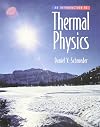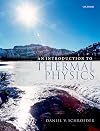
An Introduction to Thermal Physics
by Daniel V. Schroeder
On This Page
Description
Thermal physics deals with collections of large numbers of particles - typically 10 to the 23rd power or so. Examples include the air in a balloon, the water in a lake, the electrons in a chunk of metal, and the photons given off by the sun. We can't possibly follow every detail of the motions of so many particles. So in thermal physics we assume that these motions are random, and we use the laws of probability to predict how the material as a whole ought to behave. Alternatively, we can show more measure the bulk properties of a material, and from these infer something about the particles it is made of. This book will give you a working understanding of thermal physics, assuming that you have already studied introductory physics and calculus. You will learn to apply the general laws of energy and entropy to engines, refrigerators, chemical reactions, phase transformations, and mixtures. show lessTags
Recommendations

























Member Reviews
Its a bit hard to judge as I can't say I am an expert in any of thermal physics, sub- or related disciplines like statistical mechanics, or in teaching... but as a student, I think this book was a very good, concise introduction. We covered it in one 10 week quarter, with a thing here or there dropped (e.g. real-world refrigerators); so about a chapter a week, though weighted toward the later chapters. Which moved quickly, and seemed like a lot of material at times. I'm definitely going to be keeping it.
That feeling aside :), this is not a large book that tries to cover a year or more of material; it really is an introduction, but at far more detail than the 1 or 3 chapters thermodynamics gets in a general/1st year physics textbook.
That feeling aside :), this is not a large book that tries to cover a year or more of material; it really is an introduction, but at far more detail than the 1 or 3 chapters thermodynamics gets in a general/1st year physics textbook.
This was a fine supplement to the lots more cryptic text assignment by a professor. Schroeder writes well, and walked me through derivations in their context, which I found to be necessary at the undergraduate level. I went to another source for worked out problems.
Not bad as far as a thermodynamics text goes. Covers both classical thermo dynamics and statistical mechanics. The math is generally concise and easy to follow (albeit with judicious unrigourous sweeping of terms under the rug... usually fair due to very very large numbers being used in the statistics), and the verbal descriptions are decent. The authors constant use of "I" was a bit strange to me. Though I nearly read this book cover to cover, I am still not thoroughly convinced on the 2nd law. The theoretical and mathematical foundations are a bit sparse.
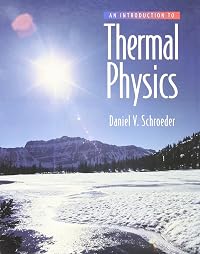
Thermodynamics is a tricky subject and some textbooks have a hard time teaching. This books is explained very clearly while leaving enough up to the reader to figure out for themselves which is the only way to learn physics. Has some useful pseudocode on implementing some thermodynamic models. Pretty cover
Ratings
Members
- Recently Added By
Author Information
3 Works 496 Members
Classifications
Statistics
- Members
- 233
- Popularity
- 139,848
- Reviews
- 4
- Rating
- (3.76)
- Languages
- English
- Media
- Paper, Ebook
- ISBNs
- 11
- ASINs
- 1