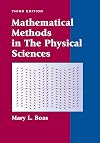
Mathematical Methods in the Physical Sciences
by Mary L. Boas
On This Page
Description
Updates the original, comprehensive introduction to the areas of mathematical physics encountered in advanced courses in the physical sciences. Intuition and computational abilities are stressed. Original material on DE and multiple integrals has been expanded.Tags
Recommendations







Member Reviews
This was the recommended text for maths for my physics first Degree, as, it transpires, it is for many, many physics undergrads.
I didn't use it enough then but when I did I found it difficult. It felt like it didn't explain enough - which looking back means didn't have enough worked examples. It also covers an enormous amount of terrain for a single volume.
Now, I find it more useful - as a reference work. It probably isn't the best book for introducing the more advanced topics - they need whole books each - but for reminding oneself of forgotten but once understood topics? It can do that job.
I didn't use it enough then but when I did I found it difficult. It felt like it didn't explain enough - which looking back means didn't have enough worked examples. It also covers an enormous amount of terrain for a single volume.
Now, I find it more useful - as a reference work. It probably isn't the best book for introducing the more advanced topics - they need whole books each - but for reminding oneself of forgotten but once understood topics? It can do that job.
This is a really solid review/overview of math for sciences, particularly physics (or engineering.) Basically, if you are a sophomore or junior undergraduate, this is all the math you have probably already (supposedly) learned, in a somewhat condensed form. If you have never done e.g. multiple integrals, Fourier series or transforms, or differential equations, this is probably not the book for you. I think it would be really hard to learn all those things, from the ground up, from this book. If, however, you have been through a set of calculus courses up through mutlivariable and differential eqs, then this is a great book precisely because it gives only quick quick coverage to theory and to basic breadth, and instead focuses on show more applying all that math you have been learning to prepare you to move through e.g. junior and senior level physics courses.
I give four stars because there are places where I did feel additional explanation -or additional worked examples- would be helpful. Like many books, it includes harder problems towards the end of each section: a few more worked examples of this relative complexity would make this a five star book. My two cents, anyway. show less
I give four stars because there are places where I did feel additional explanation -or additional worked examples- would be helpful. Like many books, it includes harder problems towards the end of each section: a few more worked examples of this relative complexity would make this a five star book. My two cents, anyway. show less
Still my favorite math text ever. I've stop consulting this book only because I know all the material at this point. Boas has a talent for explaining math simply that I've rarely found anywhere else. If you're an undergrad learning physics or calculus for the first time, use this text instead of whatever they've assigned you.
This text (and the help of as awesome physics professor) enabled my to understand, not just perform, the mathematics of classical physics. I give this book and A+ (the grade it enabled me to achieve in my Mathematical Physics course.
Ratings
Members
- Recently Added By
Lists

The r/AskScience Reading List
159 works; 3 members
Author Information

2 Works 495 Members
Classifications
Statistics
- Members
- 475
- Popularity
- 63,942
- Reviews
- 4
- Rating
- (4.09)
- Languages
- English
- Media
- Paper, Ebook
- ISBNs
- 8
- UPCs
- 1
- ASINs
- 5