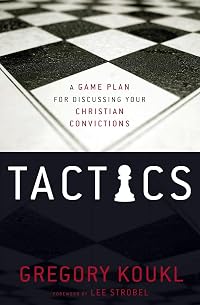
Tactics: A Game Plan for Discussing Your Christian Convictions
by Gregory Koukl
On This Page
Description
This expanded anniversary edition includes updates and expansions of existing tactics, as well as the addition of an all-new tactic and a chapter on Mini Tactics filled with simple maneuvers to aid in discussions. In a world increasingly indifferent to Christian truth, followers of Christ need to be equipped to communicate with those who do not speak their language or accept their source of authority. In Tactics, 10th Anniversary Edition, Gregory Koukl demonstrates how to artfully regain show more control of conversations, keeping them moving forward in constructive ways through thoughtful diplomacy. You'll learn how to stop challengers in their tracks and how to turn the tables on questions or provocative statements. Most important, you'll learn how to get people thinking about Jesus. Tactics provides the game plan for communicating the compelling truth about Christianity with confidence and grace. Drawing on extensive experience defending Christianity in the public square, Koukl shows readers how to: - Initiate conversations effortlessly. - Present the truth clearly, cleverly, and persuasively. - Graciously and effectively expose faulty thinking. - Skillfully manage the details of dialogue. - Maintain an engaging, disarming style even under attack. show lessTags
Recommendations




























Member Reviews
Even though this book is focused on how Christians can discuss their worldview with others, you don't have to be a believer to get a treasure trove of methods to hold discussions with people who hold opposing views to your own.
Greg's premise is to think of yourself as an ambassador for what you believe and not as a marauder trying to club someone over the head with your convictions. He says something in the beginning that I've been trying to keep in mind during my own discussions; if you're in an argument (meaning a difference of an opinion. It doesn't have to devolve into bickering and posturing), trying to persuade someone on your point of view, and you get upset, you lose. If the other person gets upset, you lose. You need to remain show more calm, ask more questions than you make assertions, and have a civil tone that represents how much you want them to understand you.
The book is chalk full of examples on how people use poor logic, make self defeating statements, hold opposing viewpoints, and have never really thought through some of the things they say. He gives ways to point out the flaws in this - in a way that isn't offensive - so you can plant a stone in their shoe and give them something to think about. As Greg says, the goal isn't to hit a home run with every encounter, just getting up to bat is sometimes the objective. Someone else will advance the runners.
Even though this book is focused on Christianity, anyone could take the principles he oulines here and use them when discussing the hot button issues that surround us today. When debating matters of politics and public policy, many people just throw out slogans and lines they've heard from other places without taking the time to think them through. Helping people to see this, in the way of an ambassador, would do a lot to calm the level of frustration and bickering that usually turns out to be the result of one of these discussions show less
Greg's premise is to think of yourself as an ambassador for what you believe and not as a marauder trying to club someone over the head with your convictions. He says something in the beginning that I've been trying to keep in mind during my own discussions; if you're in an argument (meaning a difference of an opinion. It doesn't have to devolve into bickering and posturing), trying to persuade someone on your point of view, and you get upset, you lose. If the other person gets upset, you lose. You need to remain show more calm, ask more questions than you make assertions, and have a civil tone that represents how much you want them to understand you.
The book is chalk full of examples on how people use poor logic, make self defeating statements, hold opposing viewpoints, and have never really thought through some of the things they say. He gives ways to point out the flaws in this - in a way that isn't offensive - so you can plant a stone in their shoe and give them something to think about. As Greg says, the goal isn't to hit a home run with every encounter, just getting up to bat is sometimes the objective. Someone else will advance the runners.
Even though this book is focused on Christianity, anyone could take the principles he oulines here and use them when discussing the hot button issues that surround us today. When debating matters of politics and public policy, many people just throw out slogans and lines they've heard from other places without taking the time to think them through. Helping people to see this, in the way of an ambassador, would do a lot to calm the level of frustration and bickering that usually turns out to be the result of one of these discussions show less
For a long time, I have taken a great interest in apologetics. I have a formal qualification in formal logic and, even if I didn't, it's a passion I cultivate in my spare time. I also take an avid interest in analytical philosophy, broader philosophy and world history between 500 BC to 500 AD.
These things I have tried to cultivate to the end of defending my faith for anyone who asks for an account of what I believe (1 Peter 3:15).
But apologetics doesn't work that way, as I learnt the hard way. When you are trying to love God with your mind (Luke 10:27) it doesn't help to simply know the facts. It definitely doesn't help to just give the facts (although I suppose there may be times when that is all that's required but no-one likes an show more info-dump).
So this book could not have come sooner. The skills presented here are simple and practical methods to navigate spiritual conversations without needlessly upsetting people when opposing views are at play. show less
These things I have tried to cultivate to the end of defending my faith for anyone who asks for an account of what I believe (1 Peter 3:15).
But apologetics doesn't work that way, as I learnt the hard way. When you are trying to love God with your mind (Luke 10:27) it doesn't help to simply know the facts. It definitely doesn't help to just give the facts (although I suppose there may be times when that is all that's required but no-one likes an show more info-dump).
So this book could not have come sooner. The skills presented here are simple and practical methods to navigate spiritual conversations without needlessly upsetting people when opposing views are at play. show less
Using questions to engage in conversation
This is a book about engaging in conversations about faith, especially applied to apologetics. Koukl provides a number of tactical techniques to take control of a conversation (in the sense of guiding it, not dominating it) in order to help reveal the deeper beliefs and assumptions held by others, in hopes that this will open people to the truth of the gospel. In many ways, the techniques taught here could be applied to many types of conversations, and not just apologetic ventures. But applied to apologetics and evangelism, with sensitivity, these conversation tools hold promise of opening, rather than closing ears.
While very helpful, I did find Koukl's approach to be terse at times. But this is show more likely in part due to his offering digested accounts of the conversations he records for illustration purposes. Another minor weakness in the book is Koukl's reference to Darwinian evolution almost as a view without merit, when contrasted to his apparently preferred ID view. Holding this position is fine, but I suspect what he means by Darwinism is primarily a rejection of naturalistic Darwinism as a worldview. It would help for him to nuance this point a bit more, since the topic is raised a number of times.
That said, Koukl does much to help elevate the Christian's confidence to be able to gently but firmly ask questions of others leading to opportunities to speak about Jesus. show less
This is a book about engaging in conversations about faith, especially applied to apologetics. Koukl provides a number of tactical techniques to take control of a conversation (in the sense of guiding it, not dominating it) in order to help reveal the deeper beliefs and assumptions held by others, in hopes that this will open people to the truth of the gospel. In many ways, the techniques taught here could be applied to many types of conversations, and not just apologetic ventures. But applied to apologetics and evangelism, with sensitivity, these conversation tools hold promise of opening, rather than closing ears.
While very helpful, I did find Koukl's approach to be terse at times. But this is show more likely in part due to his offering digested accounts of the conversations he records for illustration purposes. Another minor weakness in the book is Koukl's reference to Darwinian evolution almost as a view without merit, when contrasted to his apparently preferred ID view. Holding this position is fine, but I suspect what he means by Darwinism is primarily a rejection of naturalistic Darwinism as a worldview. It would help for him to nuance this point a bit more, since the topic is raised a number of times.
That said, Koukl does much to help elevate the Christian's confidence to be able to gently but firmly ask questions of others leading to opportunities to speak about Jesus. show less
Tactics is one of the most important books you could choose to read, though I would encourage the 10th anniversary edition of the same if you have to pick. Greg Koukl doesn't present tactics for proving Christianity true, though he certainly argues that effectively.
Rather, he presents methods for holding difficult conversations, regardless of the subject. While these are presented in the context of Christian beliefs, they can be applied to political discussions, family arguments, business meetings. These tactics are useful in all areas of life.
I easily consider this one of the top ten books everyone should read, and the younger the better.
Rather, he presents methods for holding difficult conversations, regardless of the subject. While these are presented in the context of Christian beliefs, they can be applied to political discussions, family arguments, business meetings. These tactics are useful in all areas of life.
I easily consider this one of the top ten books everyone should read, and the younger the better.
But that I've read only two books on evangelism methods so far, I would say this is the best I've ever read. It would be difficult to find a set of tactics sharper or more clever. It was a good idea of me to add this book to my reading list as soon as I heard it, earlier this year.
Excellent book to teach the Christian that when people make statements, assertions, or opinions it's not our responsibility to defend our side. Koukl shows the reader that by asking probing questions the Christian can direct the conversation, and once motives, biases, and definitions are known they can then make a truthful assertion of their own by asking leading questions.
This is a great book and a quick read!
This is a great book and a quick read!
Excellent Read! and Excellently Read! thought provoking strategy to just just consider, but implement. and what a way to magnify God's truths as we engage others and hope for opportunities to share the hope that is in us. may we be better at asking questions to our lived ones and those the Lord puts in our path.
Members
- Recently Added By
Lists

Great Christian Case-Making Resources
29 works; 1 member

STR's Recommended Reading List
34 works; 2 members
Recommendations by Stand To Reason
34 works; 1 member
Author Information

52 Works 3,192 Members
Gregory Koukl holds MA degrees in both apologetics and philosophy. He's spoken on over 70 university campuses and hosted his own radio talk show for 26 years defending "Christianity Worth Thinking About." Greg is founder and president of Stand to Reason (str.org) and serves as adjunct professor of Christian apologetics at Biola University.
Work Relationships
Common Knowledge
- Original publication date
- 2009
Classifications
Statistics
- Members
- 1,816
- Popularity
- 12,003
- Reviews
- 10
- Rating
- (4.46)
- Languages
- English, Spanish
- Media
- Paper, Audiobook, Ebook
- ISBNs
- 16
- UPCs
- 5
- ASINs
- 9