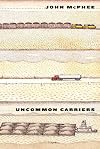
Uncommon Carriers
by John McPhee
On This Page
Description
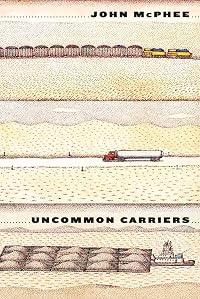
McPhee's books are about real people in real places. Over the past eight years, McPhee has spent considerable time in the company of people who work in freight transportation. This is his sketchbook of them and of his journeys with them. He rides from Atlanta to Tacoma alongside Don Ainsworth, owner and operator of a sixty-five-foot, eighteen-wheel chemical tanker carrying hazmats. He attends ship-handling school on a pond in the foothills of the French Alps, where, for a tuition of $15,000 show more a week, skippers of the largest ocean ships refine their capabilities in twenty-foot scale models. He goes up the Illinois River on a "towboat" pushing a triple string of barges, the overall vessel being "a good deal longer than the Titanic." And he travels by canoe up the canal-and-lock commercial waterways traveled by Henry David Thoreau and his brother, John, in a homemade skiff in 1839.--From publisher description. show lessTags
Recommendations




















Member Reviews
So you see a non-fiction book about transportation, trucks, ships, trains, etc., and think maybe not. But then you see the author is John McPhee, a guy who can make anything interesting, and does so here. McPhee travels with a long-haul trucker in a chemical hauler (twice!), attends a ship handling school on a pond in France, rides a barge towboat on the Illinois River, a coal train; and a couple of other transportation related things. He makes them all interesting.
McPhee writes with a firm grasp of facts and background and a deft touch with words. He spends time immersed in his subjects and it shows. His book about oranges is a classic.
McPhee writes with a firm grasp of facts and background and a deft touch with words. He spends time immersed in his subjects and it shows. His book about oranges is a classic.
It was 4:45 p.m. on a sunny, 70-degree, Friday afternoon, when I emerged from Uncommon Carriers by John McPhee to find a FedEx deliveryman at my door. Did he know I was just reading about his competitor, UPS? Was he here in my driveway to chastise me for being unfaithful?
What are the odds? I was reading how UPS perfected a sorting technology known only to them, right before he rang the doorbell. I quote, “The technology is not new, but nowhere else in the world is it used on this scale, including Memphis.” Could he see the guilt in my eyes as he handed me a package from relatives?
FedEx experienced their biggest day of the year December 18, 2006, a Monday before Christmas, when 9.8 million packages shipped to satisfy our gift giving show more needs. That is an alarming amount of L.L. Bean robes, Pottery Barn initialed towels, and Harry & David fruit baskets.
According to author McPhee, the busiest day to ship lobsters by UPS is Christmas Eve. Apparently, the traditional Christmas dinner in France is not turkey, but fresh lobster. In the chapter titled “Out in the Sort,” there are more crustaceans flying in 757s to Paris than humans.
Uncommon Carriers is the story of our nation’s freight transportation system. Short articles include how 18-wheelers transport hazardous material from coast to coast, how tow boats maneuver barges on the Mississippi River, how fuel tankers handle the open sea, how trains with miles of coal cars ascend a grade, and how lobsters fly.
Each article, first written for The New Yorker, provides fascinating information about men and women who navigate uncommon carriers. McPhee shadows major players like Don Ainsworth, a true “road” scholar, who’s shiny, chemical-tanker truck carries “hazmats.”
Unfortunately, the chapter, “Five Days on the Concord and Merrimack Rivers,” isn’t about movement of freight, but about the passage of time as McPhee and his brother recreate Henry David Thoreau and his brother’s canoe trip in 1839. Even a fanatic Thoreau fan will find this article a little slow.
This book is an enjoyable read filled with unique phraseology, slang and manly banter. Now, if I could just swap my FedEx box from Crate & Barrel with a Clearwater Seafoods' lobster. show less
What are the odds? I was reading how UPS perfected a sorting technology known only to them, right before he rang the doorbell. I quote, “The technology is not new, but nowhere else in the world is it used on this scale, including Memphis.” Could he see the guilt in my eyes as he handed me a package from relatives?
FedEx experienced their biggest day of the year December 18, 2006, a Monday before Christmas, when 9.8 million packages shipped to satisfy our gift giving show more needs. That is an alarming amount of L.L. Bean robes, Pottery Barn initialed towels, and Harry & David fruit baskets.
According to author McPhee, the busiest day to ship lobsters by UPS is Christmas Eve. Apparently, the traditional Christmas dinner in France is not turkey, but fresh lobster. In the chapter titled “Out in the Sort,” there are more crustaceans flying in 757s to Paris than humans.
Uncommon Carriers is the story of our nation’s freight transportation system. Short articles include how 18-wheelers transport hazardous material from coast to coast, how tow boats maneuver barges on the Mississippi River, how fuel tankers handle the open sea, how trains with miles of coal cars ascend a grade, and how lobsters fly.
Each article, first written for The New Yorker, provides fascinating information about men and women who navigate uncommon carriers. McPhee shadows major players like Don Ainsworth, a true “road” scholar, who’s shiny, chemical-tanker truck carries “hazmats.”
Unfortunately, the chapter, “Five Days on the Concord and Merrimack Rivers,” isn’t about movement of freight, but about the passage of time as McPhee and his brother recreate Henry David Thoreau and his brother’s canoe trip in 1839. Even a fanatic Thoreau fan will find this article a little slow.
This book is an enjoyable read filled with unique phraseology, slang and manly banter. Now, if I could just swap my FedEx box from Crate & Barrel with a Clearwater Seafoods' lobster. show less
You have to admire this book. I learned many things reading it: How Thoreau is pronounced, that trucker don't swear more (or less) than you or I (unless you are the reviewer above who was offended by the swearing), that U.P.S. has its own college and repairs Toshiba laptops, that both John McPhee and his wife had to take driving courses because of having gotten too many tickets.
But the most surprising thing I learned is that even I was insufficiently geeky to fully appreciate the level of detail and description in this book; that I was not enough of a train spotter to soak up the kind of knowledge of railroads I was being offered. Had I been that guy, I'd have rated the book more highly.
But the most surprising thing I learned is that even I was insufficiently geeky to fully appreciate the level of detail and description in this book; that I was not enough of a train spotter to soak up the kind of knowledge of railroads I was being offered. Had I been that guy, I'd have rated the book more highly.
McPhee spends time with people whose job it is to move freight around the United States: the owner-driver of an eighteen-wheeler truck, towboat captains on the Illinois River, and coal-train-drivers on the Union Pacific. He also investigates how UPS sends parcels across the whole country from a huge distribution centre in Kentucky (including live lobsters from Nova Scotia).
For a change in pace, there's a description of a canoe trip he took to retrace the 1839 journey of the Thoreau brothers on the Concord and Merrimack Rivers. And a visit to the Port-Revel ship-handling training centre in the French Alps, famous (although McPhee doesn't mention this) as the place where Depardieu's character worked in the late Truffaut film La femme show more d'à côté.
McPhee has been doing this sort of thing for a very long time, and of course he's also trained several generations of younger writers to do it, so it's all very smooth and professional, he has asked the right questions of everyone he meets on his journeys, and he mostly seems to have understood the technical aspect of what they do very well and explains it clearly. But somehow he doesn't seem very involved. He gives us the facts about the way the Powder River Basin is being dug up and shipped east in thousands of trainloads every year to be burnt to power people's TVs and air conditioners, for example, or the way UPS bribes young people to come and work for it with college courses they will probably never finish, and he allows us to suspect that these might not be altogether good things, but he never actually says so. We've got used to a more engaged style of travel-writing, perhaps. show less
For a change in pace, there's a description of a canoe trip he took to retrace the 1839 journey of the Thoreau brothers on the Concord and Merrimack Rivers. And a visit to the Port-Revel ship-handling training centre in the French Alps, famous (although McPhee doesn't mention this) as the place where Depardieu's character worked in the late Truffaut film La femme show more d'à côté.
McPhee has been doing this sort of thing for a very long time, and of course he's also trained several generations of younger writers to do it, so it's all very smooth and professional, he has asked the right questions of everyone he meets on his journeys, and he mostly seems to have understood the technical aspect of what they do very well and explains it clearly. But somehow he doesn't seem very involved. He gives us the facts about the way the Powder River Basin is being dug up and shipped east in thousands of trainloads every year to be burnt to power people's TVs and air conditioners, for example, or the way UPS bribes young people to come and work for it with college courses they will probably never finish, and he allows us to suspect that these might not be altogether good things, but he never actually says so. We've got used to a more engaged style of travel-writing, perhaps. show less
This is expert nonfiction, travel literature from the perspective of the transportation workers constantly moving freight around America's highways, rails, rivers, and skies.
Skip the gratuitous chapter about McPhee's reenactment of Thoreaus's Concord & Merrimack canoe ride, and read all the other chapters twice.
Skip the gratuitous chapter about McPhee's reenactment of Thoreaus's Concord & Merrimack canoe ride, and read all the other chapters twice.
Meh. An assortment of essays, all vaguely (some very vaguely) linked to transportation and cargo. Each one is at least mildly interesting (it is John McPhee, after all), but despite attempts to connect them (the chemical trucker delivered stuff to the coal mine!), overall there's no real theme or direction or...anything to make this a book and not a random collection of essays. One of my favorites is a trip replicating (as well as possible) one taken by a young Thoreau, and written up in his (Thoreau's) first published book. McPhee mentions frequently Thoreau's habit of digressing from the line of events to cover some interesting, but not really related subject - and that's pretty much what this book feels like, a collection of show more digressions. Mildly enjoyable, but I doubt I'll bother to reread. show less
I thoroughly enjoyed this series of essays on various forms of transport in the US and other places. It's a very unlikely subject to be so fascinating but it was both a window into a different world and also into the people who are behind it. Even though it is chock full of numbers and stats, it's the people; truck drivers, air pilots, barge pilots, etc. who end up being the story. A few words here and there bring them to life. There is also a completely enjoyable diversion when he tries to recreate the trip on the Merrimack river of Thoreau and his brother. Just a relly nice read.
Members
- Recently Added By
Lists

Short Nonfiction Collections
51 works; 4 members
Author Information

59+ Works 21,095 Members
McPhee was born in Princeton, New Jersey, and educated at Princeton University and Cambridge University. His writing career began at Time magazine and led to his long association with the New Yorker, where he has been a staff writer since 1965. That same year he published his first book, A Sense of Where You Are, with FSG, and soon followed with show more The Headmaster (1966), Oranges (1967), The Pine Barrens (1968), A Roomful of Hovings and Other Profiles (collection, 1969), The Crofter and the Laird (1969), Levels of the Game (1970), Encounters with the Archdruid (1972), The Deltoid Pumpkin Seed (1973), The Curve of Binding Energy (1974), Pieces of the Frame (collection, 1975), and The Survival of the Bark Canoe (1975). Both Encounters with the Archdruid and The Curve of Binding Energy were nominated for National Book Awards in the category of science Since 1977, the year in which McPhee received the Award in Literature from the American Academy of Arts and Letters and The John McPhee Reader and the bestselling Coming into the Country appeared in print, Farrar, Straus and Giroux has published Giving Good Weight (collection, 1979), Basin and Range (1981), In Suspect Terrain (1983), La Place de la Concorde Suisse (1984), Table of Contents (collection, 1985), Rising from the Plains (1986), Heirs of General Practice (in a paperback edition, 1986), The Control of Nature (1989), Looking for a Ship (1990), Assembling California (1993), The Ransom of Russian Art (1994), The Second John McPhee Reader (1996), and Irons in the Fire (1997). Annals of the Former World was published in 1998 and was awarded the Pulitzer Prize in 1999. McPhee has taught at Princeton as Ferris Professor since 1975. (Bowker Author Biography) show less
Awards and Honors
Common Knowledge
- Original publication date
- 2006
- Dedication
- To Sam Candler, of the Boarskin Shirt, of Cemocheckobee Creek, of the Shad Alley and the Coal Train, all aboard.
- First words
- The little four-wheelers live on risk.
- Last words
- (Click to show. Warning: May contain spoilers.)Walking on through the sultry lot, Ainsworth said, "Misuse of a resource in short supply. Some folks call that fuel."
Classifications
Statistics
- Members
- 821
- Popularity
- 33,595
- Reviews
- 29
- Rating
- (3.82)
- Languages
- English
- Media
- Paper, Audiobook, Ebook
- ISBNs
- 11
- ASINs
- 8