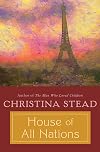
House of All Nations
by Christina Stead
On This Page
Description
The devious world of international finance comes alive in Christina Stead's enthralling epic about a ruthless bank director in 1930s Paris Praised as "a work of extraordinary talent" by the New York Times, Christina Stead's ambitiously layered House of All Nations is an engrossing satire of wealth and manipulation. Set in an elite European bank in the 1930s, Stead's epic spans the interwar years of a money-hungry Paris. Jules Bertillon, the distrustful and unpredictable bank director, sees show more every national disaster--including war--as an opportunity for riches. Adored by his clients for his ability to rake in staggering profits, Bertillon leaves no opening wasted--even if it means dealing with unsavory speculators or ruthless gamblers while his clients suffer the consequences. A stunning page-turner, House of All Nations is as significant and resonant today as it was upon its publication in 1938. show lessTags
Recommendations




















Member Reviews
House of All Nations is a whopper of a novel, and it rightly deserves its place as one that is still relevant today. It didn't sell well, and hardly anybody reads it today. But as a novel which reveals Christina Stead as one of the most wise and thoughtful writers of her time, and an advocate for women's financial independence, it has no rival.
I'm going to share my thoughts about the feminist issues raised by House of All Nations.
And to start as I mean to go on, Alan Kohler who wrote the Introduction to my edition is wrong when he writes in his first paragraph that [Christina Stead] was a Marxist, writing about capitalism and the men in it — there are no women — are financial whores.
As is authentic for the period in which it is show more set, it is, as he says, a masculine world. The bankers are all men, and so are the brokers and most of the investors and clients. There are, however, women with a lot of money: minor royalty and heiresses; and wives, divorcees and their families. And while the men tend to think of them as being universally dim and dependent, there are actually some who are smarter than they think.
In a novel bursting with villains, the biggest villain of them all is Aristide Raccamond... but it's his wife who's the brain behind the villainy. Aristide fancies himself as a genius who can outsmart Jules Bertillon, a hummingbird of rumour, fancy and adventure who owns the bank and operates it in a mercurial fashion. Taking him on is real ambition, and it's his wife who has that.
To read my (much longer) review in full please visit https://anzlitlovers.com/2025/12/28/house-of-all-nations-1938-by-christina-stead... show less
I'm going to share my thoughts about the feminist issues raised by House of All Nations.
And to start as I mean to go on, Alan Kohler who wrote the Introduction to my edition is wrong when he writes in his first paragraph that [Christina Stead] was a Marxist, writing about capitalism and the men in it — there are no women — are financial whores.
As is authentic for the period in which it is show more set, it is, as he says, a masculine world. The bankers are all men, and so are the brokers and most of the investors and clients. There are, however, women with a lot of money: minor royalty and heiresses; and wives, divorcees and their families. And while the men tend to think of them as being universally dim and dependent, there are actually some who are smarter than they think.
In a novel bursting with villains, the biggest villain of them all is Aristide Raccamond... but it's his wife who's the brain behind the villainy. Aristide fancies himself as a genius who can outsmart Jules Bertillon, a hummingbird of rumour, fancy and adventure who owns the bank and operates it in a mercurial fashion. Taking him on is real ambition, and it's his wife who has that.
To read my (much longer) review in full please visit https://anzlitlovers.com/2025/12/28/house-of-all-nations-1938-by-christina-stead... show less
Edit: Reread and enjoyed it. What a mammoth of a book.
Stead is a favourite of mine, this just wasn't my cup of tea. Can't wait to read more of her work though.
Stead is a favourite of mine, this just wasn't my cup of tea. Can't wait to read more of her work though.
Ratings
Members
- Recently Added By
Lists

Shaking a Leg
111 works; 3 members
Author Information

24+ Works 3,512 Members
Author Christina Stead was born in Rockdale, New South Wales, Australia on July 17, 1902. She left Australia in 1928 and spent time in Europe, England, and the United States before permanently returning in 1974. She wrote fifteen novels and numerous volumes of short stories. She is best known for her novel, The Man Who Loved Children, which was show more based on her childhood. Her novels were unpublished in Australia until 1965 and she was denied the Britannica-Australia award in 1967 on the grounds that she was no longer considered an Australian. In 1974, she won the Patrick White award. While living in the United States during the 1940s, she worked as a Hollywood scriptwriter and contributed to Madame Curie and They Were Expendable. She died on March 31, 1983. (Bowker Author Biography) show less
Some Editions
Work Relationships
Has as a study
Has as a commentary on the text
Common Knowledge
- Original publication date
- 1938
- Epigraph
- No one ever made enough money.
Jules Bertillon - First words
- They were in the Hotel Lotti in the Rue de Castiglione, but not in Léon's usual suite.
- Last words
- (Click to show. Warning: May contain spoilers.)For others, though, it is true, he still remained a rankle and a hurt, the charmer who deceived.
Classifications
Statistics
- Members
- 96
- Popularity
- 335,622
- Reviews
- 2
- Rating
- (3.94)
- Languages
- English
- Media
- Paper, Ebook
- ISBNs
- 9
- ASINs
- 4