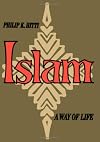
Islam, Way of Life
by Philip K. Hitti
58 Members (4.00)
On This Page
Description
Professor Hitti, the distinguished orientalist, writes vividly and on a basis of lifelong scholarship about Islam, showing that it is not only a religion but also a state and a culture and that in these overlapping and interacting aspects it is a whole way of life.Writing of Islam the religion Professor Hitti describes it as a system of beliefs and practices initially revealed by Allah to Muhammad in the seventh century, enshrined in the Arabic Koran, complemented by tradition, and modified show more through the ages in response to changes in time and place.Islam the state, he shows, is a political entity with an aggregate of institutions based on koranic law, founded by Muhammad in Medina, developed by his successors (caliphs) at the expense of the Persian and East Roman empires to a height unattained in either ancient or medieval times, and then fragmented into splinter states in western Asia, northern Africa, and southwestern and southeastern Europe.Islam the culture, he explains, is a compound of varied elements -- ancient Semitic, Indo-Persian, Hellenic -- synthesizes under the caliphate and expressed primarily through the medium of the Arabic tongue. Unlike the other two, Islam the culture was mainly formulated by conquered peoples rather than by Arabians. From the middle of the eighth century to the end of the twelfth century, it was unsurpassed in its literary, scientific, and philosophic output. In the final chapter, discussing the confrontation of Islamic culture with modernity, the author maintains that the world can view with gratitude Arab contributions to the past and can look with hope to their accomplishments in the future. show lessTags
Recommendations

















Member Reviews
Members
- Recently Added By
Author Information
31+ Works 740 Members
Born in Lebanon, Philip K. Hitti was educated at the American University of Beirut and at Columbia University in New York. He received his Ph.D. in history from Columbia in 1915, two years after he had settled in the United States. In 1925, following a number of years of teaching at Columbia and at American University of Beirut, he accepted an show more appointment at Princeton University, where he remained until his retirement in 1954. He became the first director of Princeton's Near Eastern Studies Program. Hitti translated, wrote, and lectured extensively about the Arab world and Islamic civilization. A leading authority in the United States on Arabic and Islamic studies, he promoted and popularized Arabic studies in American educational institutions for nearly half a century. His most famous work is History of the Arabs, published in 1937, today considered a standard in the field. (Bowker Author Biography) show less
Classifications
Statistics
- Members
- 58
- Popularity
- 532,200
- Rating
- (4.00)
- Languages
- English, Spanish
- Media
- Paper, Ebook
- ISBNs
- 6