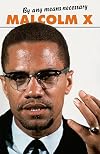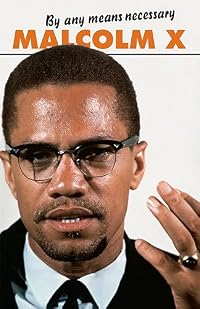
By Any Means Necessary
by Malcolm X, George Breitman (Editor)
On This Page
Description
"Readers will follow the evolution of Malcolm's views on building politial alliances, Black-white intermarriage, women's rights, capitalism and socialism and self-defense against racist terror gangs--all in his own words."--Back cover. "We want freedom by any means necessary. We want justice by any means necessary. We want equality by any means necessary." "The thing that I would like to impress upon every Afro-American leader is that no kind of action in this country is ever going to bear show more fruit unless that action is tied in with the overall international struggle." Through these speeches from the last year of his life, Malcom X takes his place as one of the twentieth century's outstanding revolutionary thinkers and leaders. Malcolm sought, as he put it, to "internationalize" the fight against racism. He condemned Washington's war in Vietnam, solidarized with the African freedom struggle, and championed the revolutionary victories of the Chinese and Cuban people. Readers will follow the evolution of Malcolm's views on building political alliances, Black-white intermarriage, women's rights, capitalism and socialism, and self-defense against racist terror gangs -- all in his own words. - Back cover. show lessTags
Recommendations









Member Reviews
By Any Means Necessary is a collection of speeches and interviews given by Malcolm X in the last year of his life. I thought I owed it to myself to read his own words. What's interesting is how graceful and thoughtful he was with his words, how he wanted to make sure that what he said was understood with clarity. These transcripts are proof that Malcolm was thoughtful and always re-examining his positions on the many issues facing African-Americans in the 1960s. I came away wanting to know more about him and his evolution as a leader. I also came away wondering what he would think of race relations in America, and the world today.
A showcase of Malcolm X's philosophical and political development in the last years of his life. It is a series of speeches. It is clear from reading that during these years he was going through a profound amount of philosophical development and it is a tragedy that he was murdered before we saw everything that he had to give to the world. I will be reading his autobiography next.
How could it be anything other than a five?
Ratings
Members
- Recently Added By
Author Information

39+ Works 13,204 Members
Born in Omaha, Nebraska, and the son of a Baptist minister, Malcolm Little grew up with violence. Whites killed several members of his family, including his father. As a youngster, he went to live with a sister in Boston where he started a career of crime that he continued in New York's Harlem as a drug peddler and pimp. While serving a prison show more term for burglary in 1952, he converted to Islam and undertook an intensive program of study and self-improvement, movingly detailed in "Autobiography of Malcolm X." He wrote constantly to Elijah Muhammad (Elijah Poole, 1897--1975), head of the black separatist Nation of Islam, which already claimed the loyalty of several of his brothers and sisters. Upon release from prison, Little went to Detroit, met with Elijah Muhammad, and dropped the last name Little, adopting X to symbolize the unknown African name his ancestors had been robbed of when they were enslaved. Soon he was actively speaking and organizing as a Muslim minister. In his angry and articulate preaching, he condemned white America for its treatment of blacks, denounced the integration movement as black self-delusion, and advocated black control of black communities. During the turbulent 1960's, he was seen as inflammatory and dangerous. In 1963, a storm broke out when he called President Kennedy's assassination a case of "chickens coming home to roost," meaning that white violence, long directed against blacks, had now turned on itself. The statement was received with fury, and Elijah Muhammad denounced him publicly. Shocked and already disillusioned with the leader because of his reputed involvement with several women, Malcolm X went on a pilgrimage to Mecca and then traveled to several African countries, where he was received as a fellow Muslim. When he returned home, he was bearing a new message: Islam is a religion that welcomes and unites people of all races in the Oneness of Allah. On the night of February 21, 1965, as he was preaching at Harlem's Audubon Ballroom, he was assassinated. (Bowker Author Biography) show less

Common Knowledge
- Canonical title
- By Any Means Necessary
- Original publication date
- 1970
- People/Characters
- Malcolm X
- First words
- Malcolm X did not take the initiative for his departure from the Nation of Islam which he had worked so hard to build; Elijah Muhammad, the leader of the sect, did that by suspending Malcolm indefinitely in December, 1963, os... (show all)tensibly for an unauthorized remark on the assassination of President John Kennedy, but actually because of simmering differences over the role of Black Muslims in the developing freedom struggle.
- Last words
- (Click to show. Warning: May contain spoilers.)Now the time will come when that sheet will be ripped off. If the federal government doesn't take it off, we'll take it off. Thank you.
Classifications
- Genres
- Nonfiction, Anthropology, General Nonfiction, History, Politics and Government
- DDC/MDS
- 305.896073 — Society, Government, and Culture Social sciences, sociology & anthropology Social group - Age, Gender, Ethnicity Ethnic and national groups Other ethnic and national groups Africans and people of African descent; Blacks of African origin standard subdivisions / located in North America African Americans {United States Blacks}
- LCC
- E185.61 .L577 — History of the United States United States Elements in the population Afro-Americans Status and development since emancipation
Statistics
- Members
- 281
- Popularity
- 112,636
- Reviews
- 3
- Rating
- (4.21)
- Languages
- English, Italian
- Media
- Paper
- ISBNs
- 6
- ASINs
- 4