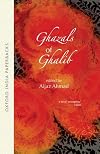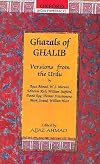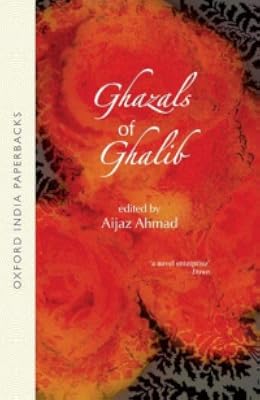
Ghazals of Ghalib: Versions from the Urdu
by Mirza Asadullah Khan Ghalib
On This Page
Description
This imaginative approach to the work of the Urdu poet Ghalib (1797-1869) presents highly original renderings, made by seven well-known American poets, of Ghalib's ghazals. The ghazals (poems consisting of at least five unrelated couplets) show a time when old values were breaking down withno new ones to take their place.Aijaz Ahmad began by selecting thirty-seven of the ghazals for literal translation. These versions were then given to the American poets who made poetic interpretations of show more those ghazals which interested them. The resulting variety of interpretation is remarkable, and indicates the evocativeness ofGhalib's poetry.The complete volume, which offers a fascinating insight into poetic creation as well as the work of this unfamiliar poet, consists of Aijaz Ahmad's introduction to Ghalib poetry, the ghazals in Urdu, the literal versions, with explanatory notes and the poems written by the American poets in responseto the ghazals. show lessTags
Recommendations



















Member Reviews
Members
- Recently Added By
Lists

Philip Ward's Lifetime Reading Plan
592 works; 22 members
Author Information

35+ Works 215 Members
He was born in 1796 in Akbarabad (present Agra). His father Abdullah Beg Khan and Uncle Nasrullah Beg Khan were in the Army. Mirza Ghalib become orphaned when he was just 5 years old. He lived with his uncle for 4 years, then his uncle also died. He started saying sher in Agra itself. He married the daughter of Nawab Ilahi Baksh 'Maaroof' and show more therefore moved to Delhi. In Delhi he devoted his full concentration to poetry. Soon he mastered the Persian language. So that no one should call him be-ustad (without a teacher), he fabricated a story that he had an Iranian teacher Abdul-samad live in house for two years to teach him Farsi. Ghalib was always proud of his Farsi poetry but he is known more by his Urdu prose and poetry. He always lived his life lacking money. After 1857 the support from the Royal durbar stopped. The pension from the British Government was stopped because he was suspected of supporting the rebels. He even traveled to Calcutta to restart the pension but to no avail. He went to the Nawab of Rampur, who promised him Rupees 200 if he lived in Rampur and Rupees 100 if he lived anywhere else. His pension was resumed 3 years after that, but all that money was used up for paying old debts. Ghalib died in 1869. (Bowker Author Biography) show less
All Editions
Awards and Honors
Notable Lists
Common Knowledge
- Canonical title
- Ghazals of Ghalib: Versions from the Urdu
- First words
- Who has appeared, God? Whose amazing signs have
I seen?
The mirror is now a six-layered principle of lingering.
.
When space is scarce, a speck of dust becomes a whole
mist of longing;
with this net, the vas... (show all)t desert itself is the prey. - Quotations
- The mind’s dealer shuffles our circumstances like
cards,
and we change like turning pages in a book. - Last words
- (Click to show. Warning: May contain spoilers.)I’ll own a house without any walls, without neighbors,
with no guard at the door;
no one will care, and when death comes, there’ll be no
mourners there.
.
What right do you have to complain, Ghalib, about
strangers?
Can’t you remember the indifference of your fellow
nationals?
.
Death came to me in a stranger’s house far away from my
country.
That way God took care of my helplessness and poverty. - Disambiguation notice
- Ahmad's Ghazals of Ghalib: Versions from the Urdu is a bi-lingual selection of Ghalib's Urdu ghazals accompanied by commentaries and literal translations. Published by Columbia and Oxford University Press India.
Classifications
- Genres
- Fiction and Literature, Poetry, Literature Studies and Criticism
- DDC/MDS
- 891.439 — Literature & rhetoric Literatures of other languages East Indo-European and Celtic literatures Modern Indic languages Hindi, Urdu Urdu
- LCC
- PK2198 .G4 .A6 — Language and Literature Indo-Iranian languages and literatures Indo-Iranian philology and literature Indo-Aryan languages Modern Indo-Aryan languages Particular languages and dialects Hindi, Urdu, Hindustani languages and Urdu literature
- BISAC
Statistics
- Members
- 53
- Popularity
- 575,475
- Rating
- (4.50)
- Languages
- English
- Media
- Paper
- ISBNs
- 4
- ASINs
- 2