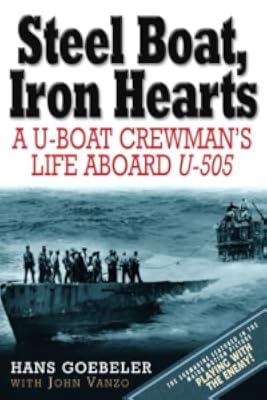
Steel Boat Iron Hearts: A U-boat Crewman's Life Aboard U-505
by Hans Goebeler
On This Page
Description
Using his own experiences, log books, and correspondence with other U-boat crewmen, Hans Goebeler offers rich and personal details about what life was like in the German Navy under Hitler. Since his first and last posting was to U-505, Goebeler's perspective of the crew, commanders, and war patrols paints a vivid and complete portrait unlike any other to come out of the Kriegsmarine. He witnessed it all, from deadly sabotage efforts that almost sunk the boat to the tragic suicide of the only show more U-boat commander who took his life during World War II. The vivid, honest, and smooth-flowing prose calls it like it was and pulls no punches. U-505 was captured by Captain Dan Gallery's Guadalcanal Task Group 22.3 on June 4, 1944. Trapped by this "hunter-killer" group, U-505 was depth-charged to the surface, strafed by machine gun fire, and boarded. It was the first ship captured at sea since the War of 1812. Today, hundreds of thousands of visitors tour U-505 each year at the Chicago Museum of Science and Industry. This edition includes a special foreword by Keith Gill, curator of U-505 at the Museum of Science and Industry. show lessTags
Recommendations



























Member Reviews
U-505, the U-Boot that currently resides in the Museum of Science and Industry in Chicago, has to have been one of the luckiest ships in WW II. It survived multiple botched patrols, was the only German sub whose captain committed suicide while on patrol, and was the most damaged sub to be able to return to base. It was captured in 1944 and secreted away until after the war, when it was donated to the museum. It's a spectacular exhibit but not for the claustrophobic.
It was imperative for the allies that it remain secret the sub had been captured as the Allies did not want even a hint that they might have captured an Enigma machine (they already had, but it was essential the Germans not suspect Enigma had been compromised.) Admiral King show more was furious they had not sunk the sub and almost had the task force commander court-martialed. The crew was hidden in Louisiana and not even allowed Red Cross parcels to protect the secret it had been captured. The Germans finally declared her sunk with all hands and notified the next of kin. The crew did not make it home until 1947. One interesting tidbit is that Ewald Felix, a member of the crew, helped the U.S. prevented the sub from sinking. He was isolated from the rest of the crew for fear he would be killed as a traitor. After the war, he lived in Poland and died in 1990.
The operational history of U-505 serves as a compelling case study in the duality of naval fortune, where the vessel was regarded as both exceptionally "lucky" and hopelessly "jinxed." From a strategic intelligence perspective, the boat’s early service record highlights the critical importance of submarine durability in the attritional environment of the Battle of the Atlantic. While structural resilience allowed the boat to survive catastrophic encounters that would have claimed lesser vessels, this physical longevity inadvertently set the stage for a protracted psychological and mechanical erosion that would eventually compromise its operational security.
One reason for the U-505's survival was that it kept having to return to Lorient for repairs almost immediately after leaving port. Repair workers were mostly French and there was constant sabotage of the boat that would show up (almost catastrophically) in diving tests or engine breakdowns usually within days after leaving for patrol. They seemed to spend more time getting repaired as stalking the allies.
The vessel's reputation for resilience was established on November 11, 1942, during a patrol in the Caribbean. A Lockheed Hudson launched a precision air attack, delivering a 250-lb bomb that struck the foredeck directly. The explosion was severe enough to tear the deck gun from the mount and breach the pressure hull. Despite the initial command to abandon ship, the crew executed a desperate two-week salvage effort to maintain buoyancy.
U-505 eventually limped back to Lorient on December 12, 1942, earning the "mixed honor" of being the most heavily damaged U-boat of the war to successfully return to port.
Following these repairs, U-505’s combat effectiveness was methodically neutralized by the French Resistance. This systematic campaign of industrial sabotage in the Lorient dockyards did more than merely disable the boat; it functioned as a form of psychological warfare against the commander, Peter Zschech. The resulting six consecutive aborted patrols—where the boat failed even to clear the Bay of Biscay—turned U-505 into a fleet-wide laughingstock. Specific mechanical failures included:
Defective Welds: Intentional structural weaknesses that led to failures during high-pressure diving tests.
Engine Sabotage: Strategic tampering by French dock workers that ensured engine breakdowns within days of departure.
Systemic Failure: The inability to sustain a patrol created a feedback loop of humiliation, as peers noted that Zschech was the only captain "guaranteed to return home" while other crews were lost at sea.
In the isolated, high-pressure environment of a submerged U-boat, the commanding officer's psychological state is the single most critical point of failure. The tenure of Peter Zschech demonstrates how a breakdown in leadership doctrine can transform a crew into a strategic liability. While Zschech was a professional veteran of the celebrated U-124, his transition to independent command revealed a temperament ill-suited for the stresses of the late-war Atlantic. He was characterized as a "hard," bad-tempered officer whose perceived indifference to morale exacerbated the frustrations caused by the boat's constant mechanical failures.
The crisis reached its terminal point on October 24, 1943. During a concentrated depth charge attack by Allied destroyers off the Azores, Zschech suffered a catastrophic mental break. In an unprecedented breach of naval discipline, he committed suicide in the control room using a Walther PPK pistol, in full view of the men he was tasked to lead. The impact of this event remains a subject of historical debate.
Geobeler challenges the traditional view of the suicide, which maintains the suicide shattered the crew's discipline, creating a vacuum of leadership and a climate of panic that persisted until the boat's capture. He insists Morale arguably improved because Zschech was loathed; his death removed a toxic presence, and the crew continued to operate professionally.
The capture of a submarine intact on the high seas is one of the most significant achievements in naval intelligence, providing a rare opportunity for technological reverse-engineering. The boarding party’s success was a triumph of improvisation; notably, only one member of the USN team had ever been on a submarine before. The recovery hinged on the "Sea Strainer" incident. Crewman Hans Goebeler had removed the strainer cover to flood the boat, but in the rush to evacuate a vessel rendered unmanageable by a jammed rudder, the cover was left nearby. USN sailor Zenon Lukosius discovered the gushing breach and, alongside Lieutenant (jg) Albert David, successfully replaced the cover despite the risk of booby traps. He was awarded the Medal of Honor.
This strategic success necessitated that the crew of U-505 vanish into a shadow world of clandestine internment to maintain the secret of the Enigma breakthrough.
Another salient feature of the book is how British and American bombing attacks actually hardened the resolve of the crew to fight on and get revenge for the damage being done to their surroundings and at home. The historical and contemporary record of using strategic bombing to force regime change is remarkably consistent: while air-power can decimate infrastructure and military hardware, it almost never results in the collapse of a government or a popular uprising.
Research across a century of warfare—from World War II to the ongoing operations in 2026—suggests that bombing often has the opposite effect, reinforcing a regime's grip on power through "rally-round-the-flag" dynamics. This was true in Germany, Vietnam, Iraq, and 2025 Iran.
Trump take note. show less
It was imperative for the allies that it remain secret the sub had been captured as the Allies did not want even a hint that they might have captured an Enigma machine (they already had, but it was essential the Germans not suspect Enigma had been compromised.) Admiral King show more was furious they had not sunk the sub and almost had the task force commander court-martialed. The crew was hidden in Louisiana and not even allowed Red Cross parcels to protect the secret it had been captured. The Germans finally declared her sunk with all hands and notified the next of kin. The crew did not make it home until 1947. One interesting tidbit is that Ewald Felix, a member of the crew, helped the U.S. prevented the sub from sinking. He was isolated from the rest of the crew for fear he would be killed as a traitor. After the war, he lived in Poland and died in 1990.
The operational history of U-505 serves as a compelling case study in the duality of naval fortune, where the vessel was regarded as both exceptionally "lucky" and hopelessly "jinxed." From a strategic intelligence perspective, the boat’s early service record highlights the critical importance of submarine durability in the attritional environment of the Battle of the Atlantic. While structural resilience allowed the boat to survive catastrophic encounters that would have claimed lesser vessels, this physical longevity inadvertently set the stage for a protracted psychological and mechanical erosion that would eventually compromise its operational security.
One reason for the U-505's survival was that it kept having to return to Lorient for repairs almost immediately after leaving port. Repair workers were mostly French and there was constant sabotage of the boat that would show up (almost catastrophically) in diving tests or engine breakdowns usually within days after leaving for patrol. They seemed to spend more time getting repaired as stalking the allies.
The vessel's reputation for resilience was established on November 11, 1942, during a patrol in the Caribbean. A Lockheed Hudson launched a precision air attack, delivering a 250-lb bomb that struck the foredeck directly. The explosion was severe enough to tear the deck gun from the mount and breach the pressure hull. Despite the initial command to abandon ship, the crew executed a desperate two-week salvage effort to maintain buoyancy.
U-505 eventually limped back to Lorient on December 12, 1942, earning the "mixed honor" of being the most heavily damaged U-boat of the war to successfully return to port.
Following these repairs, U-505’s combat effectiveness was methodically neutralized by the French Resistance. This systematic campaign of industrial sabotage in the Lorient dockyards did more than merely disable the boat; it functioned as a form of psychological warfare against the commander, Peter Zschech. The resulting six consecutive aborted patrols—where the boat failed even to clear the Bay of Biscay—turned U-505 into a fleet-wide laughingstock. Specific mechanical failures included:
Defective Welds: Intentional structural weaknesses that led to failures during high-pressure diving tests.
Engine Sabotage: Strategic tampering by French dock workers that ensured engine breakdowns within days of departure.
Systemic Failure: The inability to sustain a patrol created a feedback loop of humiliation, as peers noted that Zschech was the only captain "guaranteed to return home" while other crews were lost at sea.
In the isolated, high-pressure environment of a submerged U-boat, the commanding officer's psychological state is the single most critical point of failure. The tenure of Peter Zschech demonstrates how a breakdown in leadership doctrine can transform a crew into a strategic liability. While Zschech was a professional veteran of the celebrated U-124, his transition to independent command revealed a temperament ill-suited for the stresses of the late-war Atlantic. He was characterized as a "hard," bad-tempered officer whose perceived indifference to morale exacerbated the frustrations caused by the boat's constant mechanical failures.
The crisis reached its terminal point on October 24, 1943. During a concentrated depth charge attack by Allied destroyers off the Azores, Zschech suffered a catastrophic mental break. In an unprecedented breach of naval discipline, he committed suicide in the control room using a Walther PPK pistol, in full view of the men he was tasked to lead. The impact of this event remains a subject of historical debate.
Geobeler challenges the traditional view of the suicide, which maintains the suicide shattered the crew's discipline, creating a vacuum of leadership and a climate of panic that persisted until the boat's capture. He insists Morale arguably improved because Zschech was loathed; his death removed a toxic presence, and the crew continued to operate professionally.
The capture of a submarine intact on the high seas is one of the most significant achievements in naval intelligence, providing a rare opportunity for technological reverse-engineering. The boarding party’s success was a triumph of improvisation; notably, only one member of the USN team had ever been on a submarine before. The recovery hinged on the "Sea Strainer" incident. Crewman Hans Goebeler had removed the strainer cover to flood the boat, but in the rush to evacuate a vessel rendered unmanageable by a jammed rudder, the cover was left nearby. USN sailor Zenon Lukosius discovered the gushing breach and, alongside Lieutenant (jg) Albert David, successfully replaced the cover despite the risk of booby traps. He was awarded the Medal of Honor.
This strategic success necessitated that the crew of U-505 vanish into a shadow world of clandestine internment to maintain the secret of the Enigma breakthrough.
Another salient feature of the book is how British and American bombing attacks actually hardened the resolve of the crew to fight on and get revenge for the damage being done to their surroundings and at home. The historical and contemporary record of using strategic bombing to force regime change is remarkably consistent: while air-power can decimate infrastructure and military hardware, it almost never results in the collapse of a government or a popular uprising.
Research across a century of warfare—from World War II to the ongoing operations in 2026—suggests that bombing often has the opposite effect, reinforcing a regime's grip on power through "rally-round-the-flag" dynamics. This was true in Germany, Vietnam, Iraq, and 2025 Iran.
Trump take note. show less
Interesting perspectives from an 'average (young) enlisted man' not unlike any who serve (politics and country aside). Even though the story is told from later life, he confirmed his observations with others before putting things down in print. He also helps to give a better sense of how hard life was both on and off the U-boats. It is a worthwhile read IMHO.
Ratings
Members
- Recently Added By
Author Information
1 Work 82 Members
Common Knowledge
Classifications
- Genres
- History, Nonfiction, Biography & Memoir, General Nonfiction
- DDC/MDS
- 940.545943092 — History & geography History of Europe History of Europe 1918- Military history of World War II Naval operations German naval operations
- LCC
- D782 .U18 .G64 — History of Europe, Asia, Africa and Oceania History (General) World War II (1939-1945)
- BISAC
Statistics
- Members
- 82
- Popularity
- 388,937
- Reviews
- 2
- Rating
- (4.13)
- Languages
- English
- Media
- Paper, Audiobook, Ebook
- ISBNs
- 6
- ASINs
- 4