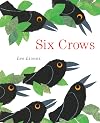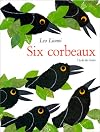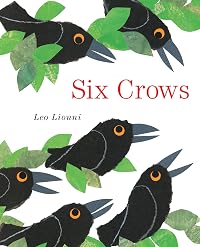
Six Crows
by Leo Lionni
On This Page
Description
An owl helps a farmer and some crows reach a compromise over the rights to the wheat crop.Tags
Recommendations









Member Reviews
Farmers plant wheat. Crows eat wheat. (I mean, the farmer conveniently plants this all-you-can-eat buffet for them!) If the farmers and the crows could talk, surely they could come to an amicable arrangement... right?
Maybe, maybe not. Maybe, instead of talking like sensible creatures, the farmer will outdo himself making progressively scarier scarecrows, and the crows will outdo EVERYBODY making progressively scarier scarefarmers, and in the meantime the wheat will wither in the field and nobody will get to eat some. At least, not until they talk it over for a change.
Very good and clear moral message for kids, and it juuuuuust avoids being too "preachy" and annoying.
Maybe, maybe not. Maybe, instead of talking like sensible creatures, the farmer will outdo himself making progressively scarier scarecrows, and the crows will outdo EVERYBODY making progressively scarier scarefarmers, and in the meantime the wheat will wither in the field and nobody will get to eat some. At least, not until they talk it over for a change.
Very good and clear moral message for kids, and it juuuuuust avoids being too "preachy" and annoying.
Uh. Nice idea, but it very much seems preachy-magic fix rather than anything else.
Still decent, but everything I've read from this author seems very much as though it's talking down to, rather than talking with.
Still decent, but everything I've read from this author seems very much as though it's talking down to, rather than talking with.
The Six Crows is a wonderful story that tells of an ancient farmer and his wheat field. All is good for the farmer until six crows descend on the field to gobble up the wheat. The frustrated farmer builds a scarecrow that causes the crows to build a kite that looks like a giant bird to scare away the scarecrow. This causes the farmer to build a bigger meaner looking scarecrow which leads to the crows building a larger kite. Fortunately there is an owl watching and he tells the farmer to talk to the crows because the wheat crop is failing due to neglect. Then the owl talks to the crows and they say it is too late but the owl says it is never too late to talk. The disaster is averted when the two sides talk and the wheat field is saved.
Never have a been disappointed by the illustrations of text of a Leo Lionni book, The Six Crows included.
Besides the creative illustrations, the text also does wonders for the book. The peaceful words of the owl: "It's never too late to talk things over" and "words can do magic" send out a very clear message about the silliness of fighting without and attempt at amends through communication.
Besides the creative illustrations, the text also does wonders for the book. The peaceful words of the owl: "It's never too late to talk things over" and "words can do magic" send out a very clear message about the silliness of fighting without and attempt at amends through communication.
In this book, Leo Lionni shows us the magic of compromise. While he is using his time trying to scare the crows away, the crows are also using their time to scare the farmer away which leads to no care for the crops. Once the crops begin to die, the crows and the farmer realize that they must compromise together in order to save the crops. This is a great story that incorporates the importance of teamwork and compromise.
A farmer of a wheat field and six crows are having a heavy dispute. Each side continues to up the other, in turn causing the conflict to worsen. A nearby owl notices the issue, and steps in to help solve their problem. The owl acts as a negotiator and convinces each party to talk peacefully to one another. In the end, they solve their problem and everyone is happy. Learning to handle disputes logically is definitely an important concept for today's youth. The story should enlighten readers to settle conflicts in a civil manner, rather than aggressive methods.
Six Crows is a cute story about a farmer, scarecrow, crows and an owl. Creativity reaches a new high in this picture book. The crows and farmer continue to compete for the scariest scarecrow or fake bird. Finally the owl talks some sense into both parties and forces them to talk to work things out. An agreement is made between the two and the fighting stops. This book would be great to teach that it is better to talk out our problems rather than show our frustration through unnecessary actions.
Members
- Recently Added By
Author Information

130+ Works 58,579 Members
Leo Lionni was born in Amsterdam on May 5, 1910. He attended the University of Zurich and also earned a doctorate in Economics from the University of Genoa in 1935. He taught himself to draw by visiting museums. After marrying Nora Maffi in 1931, Lionni moved to Milan, Italy, where he became known as a painter. In 1939 he moved to Philadelphia and show more began working in advertising design. Lionni held several positions in the artistic field including artistic director and design director. He also served as president of the American Institute of Graphic Arts. Around 1960 Lionni moved back to Italy. His first of over forty children's books was Little Blue and Little Yellow. Other titles include Inch by Inch, Frederick, Swimmy, and Alexander and the Wind-up Mouse, all of which won a Caldecott Honor. In addition, he received the American Institute of Graphic Arts Gold Medal in 1984. Lionni died on October 11, 1999 at his home in Tuscany, Italy at the age of 89. (Bowker Author Biography) show less
Work Relationships
Is contained in
Common Knowledge
- Canonical title*
- Six corbeaux
*Some information comes from Common Knowledge in other languages. Click "Edit" for more information.
Classifications
- Genres
- Children's Books, Picture Books
- DDC/MDS
- 306.2 — Society, government, & culture Social sciences, sociology & anthropology Social Behavior - Dating, Marriage, Divorce Political institutions
- LCC
- PZ7 .L6634 .S — Language and Literature Fiction and juvenile belles lettres Fiction and juvenile belles lettres Juvenile belles lettres
- BISAC
Statistics
- Members
- 916
- Popularity
- 29,203
- Reviews
- 19
- Rating
- (3.53)
- Languages
- 7 — English, French, German, Greek, Italian, Japanese, Norwegian
- Media
- Paper, Audiobook
- ISBNs
- 19
- ASINs
- 1