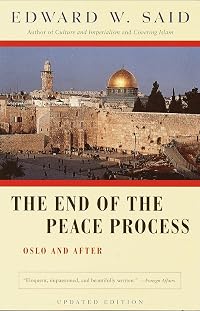
The End of the Peace Process: Oslo and After
by Edward W. Said
279 Members (4.44)
On This Page
Description
In this important collection of fifty pieces, Edward Said questions the very foundations of the Oslo accords. Signed in September 1993 on the White House lawn by Israel and the PLO, the accords were immediately hailed as a success and a breakthrough for peace in the Middle East, but Said realized that the imbalance of power between the signees would set up a problematic dynamic, bringing only an illusionary stability. The later interim agreements of Taba, Hebron, and the Wye Plantation would show more already limit the next phase -- the final-status negotiations set to conclude this year, when the future condition of refugees, Jerusalem, borders, water and compensations must be decided. Incisively cutting through the hyperbole in the press surrounding the accords, these pieces document the historic content but also give otherwise unreported accounts of what has really gone on in the occupied territory since the signing. The continuing expansion of Israeli settlements, the repressive leadership and inflated bureaucracy of Yasir Arafat, Said's own return to Jerusalem after forty-five years, the subsequent banning of his books by the Palestinian Authority, and Oslo's inability to recognize Palestine's self-determination are among the issues of peace and justice he discusses. Together these essays are an eloquent and courageous statement for peaceful coexistence and equality between two peoples, and for an end to the separation of Jews and non-Jews -- the only hope for a lasting solution in the Middle East. show lessTags
Recommendations





Member Reviews
Members
- Recently Added By
Author Information

111+ Works 16,888 Members
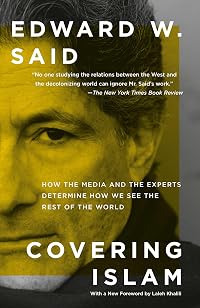
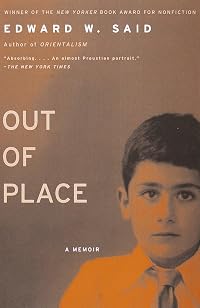
Born in Jerusalem and educated at Victoria College in Cairo and at Princeton and Harvard universities, Edward Said has taught at Columbia University since 1963 and has been a visiting professor at Harvard and Johns Hopkins University. He has had an unusual dual career as a professor of comparative literature, a recognized expert on the novelist show more and short story writer Joseph Conrad, (see Vol. 1) and as one of the most significant contemporary writers on the Middle East, especially the Palestinian question and the plight of Palestinians living in the occupied territories. Although he is not a trained historian, his Orientalism (1978) is one of the most stimulating critical evaluations of traditional Western writing on Middle Eastern history, societies, and literature. In the controversial Covering Islam (1981), he examined how the Western media have biased Western perspectives on the Middle East. A Palestinian by birth, Said has sought to show how Palestinian history differs from the rest of Arabic history because of the encounter with Jewish settlers and to present to Western readers a more broadly representative Palestinian position than they usually obtain from Western sources. Said is presently Old Dominion Foundation Professor in the Humanities at Columbia, editor of Arab Studies Quarterly, and chair of the board of trustees of the Institute of Arab Studies. He is a member of the Palestinian National Council as well as the Council on Foreign Relations in New York. (Bowker Author Biography) Edward W. Said is University Professor of English & Comparative Literature at Columbia University. He is the author of nineteen books, including "Orientalism" (which was nominated for a National Book Critics Circle Award), "Culture & Imperialism", "The End of the Peace Process", & "Out of Place", a memoir. He lives in New York City. (Bowker Author Biography) show less
Common Knowledge
- Important places
- Oslo, Norway; Palestine; Israel
- Important events
- Oslo Accords
Classifications
Statistics
- Members
- 279
- Popularity
- 116,550
- Rating
- (4.44)
- Languages
- English, German, Italian, Spanish
- Media
- Paper, Ebook
- ISBNs
- 13
- ASINs
- 2