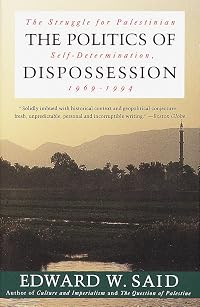
The Politics of Dispossession: The Struggle for Palestinian Self-Determination, 1969-1994
by Edward W. Said
On This Page
Description
Ever since the appearance of his groundbreaking The Question of Palestine, Edward Said has been America's most outspoken advocate for Palestinian self-determination. As these collected essays amply prove, he is also our most intelligent and bracingly heretical writer on affairs involving not only Palestinians but also the Arab and Muslim worlds and their tortuous relations with the West. In The Politics of Dispossession Said traces his people's struggle for statehood through twenty-five show more years of exile, from the PLO's bloody 1970 exile from Jordan through the debacle of the Gulf War and the ambiguous 1994 peace accord with Israel. As frank as he is about his personal involvement in that struggle, Said is equally unsparing in his demolition of Arab icons and American shibboleths. Stylish, impassioned, and informed by a magisterial knowledge of history and literature, The Politics of Dispossession is a masterly synthesis of scholarship and polemic that has the power to redefine the debate over the Middle East. show lessTags
Recommendations


Member Reviews
I've been interested in the history of Palestine for a long time, and this year I started to really become obsessed. It started when I stumbled upon a book in Philadelphia, and has been quite the journey. But lately I realized that all the words I have read have been written by Jews. It was time for a Palestinian voice, and just about every other author I read mentioned Edward Said.
I like a lot about The Politics of Dispossession but what I liked the most was that Said focused not only on Palestine, but on the whole region and the people who inhabit it. I hadn't thought about it until I read this book, but of course that makes sense; Palestinians have been scattered all over the world (but especially the area immediately surrounding show more historic Palestine), and have been for a while, so in order to learn about them we need to learn about the different countries they now reside in.
In addition to history and facts about many areas—Iraq, Jordan, Lebanon, Egypt—he also wrote about current events. Since these essays are from 1969-94, wrote a bit about the (first) Iraq war. I was only a child at the time, but I remember the buildup, all the ribbons tied around trees, and hearing about how evil Saddam was. I remember “us” kicking ass and destroying the opposition. I also remember hearing that US troops shot at the backs of the retreating Iraqi army, but I didn't really have the intelligence to fully grasp what that meant. Obviously I've since learned that the war had nothing to do with freeing anyone, that the US military is full of cowards who are too dumb to think for themselves, and that things aren't always what they seem. I wish I would have read (and been able to comprehend) Said's essays back then.
Said writes about Iraq being a cultural hub for all of the Arab world; how they had some fantastic universities and how women were freer than they were in a lot of other countries in the region. Comparing that to the Iraq of 2025, after another, longer war and way too many sanctions, makes me physically sick.
Martin Buber harped a lot about how the Jews moving to Palestine, first and foremost, need to learn the culture of those around them. Learn what makes their neighbors tick, how to speak the language, and the history and norms of the area. Said agrees, and takes it a step further: He points out how, in addition the US not having any solid Arab studies programs and the lack of books translated to English from Arabic, most Arabs hardly know anything about western culture. It seems so obvious, but knowing your neighbors makes for a lot less tumultuous life.
That said, I did get frustrated with Said's writing at times. It felt like (and I have at least a dozen examples circled in the book) that Said confuses Jews, zionists, and Israelis, and uses all the interchangeably. Not all Jews are zionist, not all zionists are Jews, not all Jews are Israeli, etc It freaks me out when people don't know that, especially when one of the people is an intellectual who wrote a lot about Palestine and Israel. There's also a weirdness around Said not saying anything about how the vast, vast, vast majority of zionists are Christian (perhaps because he is a Christian). He talks about how all the politicans in the US “scramble for Jewish votes,” which to me seems crazy. Less than two and a half percent of the US population is Jewish (that's around 7.5 million people); some of them can't or don't vote and some aren't zionist. It seems like what he meant to say is that politicians scramble to get the zionist—largely Christian—vote. Said also claims that zionism benefits Jews; I would argue that zionism benefits zionists, the majority of whom are not Jewish. Finally, his repeated use of the term “Judeo-Christian” shows us what he really thinks.
Despite the most recent essay in this book being thirty-one years old, almost everything he talks about is relevant today. Starting in the 1970s, politicians referred to any Palestinian who even criticized Israel as terrorists; this is still going on, and has only gotten worse. Golda Meir, one of the first prime ministers of Israel, said that Palestinians don't exist; this is something we still hear from just about every zionist. Said was freaked out that (I don't remember the exact number) the US giving Israel over $50 billion in a few year span; now Israel gets ten times that every year. It feels like more people are talking about this stuff now, but reading about how much nothing has changed for the better sure makes me feel hopeless.
If you're interested in learning more about Palestine, but have only read books from non-Palestinians, Edward Said will fill that gap. This book is very educational, and not only has he written tons more, but this book is also filled with other recommended reading. It has flaws, sure, but it's a necessary read for anyone who cares that children are being starved to death simply because they happened to be born Palestinian. show less
I like a lot about The Politics of Dispossession but what I liked the most was that Said focused not only on Palestine, but on the whole region and the people who inhabit it. I hadn't thought about it until I read this book, but of course that makes sense; Palestinians have been scattered all over the world (but especially the area immediately surrounding show more historic Palestine), and have been for a while, so in order to learn about them we need to learn about the different countries they now reside in.
In addition to history and facts about many areas—Iraq, Jordan, Lebanon, Egypt—he also wrote about current events. Since these essays are from 1969-94, wrote a bit about the (first) Iraq war. I was only a child at the time, but I remember the buildup, all the ribbons tied around trees, and hearing about how evil Saddam was. I remember “us” kicking ass and destroying the opposition. I also remember hearing that US troops shot at the backs of the retreating Iraqi army, but I didn't really have the intelligence to fully grasp what that meant. Obviously I've since learned that the war had nothing to do with freeing anyone, that the US military is full of cowards who are too dumb to think for themselves, and that things aren't always what they seem. I wish I would have read (and been able to comprehend) Said's essays back then.
Said writes about Iraq being a cultural hub for all of the Arab world; how they had some fantastic universities and how women were freer than they were in a lot of other countries in the region. Comparing that to the Iraq of 2025, after another, longer war and way too many sanctions, makes me physically sick.
Martin Buber harped a lot about how the Jews moving to Palestine, first and foremost, need to learn the culture of those around them. Learn what makes their neighbors tick, how to speak the language, and the history and norms of the area. Said agrees, and takes it a step further: He points out how, in addition the US not having any solid Arab studies programs and the lack of books translated to English from Arabic, most Arabs hardly know anything about western culture. It seems so obvious, but knowing your neighbors makes for a lot less tumultuous life.
That said, I did get frustrated with Said's writing at times. It felt like (and I have at least a dozen examples circled in the book) that Said confuses Jews, zionists, and Israelis, and uses all the interchangeably. Not all Jews are zionist, not all zionists are Jews, not all Jews are Israeli, etc It freaks me out when people don't know that, especially when one of the people is an intellectual who wrote a lot about Palestine and Israel. There's also a weirdness around Said not saying anything about how the vast, vast, vast majority of zionists are Christian (perhaps because he is a Christian). He talks about how all the politicans in the US “scramble for Jewish votes,” which to me seems crazy. Less than two and a half percent of the US population is Jewish (that's around 7.5 million people); some of them can't or don't vote and some aren't zionist. It seems like what he meant to say is that politicians scramble to get the zionist—largely Christian—vote. Said also claims that zionism benefits Jews; I would argue that zionism benefits zionists, the majority of whom are not Jewish. Finally, his repeated use of the term “Judeo-Christian” shows us what he really thinks.
Despite the most recent essay in this book being thirty-one years old, almost everything he talks about is relevant today. Starting in the 1970s, politicians referred to any Palestinian who even criticized Israel as terrorists; this is still going on, and has only gotten worse. Golda Meir, one of the first prime ministers of Israel, said that Palestinians don't exist; this is something we still hear from just about every zionist. Said was freaked out that (I don't remember the exact number) the US giving Israel over $50 billion in a few year span; now Israel gets ten times that every year. It feels like more people are talking about this stuff now, but reading about how much nothing has changed for the better sure makes me feel hopeless.
If you're interested in learning more about Palestine, but have only read books from non-Palestinians, Edward Said will fill that gap. This book is very educational, and not only has he written tons more, but this book is also filled with other recommended reading. It has flaws, sure, but it's a necessary read for anyone who cares that children are being starved to death simply because they happened to be born Palestinian. show less
In this forceful, challenging collection of 37 political essays from the past 25 years, Said, University Professor at Columbia, emphasises that the Palestinians are a people with their own history, society and right to self-determination. He is highly critical of Yasir Arafat's dominance of the PLO, which he calls undemocratic, corrupt and incompetent. He also forthrightly condemns the political right wing that dominates virtually every Arab government, enforcing repression, censorship and "intellectual thought control." A recurrent theme is the West's longstanding prejudice against the Arabs and Islam, manifested in media coverage of the Persian Gulf War, nonrecognition of Arab literature and racist stereotypes of Arabs. Highlights of show more this collection include a critique of U.S. policy in the Middle East, an analysis of the Israeli invasion of Lebanon and a discussion of Palestinian identity with writer Salman Rushdie. Tracing his own direct involvement in the Palestinian national movement, Said deems the recent Israeli-PLO accord a sellout by Arafat, an instrument of Palestinian surrender that suspends most of the Palestinian people's rights and consigns diaspora Palestinians (those living in Jordan, Lebanon and Syria) to permanent exile or refugee status.
In this volume Columbia professor Said, for some an enfant terrible while for others the most articulate English-language spokesperson for organized Palestinian efforts to achieve political recognition, has collected 37 of his previously published political essays. There will be no disappointments here for readers familiar with the author's work (e.g., Culture and Imperialism, LJ 3/1/93) or for those reading him for the first time. Said deals with the hotly debated concept of a geopolitical Palestine and its people; the Arab world in general, with which he is not always entirely pleased; and the intriguing relationship of the intellectual to politics and the impact of that relationship on events surrounding the "Palestine Question." Recommended for its style and potency as well as for its alternative viewpoint to the mainstream perspective, Said's book should be acquired by academic and larger public libraries.
--Sanford R. Silverburg show less
In this volume Columbia professor Said, for some an enfant terrible while for others the most articulate English-language spokesperson for organized Palestinian efforts to achieve political recognition, has collected 37 of his previously published political essays. There will be no disappointments here for readers familiar with the author's work (e.g., Culture and Imperialism, LJ 3/1/93) or for those reading him for the first time. Said deals with the hotly debated concept of a geopolitical Palestine and its people; the Arab world in general, with which he is not always entirely pleased; and the intriguing relationship of the intellectual to politics and the impact of that relationship on events surrounding the "Palestine Question." Recommended for its style and potency as well as for its alternative viewpoint to the mainstream perspective, Said's book should be acquired by academic and larger public libraries.
--Sanford R. Silverburg show less
Ratings
Members
- Recently Added By
Lists

Decolonize Palestine's Reading List
126 works; 3 members
Author Information

105+ Works 16,815 Members
Born in Jerusalem and educated at Victoria College in Cairo and at Princeton and Harvard universities, Edward Said has taught at Columbia University since 1963 and has been a visiting professor at Harvard and Johns Hopkins University. He has had an unusual dual career as a professor of comparative literature, a recognized expert on the novelist show more and short story writer Joseph Conrad, (see Vol. 1) and as one of the most significant contemporary writers on the Middle East, especially the Palestinian question and the plight of Palestinians living in the occupied territories. Although he is not a trained historian, his Orientalism (1978) is one of the most stimulating critical evaluations of traditional Western writing on Middle Eastern history, societies, and literature. In the controversial Covering Islam (1981), he examined how the Western media have biased Western perspectives on the Middle East. A Palestinian by birth, Said has sought to show how Palestinian history differs from the rest of Arabic history because of the encounter with Jewish settlers and to present to Western readers a more broadly representative Palestinian position than they usually obtain from Western sources. Said is presently Old Dominion Foundation Professor in the Humanities at Columbia, editor of Arab Studies Quarterly, and chair of the board of trustees of the Institute of Arab Studies. He is a member of the Palestinian National Council as well as the Council on Foreign Relations in New York. (Bowker Author Biography) Edward W. Said is University Professor of English & Comparative Literature at Columbia University. He is the author of nineteen books, including "Orientalism" (which was nominated for a National Book Critics Circle Award), "Culture & Imperialism", "The End of the Peace Process", & "Out of Place", a memoir. He lives in New York City. (Bowker Author Biography) show less
Classifications
- Genres
- Nonfiction, History, General Nonfiction, Politics and Government
- DDC/MDS
- 956.9404 — History & geography History of Asia Middle East Asia: Turkey, Iraq, Syria, Lebanon, Israel, Jordan The Levant Israel and Palestine 1948–
- LCC
- DS119.7 — History of Europe, Asia, Africa and Oceania Asia History of Asia Israel (Palestine). The Jews
- BISAC
Statistics
- Members
- 245
- Popularity
- 132,961
- Reviews
- 2
- Rating
- (3.50)
- Languages
- English
- Media
- Paper, Ebook
- ISBNs
- 6
- ASINs
- 1