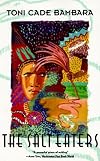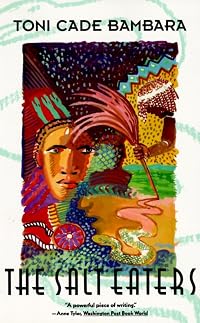
The Salt Eaters
by Toni Cade Bambara
On This Page
Description
Though they all united in their search for the healing properties of salt, some of them are centered, some are off-balance, some are frightened, and some are daring. From the men who live off welfare women to the mud mothers who carry their children in their hides, the novel brilliantly explores the narcissistic aspect of despair and the tremendous responsibility that comes with physical, spiritual, and mental well-being.Tags
Recommendations







Member Reviews
God this was good. I had a hard time following it because I read it under less-than-ideal circumstances, but I totally acknowledge that was my fault and not the book's. I'm going to be revisting this one in the future definitely. So much of this was so good--grappling with the hard questions about healing and moving on and community work. The opening line alone is like a punch in the chest, and it just keeps going from there.
I'd love to revisit this in like a group environment, but definitely will be going back at some point just to sift through more of it and see what sticks with me.
I'd love to revisit this in like a group environment, but definitely will be going back at some point just to sift through more of it and see what sticks with me.
Rating: 3.75* of five
Wonderful prose, not so much on the storytelling.
I haven't changed my mind on that one, either.
The Book Report: Velma is a healer's worst nightmare: a failed suicide depressed by life and Life. Minnie and Old Wife, who is Minnie's spirit guide, work to heal Velma's wounds both inner and outer, in the course of this novel.
And that, mes amis, is it.
My Review: Which is kinda the problem. It makes this gorgeous incantation of a tale into a pretty tough swallow. Interiority can be overdone. Bambara's enraged response to the world of 1980 (when this wa first published) was perfectly justified, as she saw coming the horrors we presently live through in the never subtle, never hidden class warfare counterattack begun after show more Nixon's crash and burn. Velma is a computer programmer, a telling detail that Bambara clearly wants to remain a detail, who can't cope with the workload...prescient much?...and whose entire world centers around *yawn* an unworthy man *cue 21st-century Serious Lady Lit music* so she loses her inner Old Wife just like Minnie did.
Minnie is a daughter of privilege, a former Bible college attendee, and now a root woman who talks to haints. I love Minnie and Old Wife with a passion! They are the kind of ladies I want to live next door to, so I can go over with a plate of blondies and a bottle of bourbon and talk about Life to them.
But loving them, and loving the loooooooooooooong internal monologues that Minnie and Old Wife share as they work to heal dull little Velma, does not make this book a novel. In French, it would be called a récit: a simple internal narrative, usually in past tense, with one PoV. It's an excellent récit, and a ~meh~ novel.
Recommended for language lovers, Southerners, and white people wondering what the fuss about African American literature is. show less
Wonderful prose, not so much on the storytelling.
I haven't changed my mind on that one, either.
The Book Report: Velma is a healer's worst nightmare: a failed suicide depressed by life and Life. Minnie and Old Wife, who is Minnie's spirit guide, work to heal Velma's wounds both inner and outer, in the course of this novel.
And that, mes amis, is it.
My Review: Which is kinda the problem. It makes this gorgeous incantation of a tale into a pretty tough swallow. Interiority can be overdone. Bambara's enraged response to the world of 1980 (when this wa first published) was perfectly justified, as she saw coming the horrors we presently live through in the never subtle, never hidden class warfare counterattack begun after show more Nixon's crash and burn. Velma is a computer programmer, a telling detail that Bambara clearly wants to remain a detail, who can't cope with the workload...prescient much?...and whose entire world centers around *yawn* an unworthy man *cue 21st-century Serious Lady Lit music* so she loses her inner Old Wife just like Minnie did.
Minnie is a daughter of privilege, a former Bible college attendee, and now a root woman who talks to haints. I love Minnie and Old Wife with a passion! They are the kind of ladies I want to live next door to, so I can go over with a plate of blondies and a bottle of bourbon and talk about Life to them.
But loving them, and loving the loooooooooooooong internal monologues that Minnie and Old Wife share as they work to heal dull little Velma, does not make this book a novel. In French, it would be called a récit: a simple internal narrative, usually in past tense, with one PoV. It's an excellent récit, and a ~meh~ novel.
Recommended for language lovers, Southerners, and white people wondering what the fuss about African American literature is. show less
I always felt at a distance from this book. Bambara’s style is dense, a tangle of overlapping perspectives and voices, which makes it difficult to follow what’s happening. This is not unexpected, and to be fair, there’s an atmosphere that is sustainable without that narrative support. Still, I found it difficult to care. I would say that tone—layered, heavy, often incantatory—became the dominant experience rather than the story itself.
The more I think about the book and its themes—fractured community, ancestral power, political exhaustion, despair, healing—the less I think I actually got from it. I suspect it might be more powerful to sit and read through in one or two sittings, rather than my preferred method of show more stretching the reading out over some time. But since that really is my preference, this probably isn’t a book I’d ever enjoy much. I hesitate to actually assess how good it is, though. show less
The more I think about the book and its themes—fractured community, ancestral power, political exhaustion, despair, healing—the less I think I actually got from it. I suspect it might be more powerful to sit and read through in one or two sittings, rather than my preferred method of show more stretching the reading out over some time. But since that really is my preference, this probably isn’t a book I’d ever enjoy much. I hesitate to actually assess how good it is, though. show less
Dense and chaotic, I don't think I absorbed all of what this book has to offer, but its offerings are so many and so deep that I know I'll be rereading and seeking again from it. Extraordinary insight into radical organizing and what it needs and takes from communities and individuals, its pitfalls, its best possibilities.
This disorienting but vivid novel deserves another read before I write this review. The book's non-linear, poetic style is a deliberate (and clever) way to reflect the protagonist's own healing, which itself involves a meandering backtracking in time before she can deal with the present (and future).
Well, this is certainly a book. I can't say much more, due to the elliptical multi-narrators stream of consciousness style, but it's about Black faith healers somewhere in the South, and um, something happens, I don't know what. Guess my Patriarchy Pants are just on too tight.
this is beautiful. i need to read it again sometime to really grasp everything.
Members
- Recently Added By
Lists

The Zora Canon
98 works; 4 members

Black Authors
384 works; 32 members

Zora Canon
100 works; 6 members

Books mentioned in bell hooks' All About Love
70 works; 1 member

The Atlantic's The Great American Novel
136 works; 12 members

Reading LIst
648 works; 1 member

1980 great books
63 works; 1 member
Author Information

22+ Works 1,794 Members
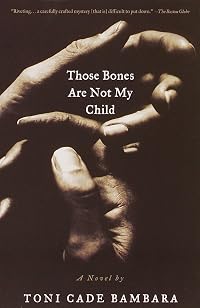
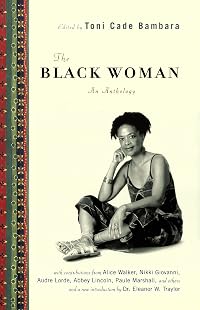
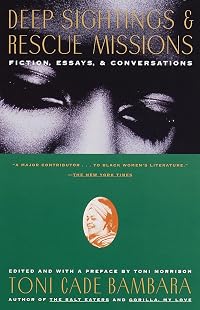
Toni Cade Bambara, a well-known teacher, writer, and social activist, was born on March 25, 1939, in New York. Bambara's mother was influenced by the Harlem Renaissance and fostered creativity in her daughter. After graduating from Queens College in 1959, Bambara worked as a social investigator for the New York Department of Welfare. This show more experience influenced her writing and reflected her interest in the welfare of the black community. Bambara returned to school, receiving her MA from City College of New York in 1965, where she taught until 1969. It was in the 1970s that Bambara wrote her most important works, including Black Woman, Southern Black Utterances Today, and Gorilla My Love. Bambara's works are frequently written in black street dialect and are set in the rural South and the urban North. She is interested in the identities and experiences of the black community and writes about their effects as a society. She has also authored several film and television scripts. Bambara is a frequent guest lecturer, visiting professor, and community leader. She received an American Book Award in 1981 Her novel The Salt Eaters (1980) is centered around a healing event that coincides with a community festival in the fictional city of Claybourne, Georgia. The novel Those Bones Are Not My Child or If Blessings Come (title of the manuscript), was published posthumously in 1999. It deals with the disappearance and murder of forty black children in Atlanta between 1979 and 1981. It was called her masterpiece by Toni Morrison, who edited it and also gathered some of Bambara's short stories, essays, and interviews in the volume Deep Sightings & Rescue Missions: Fiction, Essays & Conversations. (Vintage, 1996). Toni Cade Bambara was diagnosed with colon cancer in 1993 and died of it in 1995, at age 56. (Bowker Author Biography) show less
Awards and Honors
Awards
Notable Lists
The Great American Novels (1980)
Work Relationships
Has as a student's study guide
Common Knowledge
- Canonical title
- The Salt Eaters
- Original publication date
- 1980
- People/Characters
- Velma Henry; Minnie Ransom; Cora Rider; Sophie Heywood; Mama Mae; Portland Edges (show all 21); Smitty; James Lee Henry; Jay Patterson; Marcus Hampden; Palma Henry; Ruby; Daisy Moultrie; Jan; Dr. Julius Meadows; Cecile; Mai; Inez; Chezia; Nilda; Fred Holt
- Dedication
- Dear Khufu --
The manuscript, assembled finally in the second and third years of the Last Quarter and edited under Leo's double moons, was initially typed by Loretta Hardge and is dedicated to my first friend, teacher,... (show all) map maker, landscape aide
Mama Helen Brent Henderson Cade Brehon
who in 1948, having come upon me daydreaming in the middle of the kitchen floor, mopped around me.
Bless the workers and beam on me if you please. - First words
- "Are you sure, sweetheart, that you want to be well?"
- Last words
- (Click to show. Warning: May contain spoilers.)No need of Minnie's hands now so the healer withdraws them, drops them in her lap just as Velma, rising on steady legs, throws off the shawl that drops down on the stool a burst cocoon.
- Blurbers
- Wideman, John Edgar; Tyler, Anne
Classifications
Statistics
- Members
- 554
- Popularity
- 53,381
- Reviews
- 7
- Rating
- (3.59)
- Languages
- English, French
- Media
- Paper, Audiobook, Ebook
- ISBNs
- 12
- ASINs
- 7