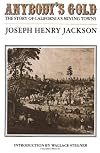
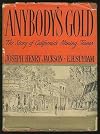
Anybody's Gold: The Story of California's Mining Towns
by Joseph Henry Jackson
On This Page
Description
This classic Chronicle book remains available as a print-on-demand title. You can purchase it from an online bookseller or by order from your local bookstore.Tags
Recommendations




















Member Reviews
This is a brightly written, very well researched and extremely readable history of the California Gold Rush. Jackson was a well-respected California historian and editor, serving as the literary editor for both the San Francisco Argonaut and then the SF Chronicle. (Here's a short biography.) He did an impressive amount of research for this book, delving into the historical archives of several libraries and museums. He was thereby able to find primary resources, including newspapers of the mining towns and the personal journals of the miners.
Beginning with a short history of pre-Gold Rush California, Jackson traces the discovery of gold and the at first gradual, and then torrential, growth of the arrival of the fortune seekers and the show more proliferation of mining camps and towns. We are taken through the evolution of the Gold Rush, starting with the early arrivals, the individualists who panned the relatively easily acquired gold out of the rivers and streams and lived together with a code of etiquette and honorable behavior that could lead to extremes, especially quick use of the hangman's rope. As the gold-rich areas became more populated, these codes would often break down. Later, as getting at the gold became harder, mining cooperatives, and even later relatively well organized large scale companies, ruled the day.
Jackson successfully puts lots of color and movement into all of this. The revels in offering characteristic incidents, gleaned often from those newspapers and journals mentioned above. He also enjoys describing the miners' superstitions, and narrating the prevailing legends and tall tales, some of which were still being offered to visitors when Jackson was doing his research. (The book was published in 1941.) Jackson, however, is not shy about immediately debunking those legends when appropriate, and rightly (in my view) saying he had providing each legend as a way of filling in the color and atmosphere of the times and of how those times have come to be viewed by subsequent generations.
There is a dark side to all of this, which Jackson mentions fairly often but doesn't delve into much or even seem particularly troubled by. That dark side, of course, is the era's racism. Mexican miners were routinely run off their land and their claims. Indians had no rights at all. Chinese people were allowed to work only those claims that whites had already worked over and abandoned and were tolerated in some areas only because they were willing to pay an additional tax for the privilege. For a modern-day reader, these facts will not be dismissed during the reading, and they do take the luster off of Jackson's overall glee in describing the times.
The final third of the book is a travelogue through the mining country, section by section, starting in the area's southernmost towns and moving north. Of course, this driving trip was taken in around 1940, pre-Interstate and pre-fast food restaurants and other chains. Jackson was driving 2-land roads, and the towns he was describing I'm sure are mostly far different today than they were 80 years ago when Jackson was describing them. There are small long-abandoned camps that Jackson describes as having only some tumbled-down buildings left to see. Those ruins are most likely by now long gone. The small cities have no-doubt grown and the relatively isolated towns either expanded or shriveled, depending on how close the Interstates came to them. I live in Mendocino County, CA, not within the Gold Rush territories but enough, and I have driven through most of Gold Rush country over the years. My wife and I spent time in the northernmost town described here, Weaverville, in northern Trinity County, and it is still a small, charming town. show less
Beginning with a short history of pre-Gold Rush California, Jackson traces the discovery of gold and the at first gradual, and then torrential, growth of the arrival of the fortune seekers and the show more proliferation of mining camps and towns. We are taken through the evolution of the Gold Rush, starting with the early arrivals, the individualists who panned the relatively easily acquired gold out of the rivers and streams and lived together with a code of etiquette and honorable behavior that could lead to extremes, especially quick use of the hangman's rope. As the gold-rich areas became more populated, these codes would often break down. Later, as getting at the gold became harder, mining cooperatives, and even later relatively well organized large scale companies, ruled the day.
Jackson successfully puts lots of color and movement into all of this. The revels in offering characteristic incidents, gleaned often from those newspapers and journals mentioned above. He also enjoys describing the miners' superstitions, and narrating the prevailing legends and tall tales, some of which were still being offered to visitors when Jackson was doing his research. (The book was published in 1941.) Jackson, however, is not shy about immediately debunking those legends when appropriate, and rightly (in my view) saying he had providing each legend as a way of filling in the color and atmosphere of the times and of how those times have come to be viewed by subsequent generations.
There is a dark side to all of this, which Jackson mentions fairly often but doesn't delve into much or even seem particularly troubled by. That dark side, of course, is the era's racism. Mexican miners were routinely run off their land and their claims. Indians had no rights at all. Chinese people were allowed to work only those claims that whites had already worked over and abandoned and were tolerated in some areas only because they were willing to pay an additional tax for the privilege. For a modern-day reader, these facts will not be dismissed during the reading, and they do take the luster off of Jackson's overall glee in describing the times.
The final third of the book is a travelogue through the mining country, section by section, starting in the area's southernmost towns and moving north. Of course, this driving trip was taken in around 1940, pre-Interstate and pre-fast food restaurants and other chains. Jackson was driving 2-land roads, and the towns he was describing I'm sure are mostly far different today than they were 80 years ago when Jackson was describing them. There are small long-abandoned camps that Jackson describes as having only some tumbled-down buildings left to see. Those ruins are most likely by now long gone. The small cities have no-doubt grown and the relatively isolated towns either expanded or shriveled, depending on how close the Interstates came to them. I live in Mendocino County, CA, not within the Gold Rush territories but enough, and I have driven through most of Gold Rush country over the years. My wife and I spent time in the northernmost town described here, Weaverville, in northern Trinity County, and it is still a small, charming town. show less
Ratings
Members
- Recently Added By
Author Information
21+ Works 283 Members
Awards and Honors
Work Relationships
Is abridged in
Common Knowledge
- Important places
- California, USA
- Original language
- English
Classifications
Statistics
- Members
- 60
- Popularity
- 513,111
- Reviews
- 1
- Rating
- (3.50)
- Languages
- English
- Media
- Paper
- ISBNs
- 2
- UPCs
- 1
- ASINs
- 5