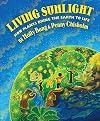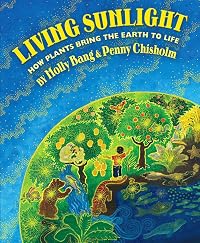
Living sunlight : how plants bring the earth to life
by Molly Bang (Author), Penny Chisholm (Author)
Sunlight
On This Page
Description
Explains the cyclical relationship between photosynthesis in plants and respiration in animals.Tags
Recommendations






Member Reviews
A lovely picture-book examination of the process of photosynthesis, intended for the early primary school student, Living Sunlight emphasizes the importance of plants, in making life possible on our world, as well as the interconnected nature of that life, which all depends upon the energy of the sun. With simple text and bright illustrations, Molly Bang and Penny Chisholm manage to explain a fairly complex process in a straightforward and engaging manner.
I did feel, on reading through the text, that while it will increase basic science literacy among younger children - giving them an idea of what photosynthesis is, and what it does - that it is not entirely successful in explaining how it works. But then, as the authors make plain in show more their four-page afterword, this is a complex topic. Maybe a basic understanding is good enough, until higher grades expose students to more information? show less
I did feel, on reading through the text, that while it will increase basic science literacy among younger children - giving them an idea of what photosynthesis is, and what it does - that it is not entirely successful in explaining how it works. But then, as the authors make plain in show more their four-page afterword, this is a complex topic. Maybe a basic understanding is good enough, until higher grades expose students to more information? show less
This is one of the best informational books I have ever read. My sister is currently a kindergarten teacher, and she highly recommended me to read this book. She explained that her students were having a difficult time understanding the life cycle and the purpose of plants. She then found this book, and it suddenly clicked with her students. The book does a phenomenal job connecting the steps of the life cycle into a relatable and easily understood manner. The authors go step by step, first explaining the sun, then how the sun creates life in plants, then how those plants help us as humans. The author’s tone is super laid back and she uses language that helps the readers relate the heavy science information, to their own personal show more lives. For example she writes, “You cannot catch my light. And neither can your parents, or your friends, your teachers, or any reptile, insect, fish, bird or mammal in the whole wide world. So… how do YOU get my energy? Do you know?” From there the author connects humans and animals to plants. I felt this was such a brilliant transition and there are many more of them like this in the book. The main message of this book is explaining why without plants, there would be no life on Earth. show less
Thanks to this book, one music major might actually be beginning to understand photosynthesis! I would use this with elementary or middle school. The voice alone (the sun speaking in 1st person) breaks down curricular "genrefication." While the text can't stand alone, I do think this book - with its iconic representation of sunlight in large swaths of yellow across the pages, and cartoon-esque fonts - immediately piques interest. Textbook information is artfully reinvented it and the result is an engaging approach to science concepts that I find quite refreshing. Use!
This is a great story for a read aloud! As a teacher I would like to use this to kickoff a unit on plants, and introduce students to the many benefits the sun creates for the earth. I also enjoyed the unique illustrations and how the sun is narrating the story. This story is almost moving when you can connect the circle of life.
Picture book with a surprising amount of scientific detail. Beautiful illustrations that are actually visual representations of the process of photosynthesis, respiration, and energy production, all tied between the sunlight, plants, and animals. Told from the point of view of the sun, the author traces the journey from the photons of the sun to the processes happening within plants and animals for growth and life. Great resource for studying heterotrophs vs. autotrophs, or cellular respiration and metabolism, etc.
"Living Sunlight" is beautifully illustrated, but almost too informative. The book is written in first person from the perspective of the sun. I think the information about how the sun's energy is used in plants and in us is important but was presented in a confusing way. It describes the cycles of photosynthesis, respiration, and how humans and plants have a mutualistic relationship, but those concepts are big ones. I didn't feel that the book described those processes in terms children would understand. However, the book was very beautiful to see. The pages of exploding color with greens and yellows when mentioning the plants, and the pages of desert with humans and animals were captivating.
Living Sunlight: How Plants Bring the Earth to Life is a decent introductory book about photosynthesis and its subsequent effects on all life on earth. The text is age appropriate for young elementary grades, and I imagine it would be a good start to conversations on the subject. I thought the illustrations were pretty, but rather busy and occasionally overwhelming. I think that simpler illustrations would have aided the dissemination of information in the text; as it stands, they take away from it. Overall, my takeaway is that there are probably better books on the subject out there.
Members
- Recently Added By
Author Information

Molly Bang was born in Princeton, New Jersey in 1943. After college, Bang taught English in Japan. She returned to the U.S and earned her graduate degree in East Asian Languages and Literatures, then worked in India, Bangladesh, and West Africa for Johns Hopkins, Unicef and Harvard. Her first books were translations of folktales, which she also show more illustrated. Bang has received many awards and honors, including the prestigious Caldecott Honor Book Award three times, for The Grey Lady and the Strawberry Snatcher, Ten, Nine, Eight and When Sophie Gets Angry - Really, Really Angry. She won the Giverny Award for Best Science Picture Book for Common Ground in 1998. Ten, Nine, Eight also won the ALA Notable Children's Book and When Sophie Gets Angry - Really, Really Angry, won the Charlotte Zolotow Award. It was also an ALA Notable Book and a Jane Addams Children's Honor Book Her titles include Nobody Particular: One Woman's Fight to Save the Bays, Tiger's Fall, Little Rat Sets Sail, My Light, and Picture This: Perception and Composition. (Bowker Author Biography) show less
Awards and Honors
Awards
Series

Common Knowledge
- Canonical title
- Living sunlight : how plants bring the earth to life
- Original publication date
- 2009
- First words
- Listen to me.
- Last words
- (Click to show. Warning: May contain spoilers.)You are living sunlight.
- Original language
- English
Classifications
- Genre
- Nonfiction
- DDC/MDS
- 572.46 — Natural sciences & mathematics Biology Biochemistry
- LCC
- QK882 .B26 — Science Botany Botany Plant physiology
- BISAC
Statistics
- Members
- 559
- Popularity
- 52,866
- Reviews
- 38
- Rating
- (3.86)
- Languages
- English, Japanese
- Media
- Paper
- ISBNs
- 7
- ASINs
- 2