The Locked Garden
by Gloria Whelan
On This Page
Description
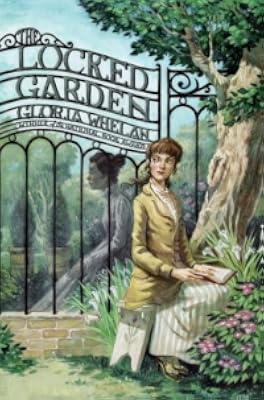
After their mother dies of typhoid, Verna and her younger sister Carlie move with their father, a psychiatrist, and stern Aunt Maude to an asylum for the mentally ill in early-twentieth-century Michigan, where new ideas in the treatment of mental illness are being proposed, but old prejudices still hold sway.Tags
Recommendations







Member Recommendations
Member Reviews
This heartwarming story takes place in 1900, two years after the mother of young Verna and Carlie died of typhoid. The girls, along with their mother’s older sister Aunt Maude (who now helps take care of them), and their father, a well-known psychiatrist, have come to Michigan so the father can take a position at the well-known asylum there. The asylum is part of the new progressive movement that believes in healing mental health through positive treatment, pleasant surroundings, and purposeful work.
At that time in history, there was still much discrimination against “insane asylums” and Aunt Maude shuddered at the very thought of contact with any of the “inmates.” But Papa brings in Eleanor, a young woman who was at the show more asylum for depression, to help cook and clean and take care of the girls. Verna and Carlie and even their father immediately take to the kind, gentle, and spirited Eleanor, much to the dismay of Aunt Maude, who can barely contain her spiteful jealousy and resentment. Papa explains to the girls, “Unhappily Aunt Maude believes love is like a glass of water, just so many sips to go around, when really it’s like scooping water from a river. Take as much as you like. The river just fills right up again.”
Meanwhile, Verna and Carlie find, much to their surprise, that the asylum is a lovely place, with trees, flowers, and animals. And the patients aren't scary at all. Those who are in the worst shape can still enjoy the outdoors by visiting a locked garden.
Aunt Maude succeeds in getting rid of Eleanor, but Verna and Carlie scheme to drive Aunt Maude back to her house and bring Eleanor back. Their plan works in part, but not without some nearly disastrous consequences. And Eleanor, a young single woman, cannot stay in the house with an unmarried man without Maude there. The girls want Papa to marry Eleanor, but Verna understands that “Aunt Maude’s and Papa’s hearts were shut away in their locked gardens.” What’s the best way to be? Verna isn’t sure: “I was a little afraid to be like Carlie and Eleanor, so quick to love you might get hurt, but I didn’t want to be like Aunt Maude and Papa, so cautious loving got away from you.”
The Locked Garden has much to recommend it for young readers. It contains interesting historical information that is seamlessly embedded in the plot, and offers lots to think about on the topics of love and friendship. I wouldn’t hesitate to recommend this book for this age group! show less
At that time in history, there was still much discrimination against “insane asylums” and Aunt Maude shuddered at the very thought of contact with any of the “inmates.” But Papa brings in Eleanor, a young woman who was at the show more asylum for depression, to help cook and clean and take care of the girls. Verna and Carlie and even their father immediately take to the kind, gentle, and spirited Eleanor, much to the dismay of Aunt Maude, who can barely contain her spiteful jealousy and resentment. Papa explains to the girls, “Unhappily Aunt Maude believes love is like a glass of water, just so many sips to go around, when really it’s like scooping water from a river. Take as much as you like. The river just fills right up again.”
Meanwhile, Verna and Carlie find, much to their surprise, that the asylum is a lovely place, with trees, flowers, and animals. And the patients aren't scary at all. Those who are in the worst shape can still enjoy the outdoors by visiting a locked garden.
Aunt Maude succeeds in getting rid of Eleanor, but Verna and Carlie scheme to drive Aunt Maude back to her house and bring Eleanor back. Their plan works in part, but not without some nearly disastrous consequences. And Eleanor, a young single woman, cannot stay in the house with an unmarried man without Maude there. The girls want Papa to marry Eleanor, but Verna understands that “Aunt Maude’s and Papa’s hearts were shut away in their locked gardens.” What’s the best way to be? Verna isn’t sure: “I was a little afraid to be like Carlie and Eleanor, so quick to love you might get hurt, but I didn’t want to be like Aunt Maude and Papa, so cautious loving got away from you.”
The Locked Garden has much to recommend it for young readers. It contains interesting historical information that is seamlessly embedded in the plot, and offers lots to think about on the topics of love and friendship. I wouldn’t hesitate to recommend this book for this age group! show less
It's the year 1900, the dawn of a new century and a chance for a new beginning for Verna and Carlie, whose mother died two years ago. They are headed to their new home—the grounds of an asylum for the mentally ill. Their father, a doctor, has been hired to treat its patients while the girls are under the strict and watchful eye of their aunt Maude. The towering asylum, the murmuring patients with their tormented pasts, the exquisite locked garden at the center of the grounds—Verna perceives forbidden mystery and enchantment everywhere. Even Aunt Maude's temper will not keep her from striking out on her own exciting adventures. But is Verna ready to confront all the secrets and emotions that have been locked within—even those of show more her own heart? show less
The loss of their mother and then the move to a new home so that their father (Edward Martin) could work at a new asylum, left twelve year old Verna and her younger sister, six year old Carlie (Caroline) to be looked after by their stern Aunt Maude. When the new help (Eleanor Miller), a patient at the asylum, started to become close to the girls, Aunt Maude became jealous of the relationship and started to take an even meaner approach to dealing with Eleanor and the children. Between the cruelty of Aunt Maude and of her own father, Eleanor had a set back causing Verna and Carlie to take drastic measures in order to help their friend.
This is a great children’s historical that has the main characters doing things that many kids would show more like to do. The decision making process is impulsive and selfish with no concern with how it may affect others. This wonderful story really brings across the lesson of consequences to Verna. There is a lot of sad parts to this book that also brings out how differently people respond to one another. Verna saw the patients of the asylum as friends while Aunt Maude saw them as something to be afraid of. For a youth book, this is dealing with serious emotional and social concepts that can leave a good opening for honest conversations. It is a historical so it also shows mental health treatment in its infancy and gives kids an idea of how different many things are now than it was just over 100 years ago.
This is an early reviewer copy from Harper Collins Children, it is not due to be released until June 2009 show less
This is a great children’s historical that has the main characters doing things that many kids would show more like to do. The decision making process is impulsive and selfish with no concern with how it may affect others. This wonderful story really brings across the lesson of consequences to Verna. There is a lot of sad parts to this book that also brings out how differently people respond to one another. Verna saw the patients of the asylum as friends while Aunt Maude saw them as something to be afraid of. For a youth book, this is dealing with serious emotional and social concepts that can leave a good opening for honest conversations. It is a historical so it also shows mental health treatment in its infancy and gives kids an idea of how different many things are now than it was just over 100 years ago.
This is an early reviewer copy from Harper Collins Children, it is not due to be released until June 2009 show less
Verna is a young lady whose small family consisting of herself, her father, younger sister Carlie, and Aunt Maude, has just moved to a remote mental hospital in Michigan in 1900. Her father has taken a position as a psychiatrist at the hospital. Once they are settled in one of the more promising patients is assigned as the family's maid. Eleanor is recovering from melancholia and quickly finds a warm welcome the children and their father. Aunt Maude however believes that Eleanor is dangerous and an unhealthy influence on the girls. Verna must grow up quickly to protect her sister and her new friend from the pitfalls of jealousy, fear, and depression that undermine the green lawns and fragrant gardens of the asylum. If she is lucky the show more hospital will become a home and the strange group of people she has met there will be able to grow into a family. Unlike many period novels set in asylums this book does not vilify the hospital or the doctors. The director believes that external beauty will call forth beauty from the soul and help patients recover. This creates an interesting atmosphere as it is the respectable, nominally sane aunt creating the dramatic tension rather than a fight between patient and doctor or between the compassion of the reader and the brutal treatments administered to the residents. show less
The Locked Garden is set in the year 1900, and is primarily the story of two sisters: Verna, age 12, and Carlie, age 6. After the recent death of their mother, the girls move with their father, who is a physician, to a new home located on the grounds of an insane asylum where he will be given the opportunity to test his theories of treating mental illness with medication. Joining the family in their journey is Aunt Maude, their maternal aunt, who seems determined to constantly remind the children and their father of the recent loss they have suffered in an effort to keep the memory of her sister alive. Shortly after starting life in their new home, their father hires a young patient, Eleanor, to assist in the care of Verna and Carlie. show more Eleanor's arrival changes everything, and soon Verna and Carlie find themselves at odds with both their father and their aunt as they try to ensure that Eleanor will remain one of the family.
This was an enjoyable read, which at times reminded me of Sarah, Plain and Tall. I found the understanding and treatment of mental illness at the time of the novel to be especially interesting. The book certainly didn't feel like a history lesson, but I felt that I learned a lot during the course of my reading. This book would be a perfect introduction to helping children have an understanding of the concepts of mental illness and depression. I can picture myself someday reading it to my own children when they are older so that we can have a discussion about what mental illness is, and how such illnesses are treated today versus in the past. The book also deals with death and grieving, although this is certainly a minor focus of the book. I am mentioning it because I really appreciated Whelan's handling of this topic.
The story itself is very fast paced. I found this to be a quick read. I was able to finish it in an afternoon. The target age group is 8-12, or grades 3-7, and I feel that this book was perfectly suited to this audience. The only reason I can't give this book a higher rating is because of the abrupt ending. I really felt that the story came to a screeching halt just as I was bracing for the climax. Perhaps this is because Whelan is planning to write a sequel, but I just found myself shocked that this book was actually over.
I would like to thank Harper Collins for generously providing me a review copy. Whelan is a great writer, and this isn't the first novel of hers that I have read. It certainly won't be my last. show less
This was an enjoyable read, which at times reminded me of Sarah, Plain and Tall. I found the understanding and treatment of mental illness at the time of the novel to be especially interesting. The book certainly didn't feel like a history lesson, but I felt that I learned a lot during the course of my reading. This book would be a perfect introduction to helping children have an understanding of the concepts of mental illness and depression. I can picture myself someday reading it to my own children when they are older so that we can have a discussion about what mental illness is, and how such illnesses are treated today versus in the past. The book also deals with death and grieving, although this is certainly a minor focus of the book. I am mentioning it because I really appreciated Whelan's handling of this topic.
The story itself is very fast paced. I found this to be a quick read. I was able to finish it in an afternoon. The target age group is 8-12, or grades 3-7, and I feel that this book was perfectly suited to this audience. The only reason I can't give this book a higher rating is because of the abrupt ending. I really felt that the story came to a screeching halt just as I was bracing for the climax. Perhaps this is because Whelan is planning to write a sequel, but I just found myself shocked that this book was actually over.
I would like to thank Harper Collins for generously providing me a review copy. Whelan is a great writer, and this isn't the first novel of hers that I have read. It certainly won't be my last. show less
This book had the potential to address an interesting topic – the treatment of mental illnesses in the early 1900s. I think the main reason the book failed to succeed was because the characters were not very compelling, and the plot was rather rote and formulaic. Many of the plot points were unrealistic; while this is often the case it can usually be overlooked if the reader is invested in the characters and the story is well executed. Often the author’s overt descriptions of a character contradicted the way the character actually acted. The book is fine for introducing the subject or providing some light reading, but does not really qualify as a must-read.
I liked this book so much...until the end. This is the story of two sisters, their father (a widower) and their dead mother's sister who move to an insane asylum in New York. It's the story of dealing with a parent's death, and people trying to slowly reform asylums. However, the ending seemed like such a let down. I don't know if Whelan was hoping to write a sequel, or whether it was supposed to be so open-ended. I didn't enjoy it.
Members
- Recently Added By
Author Information

70+ Works 12,401 Members
Gloria Whelan was born on November 23, 1923 in Detroit, Michigan. She took a strong interest in reading early in life when she was bedridden for a year with rheumatic fever. She dictated stories to her sister who would then type them. She then went on to writing poetry and later editing her high school newspaper. She attended the University of show more Michigan and earned her B.S.degree and M.S.W. degree. She began working as a social worker in Minneapolis and Detroit. She soon became tired of Detroit's hectic pace and moved to a cabin in northern Michigan.This peace was disrupted by an oil company 's desire to drill on her property. Because she did not own the mineral rights, the drilling proceeded. This experience inspired Gloria Whelan to write her children's novel, A Clearing in the Forest in 1978, which was about a boy working on an oilrig. Gloria Whelan has written several works of fiction for children and adults, many set in rural Michigan. She has also written stories set in exotic places like China and India. She won the National Book Award for Young People's Literature in 2000 for Homeless Bird - the story of a young woman in India abandoned by her mother-in-law. show less
Common Knowledge
- Original publication date
- 2009-06-02
- People/Characters
- Verna Martin; Carlie Martin (Caroline); Edward Martin; Aunt Maude; Eleanor Miller
- Important places
- Michigan, USA; USA
- First words
- We were standing on the front porch as our belongings were carried from the wagon into our new home.
- Last words
- (Click to show. Warning: May contain spoilers.)"We'll think of something," I said.
Classifications
- Genres
- Kids, Fiction and Literature, Children's Books, Tween
- DDC/MDS
- 813.54 — Literature & rhetoric American literature in English American fiction in English 1900-1999 1945-1999
- LCC
- PZ7 .W5718 .L — Language and Literature Fiction and juvenile belles lettres Fiction and juvenile belles lettres Juvenile belles lettres
- BISAC
Statistics
- Members
- 77
- Popularity
- 412,414
- Reviews
- 10
- Rating
- (3.45)
- Languages
- English
- Media
- Paper, Ebook
- ISBNs
- 5
- ASINs
- 2