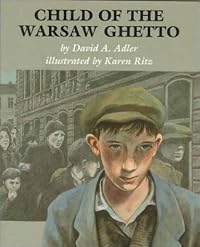
Child of the Warsaw Ghetto
by David A. Adler
On This Page
Description
The story of the Warsaw Ghetto told through the eyes of Froim Baum, who was born in Warsaw on April 15, 1936. He was sent from one death camp to another before finally being liberated at Dachau by American soldiers.Tags
Recommendations










Member Reviews
First off, this book is deceiving. While it absolutely deals with the horrific anti-semitism of WWII, the picture book portrayal of the story doesn't make it suitable for children. There's a lot of pretty heavy material in this text, a lot of which younger children probably won't understand. That being said, I wouldn't NOT read this to younger children; the illustrations are more graphic for those readers that know what they're looking at whereas younger readers will just understand the tone conveyed.
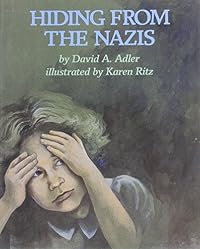
Through the telling of Froim Baum's story, Adler takes the reader through the history of WWII as it relates specifically to Poland. The gritty, dark nature of the illustrations by Ritz only further add to the dismal tone of the book, but show more not in a way that is overbearing or exploits this tragic aspect of our world history. Like I said before, this book is pretty heavy for what the outward appearances purport it to be; there's a lot of history condensed into 30 pages, but it's definitely a great introductory book for making students aware of the atrocities that took place during that time period. show less
Through the telling of Froim Baum's story, Adler takes the reader through the history of WWII as it relates specifically to Poland. The gritty, dark nature of the illustrations by Ritz only further add to the dismal tone of the book, but show more not in a way that is overbearing or exploits this tragic aspect of our world history. Like I said before, this book is pretty heavy for what the outward appearances purport it to be; there's a lot of history condensed into 30 pages, but it's definitely a great introductory book for making students aware of the atrocities that took place during that time period. show less
The horrors suffered by the Polish Jews during the early onset of WWII are chronicled through the tale of young Froim in David Adler's serious work. Froim's experiences with the terrible living conditions of the Warsaw Ghetto, witnessing the failed Warsaw Uprising firsthand, and ultimately surviving stays in both Auschwitz-Birkenau and Dachau concentration/death camps are illustrated in a shaded style which captures snippits of the mass travesties issued at the hand of Nazi Germany. The book is somewhat age-appropriate, depending on the grade which WWII is first discussed.
David Adler did an amazing job writing this biography because he made the reader feel like he was in Froim's shoes. The author begins the book by telling the readers the setting of the story as well as details of Froim's family. Adler continues the biography of Froim and tells the readers about the struggles he had to endure being a Jew in Poland. I feel like people can still relate with Froim because racism still exists to this day. This biography shows the readers the history of when Hitler was ruling Germany. I would not recommend this book for younger children due to the extreme details it has about death and war scenes. Yet it is an amazing book for older children to read.
This book is about Froim Baum and his experiences growing up as World War 2 erupted in Europe. He lives in a loving family up until his father dies, at which point the family becomes homeless. His mother receives help from an orphanage that takes in Froim, where he lives pretty happily and still visits his other from time to time. Then the ghetto was constructed, where people begged and starved in the streets, were cramped, where diseases spread, and where people were shipped off to concentration camps. Froim and his family were eventually sent to a concentration camp; in the end, Froim is rescued by American soldiers, but not without great losses.
While I can appreciate what the book was trying to do, I didn't agree with a lot of the show more stylistic choices the author took with this book. It often strays from the "eyes" of Froim Baum to talk about things that were going on in general terms, such as the set-up and start of the war, the conditions of the ghetto, etc. The book would have been more emotional, in my opinion, if it had stayed within the emotions, experiences, and point-of-view of Froim as he experienced things throughout the book, with a mote in depth explanation in the author's notes or an epilogue.
The book was mostly "fact-sounding" instead. Relationships weren't explored very well, so I was left wanting to know more about Froim and his relationships with his mother, father, siblings, and other children and adults at the orphanage and how their separation and deaths affected him, or how the events made him feel. There are some good places where I do get this, such as when we see his mother giving him treats when they still lived together, or how Froim was devastated when the the orphanage group was taken to the concentration camp and he was prevented from going with them- there needed to be more of that interiority and action from him, though.
Overall, I did learn more about the ghetto form this book, and was fascinated with what I did see Froim doing throughout the book, such as sneaking into town to buy bread for others in the ghetto, or how he escaped death at the camp. The illustrations do well to convey the situations and outlook of the circumstances, as well. show less
While I can appreciate what the book was trying to do, I didn't agree with a lot of the show more stylistic choices the author took with this book. It often strays from the "eyes" of Froim Baum to talk about things that were going on in general terms, such as the set-up and start of the war, the conditions of the ghetto, etc. The book would have been more emotional, in my opinion, if it had stayed within the emotions, experiences, and point-of-view of Froim as he experienced things throughout the book, with a mote in depth explanation in the author's notes or an epilogue.
The book was mostly "fact-sounding" instead. Relationships weren't explored very well, so I was left wanting to know more about Froim and his relationships with his mother, father, siblings, and other children and adults at the orphanage and how their separation and deaths affected him, or how the events made him feel. There are some good places where I do get this, such as when we see his mother giving him treats when they still lived together, or how Froim was devastated when the the orphanage group was taken to the concentration camp and he was prevented from going with them- there needed to be more of that interiority and action from him, though.
Overall, I did learn more about the ghetto form this book, and was fascinated with what I did see Froim doing throughout the book, such as sneaking into town to buy bread for others in the ghetto, or how he escaped death at the camp. The illustrations do well to convey the situations and outlook of the circumstances, as well. show less
The horrors and atrocities that occurred during World War II in the Jewish ghettos of eastern Europe are hard to convey to children beginning to learn about the Holocaust. David Adler takes great care in this biography to describe one Jewish boy's experiences living in the Warsaw ghetto. Although we do not get any of Mr. Adler's credentials listed in the book, in his author's note at the back he mentions personally interviewing Froim Baum (who is the subject of this biography). By taking this man's personal experience and writing a story based upon it, David Adler has made the difficult topic of World War II Jewish ghettos accessible to children in a way that is neither condescending nor too harsh. I can definitely see the potential use show more of this book in a classroom setting. show less
‘Child of the Warsaw Ghetto’ is a familiar history of the Jewish people during World War II, a story that must be retold as often as possible so humanity does not forget. The author wrote the story based on one survivor's account. The author states that Froim Baum was born in 1936 in Warsaw Poland and would have been a toddler (maybe) when the Germans invaded on September 1st, 1939.
In regards to the book itself, the author does not list any bibliographic information, nor timelines or other source material. While I am sure it was just a typo, the author states that Froim Baum was born in 1936 and his father died suddenly in 1932. Surely this was a mistake, maybe the dates should be reversed, but it was not an auspicious start.
The show more story is told in linear form and has beautiful illustrations. The author uses plain language that even young children will understand and does a good job describing what life was like in the Jewish Ghetto. One critique I have: The author lists all the concentration camps that Froim Baum was imprisoned in and missed an opportunity to describe or explain those camps in more detail at the end of the book. All things considered, 'Child of the Warsaw Ghetto' shares a part of history which children should hear and the author does a good job relating the story. show less
In regards to the book itself, the author does not list any bibliographic information, nor timelines or other source material. While I am sure it was just a typo, the author states that Froim Baum was born in 1936 and his father died suddenly in 1932. Surely this was a mistake, maybe the dates should be reversed, but it was not an auspicious start.
The show more story is told in linear form and has beautiful illustrations. The author uses plain language that even young children will understand and does a good job describing what life was like in the Jewish Ghetto. One critique I have: The author lists all the concentration camps that Froim Baum was imprisoned in and missed an opportunity to describe or explain those camps in more detail at the end of the book. All things considered, 'Child of the Warsaw Ghetto' shares a part of history which children should hear and the author does a good job relating the story. show less
A harrowing true tale of the Warsaw Ghetto shows the tragic historical events of the Holocaust through the eyes of young Froim Baum, born in 1936 and sent to the Dachau death camp before being liberated by American soldiers.
Members
- Recently Added By
Author Information

311 Works 92,808 Members
David A. Adler was born in New York City. He attended Queen's College in New York City and later, earned an MBA in Marketing from New York University. He writes both fiction and non-fiction. He is the author of Cam Jansen mysteries and the Andy Russell titles. His titles has earned him numerous awards including a Sydney Taylor Book Award for his show more title "The Number on My Grandfather's Arm," "A Picture Book of Jewish Holidays" was named a Notable Book of 1981 by the American Library Association and "Our Golda" was named a Carter G. Woodson Award Honor Book. (Bowker Author Biography) show less
Awards and Honors
Classifications
Statistics
- Members
- 102
- Popularity
- 315,807
- Reviews
- 12
- Rating
- (4.36)
- Languages
- English, German
- Media
- Paper
- ISBNs
- 2