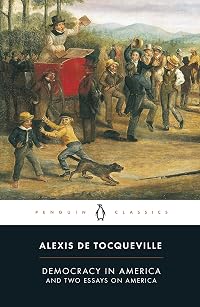
Democracy in America; and Two essays on America
by Alexis de Tocqueville
Democracy in America (Collections and Selections — )
On This Page
Description
A brilliant new translation of de Tocqueville's masterpiece also includes an account of Tocqueville's travels in Michigan among the Iroquois.Tags
Recommendations






Member Reviews
Like many people, I think that Donald Trump might not give up power if he loses the presidential election. And if he tries a coup, I'm afraid that he could succeed. I don’t think that’s the likely outcome, but it’s not something I’d discount. Deeply I want to believe in the robustness of American democracy, whose persistence (with its own specific glories, quirks, failures and hypocrisies) is something I've always taken more or less for granted. But tyranny has its own momentum, which, with some bad luck, can become unstoppable.
So I've turned to Tocqueville's Democracy in America for insight. After all, he's the guy who really believed in the wisdom of the American people (or at least of that part guided by New England mores).
I show more read the book many years ago, but this time I wanted to read it analytically in the light of the present moment. Specifically I wanted to look at what fundamentals might have changed in recent times – or slowly and incrementally – that could account for the USA’s lurch to authoritarianism.
So here are some scattergun thoughts about the book's possible lessons for today’s crisis. I put them forward less as theses than as starting points for discussion, should anyone wish to join in:
a) Most relevant so far has been Chapter 9 in the first volume: Causes Which Tend to Maintain a Democratic Republic.
What in those circumstances has changed that could give rise to Trump and possibly (shudder) to the end of democracy in America?
Having stated that "general prosperity supports the stability of all governments, but especially democratic governments which depend on the attitudes of the greatest number and primarily upon the attitudes of those most exposed to privations," Tocqueville goes on to describe how the natural bounty of America irresistibly furnishes that prosperity; the uncultivated wilderness that offers successive generations the opportunity for new wealth and fosters a repeating cycle of enterprise and dynamism.
Comparing this to the European nature, he writes (trans. Gerald Bevan):
“We Europeans are accustomed to look upon a restless spirit, an inordinate desire for wealth and an extreme passion for independence as grave social dangers. Yet precisely all these things guarantee a long and peaceful future for the republics of America Without those disquieting passions, the population would be concentrated around certain places and would soon experience, as we do, needs which are difficult to satisfy. What a fortunate country the New World is, where man's vices are almost as valuable to society as his virtues! This exerts a great influence upon the way human behaviour is judged in the two hemispheres. What we call the love of gain is often laudable hard work for the Americans who see a certain faintheartedness in what we consider to be moderation of one's desires.”
And summarising, he says:
“Prosperity influences Americans even more freely than foreigners. The American has always seen orderliness and public prosperity linked together and marching in step; he cannot imagine their existing apart.”
So here's my question/thesis/half-baked thought: If the USA, having been thoroughly populated from sea to shining sea, and having come to the end of a protracted period of post-war military and cultural expansion beyond its borders, and having come to the end of bubbles of artificial wealth creation promoted in different ways by Reagan and Clinton and the Bushes, and having (finally) experienced the decoupling of prosperity from orderliness, having run out roads as it were, could it be that the country's vices are now (finally) harmful to society? And that moderation of desires (Jimmy Carter style frugality?) is needed, but is too anathema to the Make America Great Again brigade, who are so used to seeing excess as a virtue?
Or is that typically European prejudice/faintheartedness on my part?
Or have there been other protracted periods in American history which have seen prosperity divorced from orderliness? (The Great Depression springs to mind, but the period is arguably too short; although I suppose the exceptional 4-term election of FDR might speak to a taste for strong leaders (admittedly of a vastly different stripe) in times of economic distress and national crisis.) show less
So I've turned to Tocqueville's Democracy in America for insight. After all, he's the guy who really believed in the wisdom of the American people (or at least of that part guided by New England mores).
I show more read the book many years ago, but this time I wanted to read it analytically in the light of the present moment. Specifically I wanted to look at what fundamentals might have changed in recent times – or slowly and incrementally – that could account for the USA’s lurch to authoritarianism.
So here are some scattergun thoughts about the book's possible lessons for today’s crisis. I put them forward less as theses than as starting points for discussion, should anyone wish to join in:
a) Most relevant so far has been Chapter 9 in the first volume: Causes Which Tend to Maintain a Democratic Republic.
What in those circumstances has changed that could give rise to Trump and possibly (shudder) to the end of democracy in America?
Having stated that "general prosperity supports the stability of all governments, but especially democratic governments which depend on the attitudes of the greatest number and primarily upon the attitudes of those most exposed to privations," Tocqueville goes on to describe how the natural bounty of America irresistibly furnishes that prosperity; the uncultivated wilderness that offers successive generations the opportunity for new wealth and fosters a repeating cycle of enterprise and dynamism.
Comparing this to the European nature, he writes (trans. Gerald Bevan):
“We Europeans are accustomed to look upon a restless spirit, an inordinate desire for wealth and an extreme passion for independence as grave social dangers. Yet precisely all these things guarantee a long and peaceful future for the republics of America Without those disquieting passions, the population would be concentrated around certain places and would soon experience, as we do, needs which are difficult to satisfy. What a fortunate country the New World is, where man's vices are almost as valuable to society as his virtues! This exerts a great influence upon the way human behaviour is judged in the two hemispheres. What we call the love of gain is often laudable hard work for the Americans who see a certain faintheartedness in what we consider to be moderation of one's desires.”
And summarising, he says:
“Prosperity influences Americans even more freely than foreigners. The American has always seen orderliness and public prosperity linked together and marching in step; he cannot imagine their existing apart.”
So here's my question/thesis/half-baked thought: If the USA, having been thoroughly populated from sea to shining sea, and having come to the end of a protracted period of post-war military and cultural expansion beyond its borders, and having come to the end of bubbles of artificial wealth creation promoted in different ways by Reagan and Clinton and the Bushes, and having (finally) experienced the decoupling of prosperity from orderliness, having run out roads as it were, could it be that the country's vices are now (finally) harmful to society? And that moderation of desires (Jimmy Carter style frugality?) is needed, but is too anathema to the Make America Great Again brigade, who are so used to seeing excess as a virtue?
Or is that typically European prejudice/faintheartedness on my part?
Or have there been other protracted periods in American history which have seen prosperity divorced from orderliness? (The Great Depression springs to mind, but the period is arguably too short; although I suppose the exceptional 4-term election of FDR might speak to a taste for strong leaders (admittedly of a vastly different stripe) in times of economic distress and national crisis.) show less
Hadn't read since college humanities. Filled with plenty of right-on-the-money predictions and a good balance of how far we've come / how nothing has changed moments. Even where the author is a product of his times and the material hasn't aged well he is always instructive to see his reasoning. The freedom of the press segment really pegs current media spot on.
Democracy in America and Two Essays on America (Penguin Classics) by Alexis de Tocqueville (1805–1859)
Why I picked this book up: as a kid in school I was bored to death by history. I saw it as needing to memorize dates, the classes were often thought by boring teachers, in a boring a way. I had difficulty focusing because it was monotonous with no interesting things. In college I took a history course that was FUN! I remember thinking, “What? This is history!?” The professor made it thrilling, it became super interesting. He introduced drama and tracking backgrounds that were exciting and I learned the importance f learning history. Ever since then I can't seem to get enough. With this history, I was excited to read this so I show more bought it. He wrote two essays one where he traveled around seeing what he saw and then he critiqued the pocibility of what democracy can bring.
Thoughts: this book had five main things. Equality of conditions and political equality. He said democracy is where the majority rules. I often hear “we are a democracy” all the time and yes I know we elect people in but I was taught we were given a Constitutional Republic based on laws. Some people say we are a democratic Republic but I don't like the idea of becoming a democracy. We need to hold onto the republic as long as we can.
Our history had mobility and change. Westward expansion, land speculation, social mobility, individualism, a talent for innovation, and a fearless quest for material well-being. He thinks “They encounter good fortune nearly everywhere, but not happiness.”
Women he sees a strong link between women and religion. He sees woman can decide who she wants to marry before deciding to wed.
Tyranny of the Majority and mild despotism. He sees how to negotiate problems, with times a decentralized authority, voluntary associations, lawyers, juries, and court systems. He was concerned with the liberty of the individual and the tyranny of the majority rights which I understand. Be thought the majority could stifle the individuals thought
Self-interest, well understood. He knows individual interest is not to be confused with selfishness. Instead it is an outlook that properly calibrated the relative weight of individualism vs. Group cooperation.
Why I finished this read: I enjoy history and seeing how smart Tocqueville was and seeing how in tune he was so early in my country and watching society now, the whole Covid-19 government overstepping appears to be somewhat prophetic and I did not want to miss anything he had to say.
Given that I view this author as intelligent, before his time, I am very impressed and I rated this with 5 stars. I am excited to read more history. show less
Why I picked this book up: as a kid in school I was bored to death by history. I saw it as needing to memorize dates, the classes were often thought by boring teachers, in a boring a way. I had difficulty focusing because it was monotonous with no interesting things. In college I took a history course that was FUN! I remember thinking, “What? This is history!?” The professor made it thrilling, it became super interesting. He introduced drama and tracking backgrounds that were exciting and I learned the importance f learning history. Ever since then I can't seem to get enough. With this history, I was excited to read this so I show more bought it. He wrote two essays one where he traveled around seeing what he saw and then he critiqued the pocibility of what democracy can bring.
Thoughts: this book had five main things. Equality of conditions and political equality. He said democracy is where the majority rules. I often hear “we are a democracy” all the time and yes I know we elect people in but I was taught we were given a Constitutional Republic based on laws. Some people say we are a democratic Republic but I don't like the idea of becoming a democracy. We need to hold onto the republic as long as we can.
Our history had mobility and change. Westward expansion, land speculation, social mobility, individualism, a talent for innovation, and a fearless quest for material well-being. He thinks “They encounter good fortune nearly everywhere, but not happiness.”
Women he sees a strong link between women and religion. He sees woman can decide who she wants to marry before deciding to wed.
Tyranny of the Majority and mild despotism. He sees how to negotiate problems, with times a decentralized authority, voluntary associations, lawyers, juries, and court systems. He was concerned with the liberty of the individual and the tyranny of the majority rights which I understand. Be thought the majority could stifle the individuals thought
Self-interest, well understood. He knows individual interest is not to be confused with selfishness. Instead it is an outlook that properly calibrated the relative weight of individualism vs. Group cooperation.
Why I finished this read: I enjoy history and seeing how smart Tocqueville was and seeing how in tune he was so early in my country and watching society now, the whole Covid-19 government overstepping appears to be somewhat prophetic and I did not want to miss anything he had to say.
Given that I view this author as intelligent, before his time, I am very impressed and I rated this with 5 stars. I am excited to read more history. show less
(Reprinted from the Chicago Center for Literature and Photography [cclapcenter.com]. I am the original author of this essay, as well as the owner of CCLaP; it is not being reprinted here illegally.)
The CCLaP 100: In which I read for the first time a hundred so-called classics, then write reports on whether or not they deserve the label
Essay #35: Democracy in America, by Alexis de Tocqueville (1835)
The story in a nutshell:
Although these days we take it for granted, for a long time democracy had been far from proven to be a viable, stable system of government; for example, just 15 years after the US established the peaceful democracy we now know and love, France tried doing the same thing, but in their case quickly leading to disaster, show more chaos, massive bloodshed and an eventual military dictatorship. That's why the French government sent 25-year-old Alexis de Tocqueville to the US and Canada in 1831, to study why this had gone so right there and so wrong in their own country, and especially when it came to the establishment of a fair and efficient justice system, of which France at the time was in dire need of an overhaul. de Tocqueville's eventual two-volume report, then, was essentially the first modern, sophisticated analysis of the democratic process ever written, and as such contained plenty of conclusions that came as big surprises -- that democratic stability in the US, for example, was mostly due to the intense ideological support of the system by the very rich who stood to lose a bit under one, that the reason religion is so important in the US is precisely because it is so separated from government affairs, that the assumption of innocence in criminal trials is not just some flighty liberal experiment but the very bedrock under which nearly all other aspects of a successful democracy are supported. The books were filled with dozens of such stunners, which made a lot of Europeans experience an entire sea change in the way they thought of democracies, a big part of what eventually led such government systems to become so popular over there too.
The argument for it being a classic:
The main argument for this two-book set being a classic seems to be the huge influence it's had on society -- it was not only an instant bestseller in both France and US from nearly the moment it came out, not only legitimized the budding academic field of political science in many people's eyes for the first time, but is the basis behind many of the economic theories driving our country to this day, as well as laying the blueprint for how modern secular justice systems work. And of course, let's not forget how prescient de Tocqueville was as well; he not only predicted the rise of the US and Russia as superpowers, using the constantly infighting nations of Europe as their pawns, not only predicted the coming civil war in the US over the issue of slavery thirty years before it actually happened, but also foretold the danger of American democracy causing the devolution of all aspects of culture to their lowest common denominator, through the combination of mob mentality and a materialistic middle class.
The argument against:
The main criticism of Democracy in America seems to be that it's simply not for everyone; far from the entertaining travelogue its title and origins suggest, these volumes are essentially more like textbooks, dry and obtuse most of the time and containing dozens upon dozens of pages of minutia concerning the wonky ins-and-outs of county-seat government services, the rules and hierarchies of municipal courts, &c. I mean, this is to be expected -- this is the entire reason the French government hired de Tocqueville to visit the US in the first place -- and without a doubt is important information that still continues to influence academes who study these subjects; but don't forget that we're defining "classic" here at the CCLaP 100 in terms of whether or not everyone should one day sit down and eventually read it, not just the professionals and historians who will benefit from it the most.
My verdict:
So let me admit, like so many of the pre-Victorian titles I've been reviewing for this essay series, I had a hard time simply getting through Democracy in America; because what its critics charge is definitely true, that this is much more like a schoolbook than an entertaining general-interest title, and as such contains entire chapters sometimes that come across more like census reports than something to sit down and read for pleasure from beginning to end. While that definitely makes it a must-read for anyone planning on entering a career in politics, economics or law, it also makes it a book more to be studied than enjoyed, and it seems pretty obvious to me that the actual reading of it is something that can be skipped by most people, in favor of reading a simple analysis which explains its most important insights in truncated form. It's a pretty cut-and-dried case as far as I'm concerned, which is kind of a shame for a book that still enjoys such a good reputation even 180 years after its original publication.
Is it a classic? No
(Don't forget that the first 33 essays in the "CCLaP 100" series are now available in book form!) show less
The CCLaP 100: In which I read for the first time a hundred so-called classics, then write reports on whether or not they deserve the label
Essay #35: Democracy in America, by Alexis de Tocqueville (1835)
The story in a nutshell:
Although these days we take it for granted, for a long time democracy had been far from proven to be a viable, stable system of government; for example, just 15 years after the US established the peaceful democracy we now know and love, France tried doing the same thing, but in their case quickly leading to disaster, show more chaos, massive bloodshed and an eventual military dictatorship. That's why the French government sent 25-year-old Alexis de Tocqueville to the US and Canada in 1831, to study why this had gone so right there and so wrong in their own country, and especially when it came to the establishment of a fair and efficient justice system, of which France at the time was in dire need of an overhaul. de Tocqueville's eventual two-volume report, then, was essentially the first modern, sophisticated analysis of the democratic process ever written, and as such contained plenty of conclusions that came as big surprises -- that democratic stability in the US, for example, was mostly due to the intense ideological support of the system by the very rich who stood to lose a bit under one, that the reason religion is so important in the US is precisely because it is so separated from government affairs, that the assumption of innocence in criminal trials is not just some flighty liberal experiment but the very bedrock under which nearly all other aspects of a successful democracy are supported. The books were filled with dozens of such stunners, which made a lot of Europeans experience an entire sea change in the way they thought of democracies, a big part of what eventually led such government systems to become so popular over there too.
The argument for it being a classic:
The main argument for this two-book set being a classic seems to be the huge influence it's had on society -- it was not only an instant bestseller in both France and US from nearly the moment it came out, not only legitimized the budding academic field of political science in many people's eyes for the first time, but is the basis behind many of the economic theories driving our country to this day, as well as laying the blueprint for how modern secular justice systems work. And of course, let's not forget how prescient de Tocqueville was as well; he not only predicted the rise of the US and Russia as superpowers, using the constantly infighting nations of Europe as their pawns, not only predicted the coming civil war in the US over the issue of slavery thirty years before it actually happened, but also foretold the danger of American democracy causing the devolution of all aspects of culture to their lowest common denominator, through the combination of mob mentality and a materialistic middle class.
The argument against:
The main criticism of Democracy in America seems to be that it's simply not for everyone; far from the entertaining travelogue its title and origins suggest, these volumes are essentially more like textbooks, dry and obtuse most of the time and containing dozens upon dozens of pages of minutia concerning the wonky ins-and-outs of county-seat government services, the rules and hierarchies of municipal courts, &c. I mean, this is to be expected -- this is the entire reason the French government hired de Tocqueville to visit the US in the first place -- and without a doubt is important information that still continues to influence academes who study these subjects; but don't forget that we're defining "classic" here at the CCLaP 100 in terms of whether or not everyone should one day sit down and eventually read it, not just the professionals and historians who will benefit from it the most.
My verdict:
So let me admit, like so many of the pre-Victorian titles I've been reviewing for this essay series, I had a hard time simply getting through Democracy in America; because what its critics charge is definitely true, that this is much more like a schoolbook than an entertaining general-interest title, and as such contains entire chapters sometimes that come across more like census reports than something to sit down and read for pleasure from beginning to end. While that definitely makes it a must-read for anyone planning on entering a career in politics, economics or law, it also makes it a book more to be studied than enjoyed, and it seems pretty obvious to me that the actual reading of it is something that can be skipped by most people, in favor of reading a simple analysis which explains its most important insights in truncated form. It's a pretty cut-and-dried case as far as I'm concerned, which is kind of a shame for a book that still enjoys such a good reputation even 180 years after its original publication.
Is it a classic? No
(Don't forget that the first 33 essays in the "CCLaP 100" series are now available in book form!) show less
It was unpredictable. Some chapters I loved. Others were predictable and repetitive. He ends with a stong argument, though.
One of the most pivotal books in my college education. It got me to start rethinking the concept of prisons and mass incarceration in America.
One of the most important things ever written about the US. Really thoughtful and insightful.
Members
- Recently Added By
Author Information

209+ Works 15,758 Members
French writer and politician Alexis de Tocqueville was born in Verneuil to an aristocratic Norman family. He entered the bar in 1825 and became an assistant magistrate at Versailles. In 1831, he was sent to the United States to report on the prison system. This journey produced a book called On the Penitentiary System in the United States (1833), show more as well as a much more significant work called Democracy in America (1835--40), a treatise on American society and its political system. Active in French politics, Tocqueville also wrote Old Regime and the Revolution (1856), in which he argued that the Revolution of 1848 did not constitute a break with the past but merely accelerated a trend toward greater centralization of government. Tocqueville was an observant Catholic, and this has been cited as a reason why many of his insights, rather than being confined to a particular time and place, reach beyond to see a universality in all people everywhere. (Bowker Author Biography) show less
Series

Belongs to Publisher Series
Work Relationships
Common Knowledge
- Canonical title
- Democracy in America; and Two essays on America
- Original publication date
- 1835 - part 1; 1840 - part 2
- Important places
- USA
- First words
- If the number of times an individual is cited by politicians, journalists, and scholars is a measure of their influence, Alexis de Tocqueville—not Jefferson, Madison, or Lincoln—is America’s public philosopher.
- Disambiguation notice
- Democracy in America AND Two Essays on America - please don't combine with "Democracy in America" proper.
Classifications
- Genres
- Nonfiction, Politics and Government, History, General Nonfiction, Philosophy
- DDC/MDS
- 320.973 — Society, government, & culture Political science Types of Government Political situation and conditions North America United States
- LCC
- JK216 .T713 — Political Science Political institutions and public administration (United States) Political institutions and public administration United States
- BISAC
Statistics
- Members
- 2,088
- Popularity
- 9,877
- Reviews
- 14
- Rating
- (4.03)
- Languages
- English
- Media
- Paper, Ebook
- ISBNs
- 2
- UPCs
- 1
- ASINs
- 3