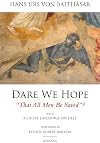
Dare We Hope That All Men be Saved?: With a Short Discourse on Hell
by Hans Urs von Balthasar
On This Page
Description
This book is perhaps one of the most misunderstood works of Catholic theology of our time. Critics contend that von Balthasar espouses universalism, the idea that all men will certainly be saved. Yet, as von Balthasar insists, damnation is a real possibility--for others but also for ourselves. Indeed, he explores the nature of damnation with sobering clarity. At the same time, he contends that a deep understanding of God's merciful love and human freedom, and a careful reading of the show more Catholic tradition, point to the possibility--not the certainty--that, in the end, all men will accept the salvation Christ won for all. For this all-embracing salvation, von Balthasar says, we may dare hope, we must pray, and with God's help we must work. The Catholic Church's teaching on Hell has been generally neglected by theologians, with the notable exception of von Balthasar. He grounds his reflections clearly in Sacred Scripture, and in Catholic teaching. While the Church asserts that certain individuals are in Heaven ("saints"), it never declares a specific individual to be in Hell. In fact, the Church hopes that in their final moments of life, even the greatest sinners would have repented of their terrible sins, and be saved. Sacred Scripture states, "God...desires all men to be saved and to come to the knowledge of the truth. For there is one God, and there is one Mediator between God and man, the man Christ Jesus, who gave himself as a ransom for all" (1st Timothy, 2:4). show lessTags
Recommendations


















Member Reviews
The Church's teaching on Hell has been generally neglected by theologians, with the notable exception of Fr. von Balthasar. However, what he has said has stirred controversy both in Europe and in the United States. Here he responds in a clear and concise way, grounding his reflections clearly in Scripture. Revelation gives us neither the assurance that all will be saved, nor the certitude that any are condemned. What it does require of us is the "hope that all men be saved" rooted in a love of Christ that reaches even into the depths of Hell.
I don't know why I keep reading these heavy theology books. Well I do know why, I'm hoping to learn more about my own faith so that I can better communicate to those who need more there there in order to believe. Yet I went away from this not really learning anymore than I did from reading discroptions of this work and the author's a Wikipedia page.
Basically we know hell is a real place. Jesus made this quite clear. The Church but can verify if someone is in heaven (the Saints who have been beatified) but we have no way of verifying for certain that someone is in hell. The Bible teaches that God desires that all men be saved, so who are we to claim that God does not save all men?
Personally I am not a universalist (someone who believes show more everyone will go to heaven) but I hope and pray that God is. show less
Basically we know hell is a real place. Jesus made this quite clear. The Church but can verify if someone is in heaven (the Saints who have been beatified) but we have no way of verifying for certain that someone is in hell. The Bible teaches that God desires that all men be saved, so who are we to claim that God does not save all men?
Personally I am not a universalist (someone who believes show more everyone will go to heaven) but I hope and pray that God is. show less
The premise of this book is fairly simple and plain and yet as with all things Balthasar it remains incredibly dense. Here are two quotes that capture a sense of what is being purported.
"... love hopes all things (1 Cor 13:7). It cannot do otherwise than to hope for the reconciliation of all men in Christ. Such unlimited hope is, from the Christian standpoint, not only permitted but commanded." (213)
"I would like to request that one be permitted to hope that God's redemptive work for his creation might succeed. Certainty cannot be attained, but hope can be justified." (187)
He covers a lot of ground in this small book and the tension he holds is commendable and I believe thoroughly biblical. This work is actually composed of three show more shorter writings. The first (Dare We Hope) is chronologically where he began to layout his thoughts on this controversial topic. The second (A Short Discourse) is a response to the critics of the first. The third and last portion is basically an epilogue comprised of two chapters dealing with 'apokatastasis' (i.e. universal salvation). Overall, this work definitely provides one with some thoughtful fodder for meditation on an oft neglected subject. show less
"... love hopes all things (1 Cor 13:7). It cannot do otherwise than to hope for the reconciliation of all men in Christ. Such unlimited hope is, from the Christian standpoint, not only permitted but commanded." (213)
"I would like to request that one be permitted to hope that God's redemptive work for his creation might succeed. Certainty cannot be attained, but hope can be justified." (187)
He covers a lot of ground in this small book and the tension he holds is commendable and I believe thoroughly biblical. This work is actually composed of three show more shorter writings. The first (Dare We Hope) is chronologically where he began to layout his thoughts on this controversial topic. The second (A Short Discourse) is a response to the critics of the first. The third and last portion is basically an epilogue comprised of two chapters dealing with 'apokatastasis' (i.e. universal salvation). Overall, this work definitely provides one with some thoughtful fodder for meditation on an oft neglected subject. show less
Ratings
Members
- Recently Added By
Author Information

194+ Works 9,681 Members
Hans Urs Von Balthasar, (1905-1988), a man of towering intellect and extraordinary culture and the author of vast theological works, is widely recognized as one of the most influential figures in theology from the twentieth century to the present. He is best known for his major work The Glory of the Lord, his multivolume trilogy on the beautiful, show more the good, and the true. show less
Series
Belongs to Publisher Series
Common Knowledge
- Canonical title
- Dare We Hope That All Men be Saved?: With a Short Discourse on Hell
- Original title
- Was dürfen wir hoffen?
- Alternate titles
- Dare we hope that "all men be saved"? : with a short discourse on hell
- Original publication date
- 1987
- Important places
- Hell
- Original language
- German
Classifications
Statistics
- Members
- 308
- Popularity
- 103,920
- Reviews
- 3
- Rating
- (3.75)
- Languages
- 6 — Czech, English, French, German, Italian, Polish
- Media
- Paper, Ebook
- ISBNs
- 9
- ASINs
- 1