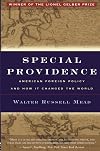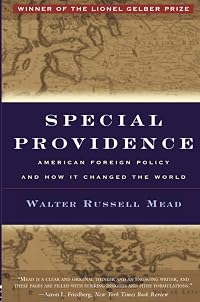
Special Providence: American Foreign Policy and How It Changed the World
by Walter Russell Mead
On This Page
Description
"God has a special providence for fools, drunks and the United States of America."--Otto von Bismarck America's response to the September 11 attacks spotlighted many of the country's longstanding goals on the world stage: to protect liberty at home, to secure America's economic interests, to spread democracy in totalitarian regimes and to vanquish the enemy utterly. One of America's leading foreign policy thinkers, Walter Russell Mead, argues that these diverse, conflicting impulses have in show more fact been the key to the U.S.'s success in the world. In a sweeping new synthesis, Mead uncovers four distinct historical patterns in foreign policy, each exemplified by a towering figure from our past. Wilsonians are moral missionaries, making the world safe for democracy by creating international watchdogs like the U.N. Hamiltonians likewise support international engagement, but their goal is to open foreign markets and expand the economy. Populist Jacksonians support a strong military, one that should be used rarely, but then with overwhelming force to bring the enemy to its knees. Jeffersonians, concerned primarily with liberty at home, are suspicious of both big military and large-scale international projects. A striking new vision of America's place in the world, Special Providence transcends stale debates about realists vs. idealists and hawks vs. doves to provide a revolutionary, nuanced, historically-grounded view of American foreign policy. show lessTags
Recommendations




Member Reviews
In Special Providence: American Foreign Policy and How It Changed the World, Walter Russell Mead gives his account of the history of U.S. foreign policy. Mead divides American foreign policy views into four schools, which he labels using an historic political figure who espoused those views. Those four schools are Hamiltonian, Wilsonian, Jeffersonian, and Jacksonian.
The Hamiltonian school focuses on American commercial interests. Hamiltonians believe that expanding American commerce should be the primary focus of U.S. foreign policy; this necessarily entails the development of a strong navy that can be used to protect American commercial interests on the seas and in foreign lands. Hamiltonians would avoid entangling foreign alliances show more for the main reason that it tends to reduce the opportunities for commercial engagement with opposing camps. But they would not shy away from fighting to protect America's primary commercial partners.
The Wilsonian school focuses on the expansion of liberal democratic institutions around the world under the theory that democracy has a pacifying effect on people, and, therefore, democracies do not fight each other. Wilsonians can be either doves or hawks, but engagement with the world is a positive good for this camp. Although, they too would avoid foreign alliances.
The Jeffersonian school focuses on the internal development and perfection of the American republic. Jeffersonians tend to be strongly anti-militarist to the point of advocating for the existence of a very small national army. Jeffersonians are, however, okay with a powerful navy. Jeffersonians are the most isolationist of the four schools; they believe that the American republic is a fragile experiment that must be protected from the corrupting influences of foreign countries. This is, by far, the least prominent school in modern America.
The Jacksonian school also focuses on the internal development and perfection of the American republic. Contrary to the Jeffersonians, though, Jacksonians believe that the United States cannot seal itself off from the corrupting influences of the world and must actively protect itself on the world stage. Jacksonians believe that the U.S. must maintain a strong military for defensive purposes, and that such defense will sometimes entail the projection of American military power to distant countries. Jacksonians typically do not like foreign alliances, but will gladly enter them if they believe that a threat to another country merely portends a threat to the United States.
As you would imagine, these descriptions given by Mead are merely simplifications of the complex foreign policy views that most American leaders and citizens have held over the years. They are, however, a good foundation upon which Mead builds his real work. Mead claims that these American foreign policy schools have had a major impact on world politics. While this is true, other than the Wilsonian school, none of these schools was really created by the United States. The real reason why American foreign policy thought has had such a major impact on world politics is not because of its intellectual draw, but because of the prevalence of American economic and military power. Again, with the exception of Wilsonianism, none of these schools is original to American foreign policy. It was American power that caused their impact on the world, not American originality in developing them. show less
The Hamiltonian school focuses on American commercial interests. Hamiltonians believe that expanding American commerce should be the primary focus of U.S. foreign policy; this necessarily entails the development of a strong navy that can be used to protect American commercial interests on the seas and in foreign lands. Hamiltonians would avoid entangling foreign alliances show more for the main reason that it tends to reduce the opportunities for commercial engagement with opposing camps. But they would not shy away from fighting to protect America's primary commercial partners.
The Wilsonian school focuses on the expansion of liberal democratic institutions around the world under the theory that democracy has a pacifying effect on people, and, therefore, democracies do not fight each other. Wilsonians can be either doves or hawks, but engagement with the world is a positive good for this camp. Although, they too would avoid foreign alliances.
The Jeffersonian school focuses on the internal development and perfection of the American republic. Jeffersonians tend to be strongly anti-militarist to the point of advocating for the existence of a very small national army. Jeffersonians are, however, okay with a powerful navy. Jeffersonians are the most isolationist of the four schools; they believe that the American republic is a fragile experiment that must be protected from the corrupting influences of foreign countries. This is, by far, the least prominent school in modern America.
The Jacksonian school also focuses on the internal development and perfection of the American republic. Contrary to the Jeffersonians, though, Jacksonians believe that the United States cannot seal itself off from the corrupting influences of the world and must actively protect itself on the world stage. Jacksonians believe that the U.S. must maintain a strong military for defensive purposes, and that such defense will sometimes entail the projection of American military power to distant countries. Jacksonians typically do not like foreign alliances, but will gladly enter them if they believe that a threat to another country merely portends a threat to the United States.
As you would imagine, these descriptions given by Mead are merely simplifications of the complex foreign policy views that most American leaders and citizens have held over the years. They are, however, a good foundation upon which Mead builds his real work. Mead claims that these American foreign policy schools have had a major impact on world politics. While this is true, other than the Wilsonian school, none of these schools was really created by the United States. The real reason why American foreign policy thought has had such a major impact on world politics is not because of its intellectual draw, but because of the prevalence of American economic and military power. Again, with the exception of Wilsonianism, none of these schools is original to American foreign policy. It was American power that caused their impact on the world, not American originality in developing them. show less
Ratings
Members
- Recently Added By
Author Information

14 Works 860 Members
Walter Russell Mead is Senior Fellow for U.S. Foreign Policy at the Council on Foreign Relations.
Awards and Honors
Common Knowledge
- Canonical title
- Special Providence: American Foreign Policy and How It Changed the World
- Original publication date
- 2001 (1st edition, New York, Knopf) (1st edition, New York, Knopf)
- Important places
- USA
- Epigraph
- God has a special providence for fools, drunks, and the United States of America.
--Attributed to Otto Von Bismarck - First words
- Lord Bryce, a British statesman who served as Britain's ambassador to the United States from 1907 to 1913, once wrote that the role of foreign policy in American life could be described the way travelers described snakes in I... (show all)reland: "There are no snakes in Ireland."
- Blurbers
- Brinkley, Douglas; Lind, Michael; Holbrooke, Richard; Mandelbaum, Michael; Steel, Ronald
- Disambiguation notice
- Full title (2001): Special providence : American foreign policy and how it changed the world
Classifications
- Genres
- Nonfiction, Politics and Government, History, General Nonfiction, Philosophy
- DDC/MDS
- 327.73 — Society, government, & culture Political science International Relations: Spies North America United States
- LCC
- E183.7 .M47156 — History of the United States United States History Diplomatic history. Foreign and general relations.
- BISAC
Statistics
- Members
- 305
- Popularity
- 105,519
- Reviews
- 1
- Rating
- (4.13)
- Languages
- English, French
- Media
- Paper, Ebook
- ISBNs
- 6
- ASINs
- 2