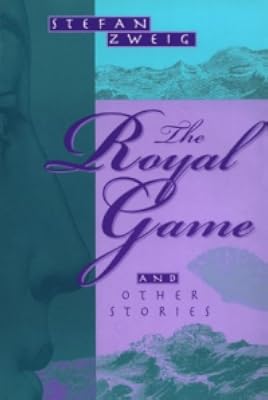
The Royal Game and Other Stories
by Stefan Zweig
On This Page
Description
Stefan Zweig gained early fame as a poet, translator, and biographer. When he added fiction to his repertoire, his work was critically acclaimed. However, Zweig has fallen into an undeserved obscurity, and unlike the works of his contemporaries and admirers--fellow Austrian and German writers such as Thomas Man, Herman Hesse, and Sigmund Freud--Zweig's writings have become almost completely unavailable to the English-speaking audience. The Royal Game and Other Stories is a collection of five show more of his brilliant creative achievements, revives Zweig's art, making it once again available to a wide range of readers. Spanning his entire career, the stories included--""The Royal Game,"" ""Amok,"" ""Letter from an Unknown Woman,"" ""The Burning Secret,"" and ""Fear""--each reveal an individual's passionate response to life. Toying with the theme of the mind left to itself, Zweig gives the reader everything from the story of a child's distrust of his mother to one of a man driven to insanity by his imaginary chess games. Zweig's enormous interest in psychology and psychological problems combine with early century settings to provide compelling stories that prove Zweig to be a master of psychological narrative. Through the years, the stories of Stefan Zweig have been hailed as intense and memorable psychological thrillers--adventures of the mind--with wide, universal appeal. The five masterpieces in this book reveal why Zweig has earned such praise, and should help his legacy continue on to a new generation of readers. show lessTags
Recommendations





















Member Reviews
A claustrophobic collection on monomania.
Zweig feels to me to be like the Jodi Picoult of his time: both are widely-read authors of their time whose almost defiantly-plain and simple proses are so good at capturing the psychology of individual characters leading up to and after a pivotal moment. The hindsight of time and his resurgent popularity have revealed Zweig to contain evergreen aspects of the human condition, which makes me wonder how fickle reading habits are and what contemporary works will still be marvelled in a century.
Favourite story: The Burning Secret is absolutely brilliant.
Remaining ranking: Followed by a tie between The Royal Game and Fear. Then Letter from an Unknown Woman. Then Amok firmly trampled and battened down show more in last place because I just loathe the plot itself. show less
Zweig feels to me to be like the Jodi Picoult of his time: both are widely-read authors of their time whose almost defiantly-plain and simple proses are so good at capturing the psychology of individual characters leading up to and after a pivotal moment. The hindsight of time and his resurgent popularity have revealed Zweig to contain evergreen aspects of the human condition, which makes me wonder how fickle reading habits are and what contemporary works will still be marvelled in a century.
Favourite story: The Burning Secret is absolutely brilliant.
Remaining ranking: Followed by a tie between The Royal Game and Fear. Then Letter from an Unknown Woman. Then Amok firmly trampled and battened down show more in last place because I just loathe the plot itself. show less
Zweig is a master storyteller! Each of these five long short stories (probably too long to be short stories and too short to be novellas) is a psychological thriller, describing obsession so clearly that you, the reader, are swept up its suspense. Zweig, an Austrian Jew, wrote "The Royal Game", during WWII. It has been said to depict Nazi psychological warfare. It along with "The Burning Secret" were my favorites in this volume. But each one is exceptional and wonderfully written. Highly recommended!
An amazing assemblage of stories. Although the titular one "takes the cake" (as they say) the rest were fully explorable. It was like going into a literary maze and experiencing everything while being guided on the path by the plot-line and being given asides by the characters. Zweig was a talent, for sure, and he shows himself in fine form here with his prose. There is a lot of creativity, originality, and things to garnish here and I recommend this book for all those interested in world literature. I assure you, it will not be a bad decision.
4.5 stars.
4.5 stars.
Well I think I liked this more than Twenty-four Hours in the Life of a Woman - although they are of course completely different subjects...or are they???? I think Zweig is interested in the human condition...and what IS the human condition, I hear you ask? Well, speaking as a mere human, who has not studied psychology or Freud or anything like that...for me ... the conundrum of human existence is that we often know better, but we don't....or we supposedly have access to rationality of thought but are subject to our whims or passion. Why, for example, every year do I firmly avow that I will lose weight, that I won't drink so much wine of an evening and yet...and yet....those enticing strawberry tartlets....that enticing glass of show more wine...or two....This next story from Zweig takes us on board a liner (ooh how I dream of travelling on a liner). Ooh how wonderful to not have to think of anything but the next game of chess or bridge.....or perhaps not? Travelling on the liner is Mirko Czentovic, the world chess champion. Mirko, despite his prowess at chess, to all intents and purposes is a social oaf - maybe even a cultural cretin. Our unnamed narrator declares a fascination with "monomania, by persons wrapped up in a single idea..." and sets out to snare the champion into a game or several games so he can "examine this speciment of one-track intellect under a magnifying glass." And so follows a study of all sorts of conundrums....can chess be called just a game? Can it be played alone? What is the difference between amateur and professional? Is obsession unhealthy? I don't want to give too much away but this is so much more than a story about playing by the rules...it's about playing to live or indeed, to survive. show less
Although there are a number of stories by Zweig that I have enjoyed a great deal, I did not particularly like (or enjoy) most of the ones in this collection, to my dismay (“The Royal Game,” “Amok,” “Fear,” “The Burning Secret”). They tended to impress me in their technical aspects: the care in the writing, the creativity, the plotting…but the stories as a whole left me largely unimpressed. Most deal with state of mind and interior thoughts. The one I enjoyed the most is one of his most famous stories, “Letter From an Unknown Woman.” It was made into a celebrated film in 1948 (by Max Ophüls) which I’ve never seen and into a Chinese version (that is quite faithful to the story) in 24 which I have enjoyed immensely.
I had never heard of Stefan Zweig and have LT members to thank for recommending this book.
Zweig was born in Vienna in 1881 to wealthy parents and became a poet, translator, biographer and novelist. His life ended dramatically when he and his wife committed suicide in Brazil in 1942 after being distraught over the increasing power of the Nazis in Europe.
The Royal Game (or Chess Story) was the last thing he wrote. The other stories in this collection are: Amok, The Burning Secret, Fear, and Letter From An Unknown Woman. For the most part, they are all stories of obsession (e.g., "chess-poisoning") or mental cat and mouse games where you're not always sure who's the cat and who's the mouse. There is a feverish quality to all the stories show more which I really got caught up in.
My favorite was probably Letter From An Unknown Woman about a famous novelist who receives a letter in an unknown handwriting addressed only "To you who never really knew me." There is no return address and no signature. It turns out to be a letter from a woman who has loved the novelist since she was 13 years old. "Nothing on earth equals the unseen, hidden love of a child, because it is so without hope, so servile, so submissive, so observant and intense, as the covetous and unconciously demanding love of a grown woman never is." (p. 223) The writer of the letter is now an adult who fears she may be dying of influenza and wants the novelist to know how much she loved him. "You'll receive this testament from me only when I'm dead--from one who loved you more than anyone else and whom you didn't recognise; from one who always waited for you but for whom you never sent." (p. 249) The big question is will the novelist figure out who sent the letter.
Another one I really liked was The Burning Secret. It's about a sickly, young boy recuperating at a resort with his mother whose boring days suddenly change with the arrival of a fascinating young bachelor on vacation who takes an interest in him. The boy's "face didn't altogether lack good looks but its character was as yet unformed. The battle between manhood and childhood seemed scarcely to have begun." (p. 103) The bachelor turns out to be an aristocratic baron who has hunted elephants in India and who is also a "woman hunter." The story is about what happens when it dawns on the boy that the bachelor is really interested in his mother, not him.
I'm giving this book 4 1/2 stars. I really enjoyed the stories but they are similar in tone and I would recommend reading them one at time with a break in between. They're all about 50 pages long and I'd make sure you had time to read each story straight through because once you start, you'll want to know how it ends. show less
Zweig was born in Vienna in 1881 to wealthy parents and became a poet, translator, biographer and novelist. His life ended dramatically when he and his wife committed suicide in Brazil in 1942 after being distraught over the increasing power of the Nazis in Europe.
The Royal Game (or Chess Story) was the last thing he wrote. The other stories in this collection are: Amok, The Burning Secret, Fear, and Letter From An Unknown Woman. For the most part, they are all stories of obsession (e.g., "chess-poisoning") or mental cat and mouse games where you're not always sure who's the cat and who's the mouse. There is a feverish quality to all the stories show more which I really got caught up in.
My favorite was probably Letter From An Unknown Woman about a famous novelist who receives a letter in an unknown handwriting addressed only "To you who never really knew me." There is no return address and no signature. It turns out to be a letter from a woman who has loved the novelist since she was 13 years old. "Nothing on earth equals the unseen, hidden love of a child, because it is so without hope, so servile, so submissive, so observant and intense, as the covetous and unconciously demanding love of a grown woman never is." (p. 223) The writer of the letter is now an adult who fears she may be dying of influenza and wants the novelist to know how much she loved him. "You'll receive this testament from me only when I'm dead--from one who loved you more than anyone else and whom you didn't recognise; from one who always waited for you but for whom you never sent." (p. 249) The big question is will the novelist figure out who sent the letter.
Another one I really liked was The Burning Secret. It's about a sickly, young boy recuperating at a resort with his mother whose boring days suddenly change with the arrival of a fascinating young bachelor on vacation who takes an interest in him. The boy's "face didn't altogether lack good looks but its character was as yet unformed. The battle between manhood and childhood seemed scarcely to have begun." (p. 103) The bachelor turns out to be an aristocratic baron who has hunted elephants in India and who is also a "woman hunter." The story is about what happens when it dawns on the boy that the bachelor is really interested in his mother, not him.
I'm giving this book 4 1/2 stars. I really enjoyed the stories but they are similar in tone and I would recommend reading them one at time with a break in between. They're all about 50 pages long and I'd make sure you had time to read each story straight through because once you start, you'll want to know how it ends. show less
Overall a very enjoyable experience. Every story a literal telling that was done masterfully. Though I typically enjoy a less literal work, Zweig can make you read on, and for that I am grateful, and also quite glad he has been rediscovered and getting his proper due.
Members
- Recently Added By
Lists

Blue Pyramid 1,276 Best Books of All Time
1,248 works; 32 members
Author Information

888+ Works 32,723 Members
Born in Vienna, the prolific Zweig was a poet in his early years. In the 1920s, he achieved fame with the many biographies he wrote of famous people including Balzac, Dostoevsky, Dickens and Freud. Erasmus with whom he closely identified, was the subject of a longer biography. He also wrote the novellas Amok (1922) and The Royal Game (1944). As show more Nazism spread, Zweig, a Jew, fled to the United States and then to Brazil. He hoped to start a new life there, but the haunting memory of Nazism, still undefeated, proved too much for him. He died with his wife in a suicide pact. (Bowker Author Biography) show less
Some Editions
Series
Belongs to Publisher Series
Work Relationships
Contains
Common Knowledge
- Canonical title
- The Royal Game and Other Stories
Classifications
- Genres
- Fiction and Literature, General Fiction
- DDC/MDS
- 833.912 — Literature & rhetoric German & related literatures German fiction 1900- 1900-1990 1900-1945
- LCC
- PT2653 .W42 .A24 — Language and Literature German, Dutch and Scandinavian literatures German literature Individual authors or works 1860/70-1960
- BISAC
Statistics
- Members
- 238
- Popularity
- 136,734
- Reviews
- 9
- Rating
- (4.19)
- Languages
- Dutch, English, German
- Media
- Paper
- ISBNs
- 8