A Party in Ramadan
by Asma Mobin-Uddin
On This Page
Description
Ramadan is coming and Leena is excited. Although she is too young to fast each day during the Muslim holy month, she decides to fast on a Friday that her aunt will be visiting. Now Leena has a dilemma. She receives an invitation to a party which happens to fall on that same Friday. Leena doesn't want to miss the party, but she doesn't want to miss fasting either. So Leena decides to go to the party, but not eat or drink Later, she will join her family for the meal known as iftar, when the show more daily fast is broken. But when Leena, who is the only Muslim at the party, sees her friends enjoying fresh lemonade and chocolate cake, her stomach starts to growl and her head begins to hurt. Will she keep her Ramadan fast? show lessTags
Recommendations













Member Reviews
Although too young to participate in the full month of Ramadan fasting, Leena is determined to abstain from food and water for at least one day, selecting the very first Friday of the season, when her Aunt Sana will be visiting with the family. But when she is invited to her friend Julia's birthday party - a party with a pony! - the very same day, she is faced with a difficult choice. Leena doesn't want to give up her fast (and the subsequent breaking of the fast, together with her family), but also doesn't want to miss the party. If she attends the party while also fasting, can she hold to her intention, in the face of chocolate cake and lemonade?
This warmhearted, realistic examination of one young Muslim girl's experiences, in trying show more to reconcile her religious duties with the social demands of a multicultural society - one in which many of her friends do not observe the same customs - is absolutely spot-on, really highlighting the importance of Ramadan in a way I have not seen in other children's books on the subject. Perhaps because the reader can see the tension in A Party in Ramadan, is witness to the young heroine's struggle to reconcile her two conflicting desires, as well as what she believes she should do, the narrative here (without being morose) is really quite moving. The happy ending is just icing on the cake!
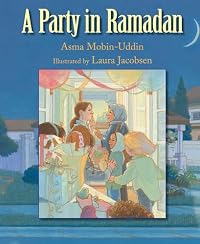
With an engaging story, appealing pastel pencil illustrations by Laura Jacobsen, and a little author's note at the end, explaining the significance of the month of Ramadan, this is now one of my favorite children's books on the topic! Highly recommended (along with Maha Addasi's The White Nights of Ramadan) to anyone looking for high quality stories set during this important time in the Islamic calendar! show less
This warmhearted, realistic examination of one young Muslim girl's experiences, in trying show more to reconcile her religious duties with the social demands of a multicultural society - one in which many of her friends do not observe the same customs - is absolutely spot-on, really highlighting the importance of Ramadan in a way I have not seen in other children's books on the subject. Perhaps because the reader can see the tension in A Party in Ramadan, is witness to the young heroine's struggle to reconcile her two conflicting desires, as well as what she believes she should do, the narrative here (without being morose) is really quite moving. The happy ending is just icing on the cake!
With an engaging story, appealing pastel pencil illustrations by Laura Jacobsen, and a little author's note at the end, explaining the significance of the month of Ramadan, this is now one of my favorite children's books on the topic! Highly recommended (along with Maha Addasi's The White Nights of Ramadan) to anyone looking for high quality stories set during this important time in the Islamic calendar! show less
I absolutely love this CRF book. The plot of this book is so well developed that I didn't need to necessarily know anything about Ramadan to follow along. For example, throughout the book the reader is given information on the traditions and Leena's want to participate. Another thing I love about this book is that it challenges readers to see a new perspective. There are not many books that focus on Islamic culture, so this book is a really great window into that culture as well as a mirror (in my case) for Leena's friends and how they can cross cultural divides to support their friend. The big idea of this book is to value your culture.
The book, A Party in Ramadan, did a very good job at interweaving religion and culture into this book. I liked this book because it portrayed an experience that could be relatable to some students. This contemporary realistic fiction book pushed the reader to think about tough issues and broaden perspectives by showing what those who celebrate Ramadan had to do during their fasting period. "Leena's mother explained that, because Leena was fasting, she would not be eating with the other girls. 'Oh, but we're not having a meal,' Mrs. Bernard said, 'We're just having cake and punch.' 'She can't eat or drink anything at all during the fast,' said Leena's mother, 'not even water." In this quote, the author shows the mother explaining the show more fast to Mrs. Bernard, who was unaware of the specifics of Ramadan. This example could also inform readers who may be just as unaware about Ramadan. It could give the reader a different perspective and issue to think about. A child who may celebrate other religious holidays could read this book and have a greater understanding for what students who celebrate Ramadan may experience.
The plot also did a great job at portraying this tough issue throughout the story. There was plenty of conflict when Leena saw the other kids eating cake or drinking lemonade and wished she could be there sharing in that experience. "Leena smiled at her friend. 'Thanks, Amy, but I'm fine. Go and eat, and then we'll sit together. Don't miss the chocolate cake.' Amy paused, 'Are you sure?' she asked. 'Yes, I'm sure,' said Leena. But Leena was not so sure." Not being able to eat all day was a major struggle for Leena, but she wanted others to experience the party, even if she had to wait to eat. Later in the story, the author showed the two cultures merging together and appreciating a difference in religion and beliefs. "As the family began eating dessert, the doorbell rang. It was Julia and her family and Amy and her mom. They were carrying chocolate cake from the party. 'Hello Mrs. Ahmad,' said Mrs. Bernard. 'We thought Leena might like some cake. We saved some for her.' 'How kind of you! Please join us for dinner,' said Leena's mom, warmly inviting the guests to the table." Here, it shows the other family's appreciation for Leena and her dedication to her religion to not take the cake earlier at the party. I also like that it shows Leena's family welcoming the guests into their home during the holiday. At the end of the book, Leena gets chocolate pudding from her family as a reward for fasting during the party. "She looked into her sister's face. She remembered how she had felt at the party when she really wanted to eat the chocolate icing on Julia's cake and couldn't. Leena took a second spoonful of pudding. The she slid the cup in front of her sister. 'Here you go, Amira. You can have the rest.'" This is how the book ends and I love that it included the golden rule of treat others how you would like to be treated. Leena acknowledges how much she had to resist earlier in the day and wanted her sister not to have a similar experience. Overall, the main message of the book is to appreciate multiple cultures and religions, and that if you show dedication to your beliefs, others may grow in appreciation for you and your religious ways. show less
The plot also did a great job at portraying this tough issue throughout the story. There was plenty of conflict when Leena saw the other kids eating cake or drinking lemonade and wished she could be there sharing in that experience. "Leena smiled at her friend. 'Thanks, Amy, but I'm fine. Go and eat, and then we'll sit together. Don't miss the chocolate cake.' Amy paused, 'Are you sure?' she asked. 'Yes, I'm sure,' said Leena. But Leena was not so sure." Not being able to eat all day was a major struggle for Leena, but she wanted others to experience the party, even if she had to wait to eat. Later in the story, the author showed the two cultures merging together and appreciating a difference in religion and beliefs. "As the family began eating dessert, the doorbell rang. It was Julia and her family and Amy and her mom. They were carrying chocolate cake from the party. 'Hello Mrs. Ahmad,' said Mrs. Bernard. 'We thought Leena might like some cake. We saved some for her.' 'How kind of you! Please join us for dinner,' said Leena's mom, warmly inviting the guests to the table." Here, it shows the other family's appreciation for Leena and her dedication to her religion to not take the cake earlier at the party. I also like that it shows Leena's family welcoming the guests into their home during the holiday. At the end of the book, Leena gets chocolate pudding from her family as a reward for fasting during the party. "She looked into her sister's face. She remembered how she had felt at the party when she really wanted to eat the chocolate icing on Julia's cake and couldn't. Leena took a second spoonful of pudding. The she slid the cup in front of her sister. 'Here you go, Amira. You can have the rest.'" This is how the book ends and I love that it included the golden rule of treat others how you would like to be treated. Leena acknowledges how much she had to resist earlier in the day and wanted her sister not to have a similar experience. Overall, the main message of the book is to appreciate multiple cultures and religions, and that if you show dedication to your beliefs, others may grow in appreciation for you and your religious ways. show less
A lot of dialogue here, but a unique approach! Young Muslim girl Lina is learning how to negotiate her religious identity with the non-Muslim circle of friends and environment she's in. The message is about strong faith, and how even strong faith is tested in order to teach us and make us stronger.
This is very overtly religious. Some Ramadan books do not as actively engage with the meaning of ritual as this one. For that reason, I like this book a lot; for that reason, there may be pushback about this book in the American public school system. (Just something to beware of.)
The struggle, however, is very relevant to Muslim children in the 2nd-4th grades. It seems the 3rd grade is about the time that most Muslim youth are starting to do show more the whole Ramadan fast, and learning how to be hungry and still love their God is difficult. This book directly deals with what it's like to be a hungry kid and not understanding why a loving god would have such high demands. For kids and families who share this way of thinking, this may be a good book to read. It's quite long--- considering the target age group, I don't imagine an 8-10 year old reading this alone, but maybe an older kid would enjoy reading it and reminiscing about her or his first Ramadan. show less
This is very overtly religious. Some Ramadan books do not as actively engage with the meaning of ritual as this one. For that reason, I like this book a lot; for that reason, there may be pushback about this book in the American public school system. (Just something to beware of.)
The struggle, however, is very relevant to Muslim children in the 2nd-4th grades. It seems the 3rd grade is about the time that most Muslim youth are starting to do show more the whole Ramadan fast, and learning how to be hungry and still love their God is difficult. This book directly deals with what it's like to be a hungry kid and not understanding why a loving god would have such high demands. For kids and families who share this way of thinking, this may be a good book to read. It's quite long--- considering the target age group, I don't imagine an 8-10 year old reading this alone, but maybe an older kid would enjoy reading it and reminiscing about her or his first Ramadan. show less
I read “A Party in Ramadan” by Asma Mobin-Uddin. The book was a realistic fiction picture book. The author used plot, characters, and illustrations to incorporate with the main theme of importance of religion.
The author used plot by creating a scenario where the main character’s religion was a barrier for attending his friend’s birthday party, but in the end, the kids brought food from the party to celebrate the breaking of the fast.
The author’s use of characters helps by showing how even though none of the boy’s friends shared the same religion, they still cared enough to be included in it.
Lastly, the author’s use of illustrations helps because a lot of kids do not know what Ramadan is and by seeing pictures, it gives show more them a better sense of what it’s all about. show less
The author used plot by creating a scenario where the main character’s religion was a barrier for attending his friend’s birthday party, but in the end, the kids brought food from the party to celebrate the breaking of the fast.
The author’s use of characters helps by showing how even though none of the boy’s friends shared the same religion, they still cared enough to be included in it.
Lastly, the author’s use of illustrations helps because a lot of kids do not know what Ramadan is and by seeing pictures, it gives show more them a better sense of what it’s all about. show less
I liked this story for many reasons. One of them being it gets readers familiar with a culture. For example, in the story a little girl goes to a party, but cannot eat the cake because she is fasting for Ramadan. This shows readers what Ramadan is, what it is like, and what people who participate in it have to do. Another reason I like the story is because it pushes readers outside of the normal literature story. For example, it focuses on culture other than American. Readers are able to be immersed into a new culture and take a closer look into how the Muslim culture celebrates, thinks, and feels. The main message of this story is to appreciate where you come from. Leena was upset at first about not being able to eat at the birthday show more party she was at. By the end she discovered that it was worth it and to appreciate her culture. show less
I liked this book for two reasons. First, I liked the plot because I was able to learn more about Ramadan and how people celebrate it. It was interesting to see how Leena's religion impacted her social life, and how her friends reacted to her not being allowed to eat anything at the party because she was fasting for Ramadan. I also liked this book because of the characters. It was nice reading about how supportive Leena's family was towards her fasting, with her mother reminding her that she didn't have to if she wasn't feeling up to it. Her friends and their parents were also very understanding by bringing Leena cake after the party so she wouldn't feel left out. The main message of this book is to stand by what you believe in, even if show more it is difficult. Fasting was difficult for Leena, but she still managed to get through the day with the support of her friends and family. show less
Members
- Recently Added By
Author Information

3 Works 343 Members
All Editions
Awards and Honors
Awards
Notable Lists
Classifications
Statistics
- Members
- 68
- Popularity
- 458,387
- Reviews
- 14
- Rating
- (4.30)
- Languages
- English
- Media
- Paper, Ebook
- ISBNs
- 4
- ASINs
- 1