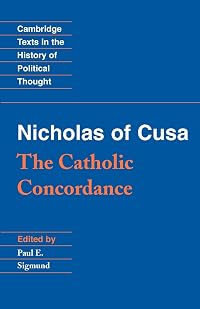
Nicholas of Cusa: The Catholic Concordance
by Nicholas of Cusa
On This Page
Description
Now available in paperback, this is the first English translation of the most important work of political thought of the fifteenth century. The Catholic Concordance is the first major treatise to argue for consent through representative councils as a major prerequisite for legitimate law and government, and is the most learned and original work associated with the conciliar movement in the late medieval church. Cusa's arguments influenced such thinkers as Luther, Bruno and Locke, and show more Professor Sigmund's introduction places his work in its full historical and philosophical context. The volume contains all the standard series features including a chronology, note on sources and bibliography, and as one of the earliest formulations of the view that political legitimacy rests on consent, The Catholic Concordance will be of interest to a wide range of scholars and students of the history of European ideas. show lessTags
Recommendations








Members
- Recently Added By
Author Information

137+ Works 869 Members
Churchman, humanist, and philosopher, Nicholas of Cusa was born in Kues (Latin, Cusa), Germany, and educated at the famous school of the Brethren of the Common Life in Deventer, Holland. Following university training in philosophy, theology, and canon law, he began a career as a legal adviser to church officials. He served on several important show more embassies as papal representative and was made a cardinal in 1448. Nicholas's philosophical works are characterized by their concern with the problem of knowledge. On Learned Ignorance (De Docta Ignorantia) and On Conjectures (De conjecturis), both written in 1440, emphasize the limitation placed on human reason by its need to extend its knowledge through a comparison of the unknown with the known. Since absolute precision can never be attained by a finite comparative power, the absolute truth is unattainable by rational means. Wisdom thus consists in recognizing the approximate, conjectural character of all rational theories, and Nicholas was hopeful that reflection on the limits of rational investigation would serve to banish dogmatism from philosophical and theological disputes. In his cosmological speculations, he asserted the indeterminacy of the physical universe, and hence denied that the earth could be located precisely at the center of the cosmos. He thus represents a step toward a more open-ended view of the universe. (Bowker Author Biography) show less
Series
Belongs to Publisher Series
Common Knowledge
- Canonical title
- Nicholas of Cusa: The Catholic Concordance
Classifications
- Genres
- Nonfiction, Religion & Spirituality, History, Philosophy, Politics and Government
- DDC/MDS
- 262.02 — Religion Christian organization, social work & worship Ecclesiology Ecclesiastic Polity Catholic
- LCC
- BX1790 .N5 .C613 — Philosophy, Psychology and Religion Christian Denominations Christian Denominations Catholic Church Catholic Church and the state
- BISAC
Statistics
- Members
- 40
- Popularity
- 733,711
- Languages
- English, Slovenian
- Media
- Paper, Ebook
- ISBNs
- 3