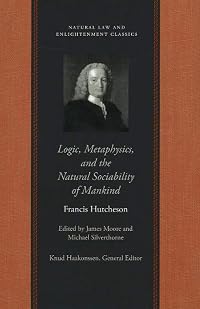
Logic, Metaphysics, And the Natural Sociability of Mankind
by Francis Hutcheson
On This Page
Description
Until the publication of this Liberty Fund edition, all but one of the works contained in "Logic, Metaphysics, and the Natural Sociability of Mankind" were available only in Latin. This milestone English translation will provide a general audience with insight into Hutcheson's thought. In the words of the editors: "Hutcheson's Latin texts in logic ("Logicae Compendium") and metaphysics "(Synopsis Metaphysicae") form an important part of his collected works. Published respectively in 1756 show more and, in its second edition, 1744, these works represent Hutcheson's only systematic treatments of logic, ontology, and pneumatology, or the science of the soul. They were considered indispensable texts for the instruction of students in the eighteenth century. Any serious study of Hutcheson's moral and political philosophy must take into account his understanding of logic (of ideas, judgments, propositions, and reasoning) and metaphysics (of existence, individuation, causation, substance, the soul, and the attributes of God)." The introduction and notes to this translation situate the texts in the context of Hutcheson's mature philosophy and relate it to his teaching at Glasgow from 1730 until his death in 1746. At the same time, the editors show the links to his early teaching in Dublin in the 1720s. The work on natural sociability was Hutcheson's significant inaugural lecture at Glasgow.. James Moore is Emeritus Professor of Political Science at Concordia University in Montreal. Michael Silverthorne is Honorary University Fellow in the School of Classics at the University of Exeter. Knud Haakonssen is Professor of Intellectual History and Director of the Centre for Intellectual History at the University of Sussex, England. show lessTags
Recommendations













Members
- Recently Added By
Author Information
22+ Works 375 Members
The founder of moral sense theory was born in County Down, Ireland. Francis Hutcheson's father and grandfather were Presbyterian ministers, and he studied at the University of Glasgow from 1711 to 1717 in preparation for the Presbyterian ministry. For the next decade, he taught at an academy for dissenting clergy in Dublin, most of the time show more serving as its head. He was appointed professor of moral philosophy at Glasgow in 1730, a position he held until his death. Hutcheson's principal contributions to philosophy were in the fields of moral philosophy and aesthetics. His chief works are Inquiry into the Original of Our Ideas of Beauty and Virtue (1725), Philosophiae Moralis Institutio (1742), and the posthumously published System of Moral Philosophy (1755). Against the English rationalists Samuel Clarke and Richard Price, Hutcheson rigorously developed Shaftesbury's suggestion that moral distinctions are made by our sensitive rather than our rational nature. In aesthetics he gave an analogous account of our sense of beauty. Hutcheson's theories profoundly influenced Hume and also had a significant impact on Kant in his precritical period. (Bowker Author Biography) show less
Series
Belongs to Publisher Series
Common Knowledge
- Canonical title
- Logic, Metaphysics, And the Natural Sociability of Mankind
Classifications
Statistics
- Members
- 46
- Popularity
- 650,499
- Languages
- English
- Media
- Paper, Ebook
- ISBNs
- 4
- ASINs
- 1