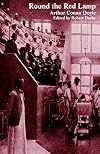
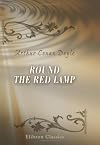
Round the Red Lamp
by Arthur Conan Doyle 
On This Page
Description
Today, he is acclaimed as one of the most famous originators of the genre of detective fiction, but Sir Arthur Conan Doyle's literary talents were broad, and he dabbled in many styles and themes over the course of his career. Round the Red Lamp is one of Doyle's tales set in the rough and tumble world of the nineteenth-century medical establishment..
Tags
Recommendations


















Member Reviews
Facts and fancies of medical life. This collection includes two fantasy tales, "Lot No. 249," featuring a reanimated mummy, and "The Los Amigos Fiasco," in which an attempt to electrocute a criminal creates a superhuman prisoner who cannot be killed.
This collection began as a series of eight stories commissioned by Jerome K. Jerome for his Idler magazine, but, of the eight, only three appeared there, the other five having been rejected for being too "realistic". In his preface, Doyle notes that a red lamp "is the usual sign of a general practitioner in England." This volume includes 15 medical stories. Several of the short stories appear in this volume for the first time because "when they were written, they proved to be too strong for show more the public taste." Doyle defends the emphasis in these stories on "the graver side of life," and compares their action on the reader to a tonic, "bitter to the taste but bracing in the result." [Note: Doyle wrote 18 short stories that Rodin and Key defined as "medical fiction."] show less
This collection began as a series of eight stories commissioned by Jerome K. Jerome for his Idler magazine, but, of the eight, only three appeared there, the other five having been rejected for being too "realistic". In his preface, Doyle notes that a red lamp "is the usual sign of a general practitioner in England." This volume includes 15 medical stories. Several of the short stories appear in this volume for the first time because "when they were written, they proved to be too strong for show more the public taste." Doyle defends the emphasis in these stories on "the graver side of life," and compares their action on the reader to a tonic, "bitter to the taste but bracing in the result." [Note: Doyle wrote 18 short stories that Rodin and Key defined as "medical fiction."] show less
Ratings
Members
- Recently Added By
Author Information

3,989+ Works 169,268 Members
The most famous fictional detective in the world is Arthur Conan Doyle's Sherlock Holmes. However, Doyle was, at best, ambivalent about his immensely successful literary creation and, at worst, resentful that his more "serious" fiction was relatively ignored. Born in Edinburgh, Doyle studied medicine from 1876 to 1881 and received his M.D. in show more 1885. He worked as a military physician in South Africa during the Boer War and was knighted in 1902 for his exceptional service. Doyle was drawn to writing at an early age. Although he attempted to enter private practice in Southsea, Portsmouth, in 1882, he soon turned to writing in his spare time; it eventually became his profession. As a Liberal Unionist, Doyle ran, unsuccessfully, for Parliament in 1903. During his later years, Doyle became an avowed spiritualist. Doyle sold his first story, "The Mystery of the Sasassa Valley," to Chambers' Journal in 1879. When Doyle published the novel, A Study in Scarlet in 1887, Sherlock Holmes was introduced to an avid public. Doyle is reputed to have used one of his medical professors, Dr. Joseph Bell, as a model for Holmes's character. Eventually, Doyle wrote three additional Holmes novels and five collections of Holmes short stories. A brilliant, though somewhat eccentric, detective, Holmes employs scientific methods of observation and deduction to solve the mysteries that he investigates. Although an "amateur" private detective, he is frequently called upon by Scotland Yard for assistance. Holmes's assistant, the faithful Dr. Watson, provides a striking contrast to Holmes's brilliant intellect and, in Doyle's day at least, serves as a character with whom the reader can readily identify. Having tired of Holmes's popularity, Doyle even tried to kill the great detective in "The Final Problem" but was forced by an outraged public to resurrect him in 1903. Although Holmes remained Doyle's most popular literary creation, Doyle wrote prolifically in other genres, including historical adventure, science fiction, and supernatural fiction. Despite Doyle's sometimes careless writing, he was a superb storyteller. His great skill as a popular author lay in his technique of involving readers in his highly entertaining adventures. (Bowker Author Biography) show less
Arthur Conan Doyle has a Legacy Library. Legacy libraries are the personal libraries of famous readers, entered by LibraryThing members from the Legacy Libraries group.
Series
Belongs to Publisher Series
Work Relationships
Is contained in
Contains
Common Knowledge
- Original title
- Round the Red Lamp: Being Facts and Fancies of Medical Life
- Original publication date
- 1894-10-23
- First words
- My first interview with Dr James Winter was under dramatic circumstances.
[Being an extract from a long and animated correspondence with a friend in America.]
I quite recognise the force of your objection that an invalid or a woman in weak health would get no good from stories which attempt ... (show all)to treat some features of medical life with a certain amount of realism. (Preface)
Classifications
Statistics
- Members
- 125
- Popularity
- 256,196
- Reviews
- 1
- Rating
- (4.00)
- Languages
- English, Italian, Spanish, Swedish
- Media
- Paper, Ebook
- ISBNs
- 55
- ASINs
- 8