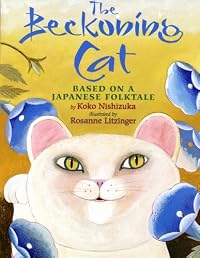
The Beckoning Cat: Based on a Japanese Folktale
by Koko Nishizuka
On This Page
Description
A retelling of the traditional Japanese tale describing the origins of the beckoning cat and how it came to be a symbol of good luck.Tags
Recommendations


















Member Reviews
Yohei, a poor young fish-monger whose father is very ill, finds his luck begins to change after the white cat he helps one rainy night decides to repay his kindness, bringing him many new customers. Taken from Japanese folklore, Nishizuka's book is rather unprepossessing at first, until the reader is gradually won over by the combination of simple text and gentle illustrations. Rosanne Litzinger's watercolor, pencil, and gouache art utilizes an appealing color range, and although her rounded human figures didn't always appeal to me, I thought her kitty-cat was adorable.
I did wish, as I so often do, that the author had provided some sort of background information or source material, so those interested in reading further could do so. show more When and where in Japan did this story originate...? Is it still well-known, or do people accept the porcelain cat-figures as a matter of course, without thinking of their origin? In any case, I did enjoy this little book, and having never noticed the beckoning cat in any of the many Japanese restaurants I frequent, will now be on the lookout for it... show less
I did wish, as I so often do, that the author had provided some sort of background information or source material, so those interested in reading further could do so. show more When and where in Japan did this story originate...? Is it still well-known, or do people accept the porcelain cat-figures as a matter of course, without thinking of their origin? In any case, I did enjoy this little book, and having never noticed the beckoning cat in any of the many Japanese restaurants I frequent, will now be on the lookout for it... show less
I really liked this book. It was very informational to me. The pictures really enhanced the feeling of the book. I could really see how tired he must be getting from carrying the balanced barrels on his back. I've only seen this in movies with older men, not children. And I loved the plot and how the cat brought all of these people to buy Yohei's fish when he couldn't go out and sell them himself. I can really relate to not wanting to leave the house, as my mother has cancer, and I want to stay with her as much as possible. So, I understand how thankful and grateful he must be to the cat and those people for coming to him so he could still do what he needs to. The big message for this book, is friends can make a big difference. I would show more definitely recommend this book to anyone else. Now I understand what the cat means when I go into a Chinese restaurant. show less
Traditional
The origin story of the maneki-neko, or beckoning cat. If you've ever been to a Sushi restaurant, you've seen the little white cat, sitting on a red pillow, one paw lifted into the air. It is the symbol of good fortune in Japan. I love traditional folk tales, and Japanese tales are especially rich in content. I thought this was a great story of friendship and loyalty, and successfully conveyed ideas of taking care of those less fortunate than you, doing good works.
The origin story of the maneki-neko, or beckoning cat. If you've ever been to a Sushi restaurant, you've seen the little white cat, sitting on a red pillow, one paw lifted into the air. It is the symbol of good fortune in Japan. I love traditional folk tales, and Japanese tales are especially rich in content. I thought this was a great story of friendship and loyalty, and successfully conveyed ideas of taking care of those less fortunate than you, doing good works.
Yohei is a young boy who sells fish each day in order to take care of his ill father. One rainy night, he finds a stray cat at his doorstep. He brings the cat into his home and gives the cat half of his dinner even though he knows that he will go to bed hungry because of this. The next day, Yohei is forced to leave his fish selling when he receives word that his father has a high fever. As Yohei is tending to his father, people begin to show up at his door to buy fish. They claim that the cat summoned them over by waiving to them. With the help of the cat beckoning people over, Yohei is able to sell enough fish to afford to get the medicine that his father needs.
As almost everyone has seen the beckoning "Lucky Cat" statues, this is a tale that is sure to intrigue children. The words and images play well off of each other, with the soft yet accented illustrations creating a child-friendly feel while pairing well with the Japanese style. It is a sweet tale of repayments of kindness.
This exploration into Japanese folklore is great for students because most would be able to recognize the "Lucky Cat" and relate the story to their lives. It is a fantastic inspiration for students to perform good deeds.
This exploration into Japanese folklore is great for students because most would be able to recognize the "Lucky Cat" and relate the story to their lives. It is a fantastic inspiration for students to perform good deeds.
Yohei is a young boy who lives in a small Japanese village. He takes care of his father, who is sick, and sells fish door to door and in the port in order to pay for his medicine. Even though he worked very hard they were very poor. One day, Yohei opened the door to find a dirty white cat asking to come in. Even though they had very little food, Yohei shares his portion with the cat and quickly makes a new friend. The ext day the cat was gone. Three days later Yohei had to end his day early as his father was running a very high fever. He did not know what to do since he could not sell fish and take care of his father at the same time.
Suddenly, people started knocking on Yohei's door wanting to buy fish. They all told him that they were show more showed the way to his house by the white cat who waved in his direction. People continued to come to Yohei's home to buy fish and he was able to take care of his father and make money for them at the same time. He bought his father the medicine he needed and he got better. This is how the symbol of the beckoning cat came to mean good luck and wealth in Japan.
I thought this book was very interesting as I did not know the story behind the figurines. I have seen them many times but it did not occur to me that there would be such a long history behind them. The story explains it well and has a good moral for children to learn.
The art is beautiful and goes very well with the story. It is traditional and seems historically accurate regarding dress and style of the era. The cat is drawn to resemble the figurines more than a real cat but it makes it easy to make the correlation between them that way. show less
Suddenly, people started knocking on Yohei's door wanting to buy fish. They all told him that they were show more showed the way to his house by the white cat who waved in his direction. People continued to come to Yohei's home to buy fish and he was able to take care of his father and make money for them at the same time. He bought his father the medicine he needed and he got better. This is how the symbol of the beckoning cat came to mean good luck and wealth in Japan.
I thought this book was very interesting as I did not know the story behind the figurines. I have seen them many times but it did not occur to me that there would be such a long history behind them. The story explains it well and has a good moral for children to learn.
The art is beautiful and goes very well with the story. It is traditional and seems historically accurate regarding dress and style of the era. The cat is drawn to resemble the figurines more than a real cat but it makes it easy to make the correlation between them that way. show less
The story introduces us to Yohei, who buys fish from the port and then sells them door-to-door. He is a poor kid but a hard worker. When his father takes ill, he has to work even harder to get money for medicine for his father, but he can't carry more than a couple baskets of fish. One night, a cat shows up, all wet and shivering. He takes the cat in, warms her up, and feeds her half of his (tiny) supper. Kitty is happy and purrs and disappears the next day. Shortly thereafter, Yohei's father grows worse and he is forced to go home and care for him. He's worried about how he can do his job when he can't leave the house.
The white cat shows up again. Then people start coming to his house to buy fish; the cat is outside the home and show more "beckoning" at people with one raised paw to bring them over. Yohei is able to stay at home to care for his dad and sells all his fish. He eventually makes enough money to buy his dad medicine, so his dad gets better.
The artist does an excellent job in matching her art to the story. The characters are dressed in appropriate, traditional Japanese clothing, and the art has the vibe of Japanese folk art. It reminds me of paintings I have seen done by Japanese artists.
The tale explains the source and origin behind the white ceramic cat that many Japanese shops and restaurants showcase in their business. It is done in the hope of attracting new customers and welcoming old ones. I'd always wondered what that statue meant, so this was an interesting read! show less
The white cat shows up again. Then people start coming to his house to buy fish; the cat is outside the home and show more "beckoning" at people with one raised paw to bring them over. Yohei is able to stay at home to care for his dad and sells all his fish. He eventually makes enough money to buy his dad medicine, so his dad gets better.
The artist does an excellent job in matching her art to the story. The characters are dressed in appropriate, traditional Japanese clothing, and the art has the vibe of Japanese folk art. It reminds me of paintings I have seen done by Japanese artists.
The tale explains the source and origin behind the white ceramic cat that many Japanese shops and restaurants showcase in their business. It is done in the hope of attracting new customers and welcoming old ones. I'd always wondered what that statue meant, so this was an interesting read! show less
Members
- Recently Added By
Lists

My Wishlist - Children's
185 works; 4 members

al.vick-wishlist-Children's
462 works; 3 members
Author Information
1 Work 158 Members
All Editions
Awards and Honors
Classifications
Statistics
- Members
- 158
- Popularity
- 206,587
- Reviews
- 59
- Rating
- (4.09)
- Languages
- English
- Media
- Paper
- ISBNs
- 5
- ASINs
- 5