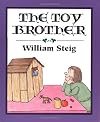
The Toy Brother
by William Steig
On This Page
Description
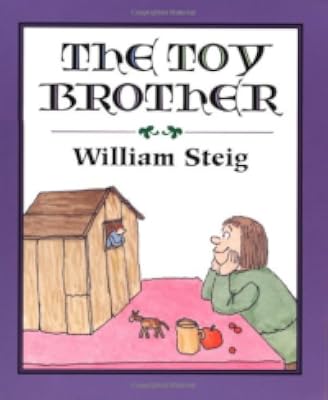
An apprentice alchemist finds that his despised kid brother is the only one who can help him when he concocts a potion which makes him the size of a peanut.Tags
Recommendations



Member Reviews
Pass on this if your family prefers to avoid magic.
This book is a good one for exploring pride, disobedience, natural (or perhaps unnatural) consequences, sibling relationships, caring for others and good/bad decisions.
This book is a good one for exploring pride, disobedience, natural (or perhaps unnatural) consequences, sibling relationships, caring for others and good/bad decisions.
This is a perfectly competent story about what happens when one brother shrinks himself when their parents are away. Wacky Hijinks Ensue!
Except I didn't find it very interesting myself. The storyline is fairly realistic (well, once you get over the magic), but it just didn't draw me in. And so it goes, we can't all be fans of every book.
Except I didn't find it very interesting myself. The storyline is fairly realistic (well, once you get over the magic), but it just didn't draw me in. And so it goes, we can't all be fans of every book.
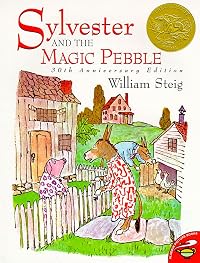
... altogether out of their medieval minds." Too funny. And it's got brotherly relationships down pat. I like this more than Sylvester and the Magic Pebble and am keeping it for a while, to reread before giving to my OBCZ."
This is a really interesting book that has some great vocabulary words in it. It is probably best for older children, grades four and up. It teaches them about family relationships and teamwork.
Ratings
Members
- Recently Added By
Lists

The Story of the World: History for the Classical Child: Activity Book Two
415 works; 2 members
Author Information

73+ Works 31,522 Members
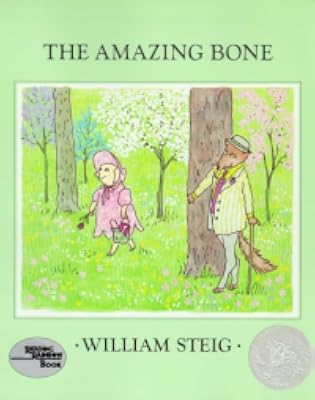
William Steig was born in Brooklyn, New York, on November 14, 1907, and spent his childhood in the Bronx. Steig found an outlet for his talent by creating cartoons for the high school newspaper. After high school graduation, Steig spent two years at City College, three years at the National Academy, and five days at the Yale School of Fine Arts show more before dropping out. During his early days as a free-lance artist, he supplemented his income with work in advertising, although he intensely disliked it. He illustrated for the The New Yorker, beginning in 1930. During the 1940s, Steig's creativity found a more agreeable outlet when he began carving figurines in wood; his sculptures are on display as part of the collection in the historic home of Franklin D. Roosevelt in Hyde Park, New York, and in several museums in New England. In 1967, Bob Kraus, a fellow cartoonist at The New Yorker, was in the process of organizing Windmill Books, an imprint for Harper & Row. Kraus suggested that Steig try writing and illustrating a book for a young audience. The result was Steig's letter-puzzle book entitled C D B!, published in 1968. Roland the Minstrel Pig, was published the same year. With his very next title, Sylvester and the Magic Pebble, he won the Caldecott Medal. The Amazing Bone was also a Caldecott Honor Book.In 1972, Steig published his first children's novel, Dominic, which won the Christopher Award. Abel's Island followed and was a Newberry Honor Book. William Steig died in October 3, 2003 in Boston Massachusettes. (Bowker Author Biography) show less
Common Knowledge
- Canonical title
- The Toy Brother
Classifications
Statistics
- Members
- 328
- Popularity
- 97,470
- Reviews
- 4
- Rating
- (3.10)
- Languages
- English, German
- Media
- Paper
- ISBNs
- 12
- ASINs
- 2