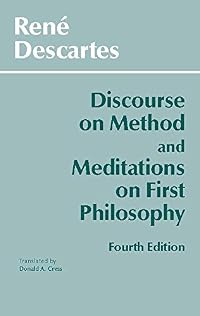
Discourse on Method / Meditations on First Philosophy
by René Descartes
On This Page
Description
Brought to you by Penguin.This Penguin Classic is performed by Rory Alexander.
René Descartes was a central figure in the scientific revolution of the seventeenth century. In his Discourse on Method he outlined the contrast between mathematics and experimental sciences, and the extent to which each one can achieve certainty. Drawing on his own work in geometry, optics, astronomy and physiology, Descartes developed the hypothetical method that characterizes modern science, and this soon show more came to replace the traditional techniques derived from Aristotle. Many of Descartes' most radical ideas - such as the disparity between our perceptions and the realities that cause them - have been highly influential in the development of modern philosophy.
© René Descartes 2005 (P) Penguin Audio 2021
. show less
Tags
Recommendations













Member Recommendations
Voracious_Reader Spinoza is another from the rationalist school of philiosophy, i.e., truth is not reached through sensory (Hume etc.) experience, but is reached through intellect/reason and deduction.
20
Voracious_Reader Another rationalist.
Member Reviews
This must-read classic of modern philosophy lays out, in great detail, the primary skeptical challenge that philosophers are still trying to dig out of today. While the phrase “I think, therefore I am” is an important philosophical find (denying your own existence presupposes your existence), the deeper issue Descartes uncovered is that, beyond the certain knowledge of your own existence, you could still be wrong about everything else.
Descartes sought to reject any of his beliefs that introduced even the slightest degree of doubt. He began by finding reason to distrust the senses, along with his ability to distinguish dreams from waking life. He then imagined the possibility of being deceived by a “malicious, powerful, cunning show more demon” that convinced him of seemingly certain—albeit false—beliefs, such as the mathematical truth that 2 3=5.
The result was that Descartes had to reject all of his beliefs, as they were all subject to some degree of doubt. But there was one belief that was beyond doubt: the certainty of his own existence, which even the evil demon could not call into question. (It’s possible to think false beliefs, but it’s not possible to think you’re thinking when you’re not.)
Modern versions of “Descartes’ demon” include the possibility that we are all living inside a computer simulation or that we are “brains in a vat” manipulated by scientists to simulate artificial experiences. The unnerving thing about these scenarios—for those who have given them sufficient consideration—is that, despite their apparent implausibility, there is no way to disprove them. I may be certain of my own existence, but the nature of this existence is still left wide open. I could exist in a computer simulation, as a brain in a vat, or as an immaterial entity manipulated by an evil demon. How could I prove otherwise?
So how do you deal with this skeptical challenge? I see three main options: (1) deny the possibility of any knowledge at all, following the ancient Pyhronnian Skeptics, (2) ground knowledge in the idea that God is a perfect being and wouldn’t deceive you, as Descartes did, or (3) accept that certain knowledge is not possible but that certainty is not required for knowledge (the critical rationalist approach). I suppose the fourth possibility is to remain blissfully unaware of the problem at all.
Descartes pursued the second option, using a version of St. Anselm’s ontological argument to demonstrate that God is perfect and would never deceive him. This is ultimately a failed solution, as the ontological argument has so many valid objections and refutations that today it is not taken very seriously even by theists.
Further, Descartes ultimately argues in a circle to get out of his own dilemma. He tells us we shouldn’t trust our judgment regarding the basic truths of arithmetic, such as 2 3=5, but then tells us we should trust our judgment regarding the existence of a perfect being that wouldn’t deceive us. But since he tells us that we shouldn’t trust our judgments before establishing the existence of God, how can we then trust our judgments concerning the existence of God?
So Descartes introduced a critical philosophical problem but blatantly failed to resolve it. This is why I see his legacy as mixed. I also see Descartes as getting too much credit in two important respects.
First, Descartes is often referred to as the “father of modern philosophy,” yet Francis Bacon published his masterwork, the Novum Organum, in 1620, a full two decades before Descartes published the Meditations in 1641. Bacon laid out a new system of philosophy that influenced both the founding of the British Royal Society and later the Encyclopédie of the Enlightenment. Bacon’s attack on Aristotelianism and Scholasticism and his charting of a new path for philosophy and science based on inductive reasoning suggests to me that he is the real father of modern philosophy, not Descartes.
Second, Descartes is not the first philosopher to engage in a process of systematic doubt or to develop arguments against the reliability of the senses. The ancient Phyronnian skeptics, as well as Sextus Empiricus, hold that distinction, and would not have viewed his distrust of the senses as particularly innovative.
My recommendation would be to read the Meditations for Descartes’ systematic method of doubt, an understanding of the skeptical challenge, and the reasoning behind the certainty of your own existence. Beyond that, ignore his solutions and instead read the works of Karl Popper to see how critical rationalism is the only workable, albeit imperfect, solution to the skeptical challenge. show less
Descartes sought to reject any of his beliefs that introduced even the slightest degree of doubt. He began by finding reason to distrust the senses, along with his ability to distinguish dreams from waking life. He then imagined the possibility of being deceived by a “malicious, powerful, cunning show more demon” that convinced him of seemingly certain—albeit false—beliefs, such as the mathematical truth that 2 3=5.
The result was that Descartes had to reject all of his beliefs, as they were all subject to some degree of doubt. But there was one belief that was beyond doubt: the certainty of his own existence, which even the evil demon could not call into question. (It’s possible to think false beliefs, but it’s not possible to think you’re thinking when you’re not.)
Modern versions of “Descartes’ demon” include the possibility that we are all living inside a computer simulation or that we are “brains in a vat” manipulated by scientists to simulate artificial experiences. The unnerving thing about these scenarios—for those who have given them sufficient consideration—is that, despite their apparent implausibility, there is no way to disprove them. I may be certain of my own existence, but the nature of this existence is still left wide open. I could exist in a computer simulation, as a brain in a vat, or as an immaterial entity manipulated by an evil demon. How could I prove otherwise?
So how do you deal with this skeptical challenge? I see three main options: (1) deny the possibility of any knowledge at all, following the ancient Pyhronnian Skeptics, (2) ground knowledge in the idea that God is a perfect being and wouldn’t deceive you, as Descartes did, or (3) accept that certain knowledge is not possible but that certainty is not required for knowledge (the critical rationalist approach). I suppose the fourth possibility is to remain blissfully unaware of the problem at all.
Descartes pursued the second option, using a version of St. Anselm’s ontological argument to demonstrate that God is perfect and would never deceive him. This is ultimately a failed solution, as the ontological argument has so many valid objections and refutations that today it is not taken very seriously even by theists.
Further, Descartes ultimately argues in a circle to get out of his own dilemma. He tells us we shouldn’t trust our judgment regarding the basic truths of arithmetic, such as 2 3=5, but then tells us we should trust our judgment regarding the existence of a perfect being that wouldn’t deceive us. But since he tells us that we shouldn’t trust our judgments before establishing the existence of God, how can we then trust our judgments concerning the existence of God?
So Descartes introduced a critical philosophical problem but blatantly failed to resolve it. This is why I see his legacy as mixed. I also see Descartes as getting too much credit in two important respects.
First, Descartes is often referred to as the “father of modern philosophy,” yet Francis Bacon published his masterwork, the Novum Organum, in 1620, a full two decades before Descartes published the Meditations in 1641. Bacon laid out a new system of philosophy that influenced both the founding of the British Royal Society and later the Encyclopédie of the Enlightenment. Bacon’s attack on Aristotelianism and Scholasticism and his charting of a new path for philosophy and science based on inductive reasoning suggests to me that he is the real father of modern philosophy, not Descartes.
Second, Descartes is not the first philosopher to engage in a process of systematic doubt or to develop arguments against the reliability of the senses. The ancient Phyronnian skeptics, as well as Sextus Empiricus, hold that distinction, and would not have viewed his distrust of the senses as particularly innovative.
My recommendation would be to read the Meditations for Descartes’ systematic method of doubt, an understanding of the skeptical challenge, and the reasoning behind the certainty of your own existence. Beyond that, ignore his solutions and instead read the works of Karl Popper to see how critical rationalism is the only workable, albeit imperfect, solution to the skeptical challenge. show less
This is not an easy collection of writings to review. How does one sum up writing that attempts to lay out a method for and then drive to what becomes a core principle of rationalist approaches to modern philosophy? Descartes offers his own summary in cogito ergo sum -- I think, therefore I am. And the fact that you have mostly likely heard this phrase and can link it to Descartes suggests the influence this work has had.
I'll be the first to admit that although I had certainly heard the phrase "cogito ergo sum" and probably had to read some of Discourse on Method at some point in my undergraduate years, I had next to no concept of why the observation was so meaningful. So here is an attempt to put it in perspective that made sense to show more me (upon a couple of readings).
Imagine anything that you know or take to be true and divide/dissect it into the core claims, assumptions, beliefs, and measurements that comprise it. How many of those component pieces of the thing that you hold true are things that you, personally, know distinctly and with certainty? Now take all those core claims, assumptions, beliefs, and measurements from the first dissection and divide/dissect those into the claims, etc. that they are built on. If you are engaging in this process honestly, then you now have exponentially more claims, etc. And ask yourself: of all those claims, etc., how many do you, personally, know with certainty or distinctness? Now imagine, after layers of mental dissection, you have the idea that you took as truth disassembled into hundreds of component claims, etc., all stacked on each other in strata. Imagine that some of those claims etc. can be doubted and a contrary position stated. Maybe it's a handful of such claims, etc. that can be doubted, but how many before the initial truth unravels? Truths that we adopt because they are given to us are built upon similar structures of claims, etc., so how can you really know that any of those things are true?
Descartes offers a method for engaging in this kind of work as well as a starting truth: cogito ergo sum. It is the base truth that cannot be doubted. You are having thoughts all the time. And if you are having thoughts, you exist. And if you are not, then you don't. Truth builds upon this core truth, iteratively and (if we do it right) carefully. All of the faculties of reason that are in us can be confidently used in the pursuit of truth by exposing doubts and reasoning our way through them to indubitable claims from which we can make reasonable inferences and deductions. Except with the senses ... they're a little too unreliable.
Now I'm a bit less skeptical of empiricism than Descartes, but I understand where he was coming from about the potential fallibility of the senses. As I see it, sense data, aided by reason, disciplined by a method of analysis (e.g., the scientific method) can yield the "clear and distinct" impressions that Descartes says are important to truth. In fact, empiricism seems to give a better definition of what clarity and distinctiveness might mean -- more so than is easily extracted from this volume.
At times a bit too insistent on the importance of God to establish the perfection that becomes the goal of doubting and dismissing doubt. Descartes acknowledges the ancients but then also dismisses them; yet, there seems to be more in this volume that is owed to Plato and Aristotle than is acknowledged.
Nevertheless I have to give this foundational work at least 4-stars. Any less is just iconoclastic. show less
I'll be the first to admit that although I had certainly heard the phrase "cogito ergo sum" and probably had to read some of Discourse on Method at some point in my undergraduate years, I had next to no concept of why the observation was so meaningful. So here is an attempt to put it in perspective that made sense to show more me (upon a couple of readings).
Imagine anything that you know or take to be true and divide/dissect it into the core claims, assumptions, beliefs, and measurements that comprise it. How many of those component pieces of the thing that you hold true are things that you, personally, know distinctly and with certainty? Now take all those core claims, assumptions, beliefs, and measurements from the first dissection and divide/dissect those into the claims, etc. that they are built on. If you are engaging in this process honestly, then you now have exponentially more claims, etc. And ask yourself: of all those claims, etc., how many do you, personally, know with certainty or distinctness? Now imagine, after layers of mental dissection, you have the idea that you took as truth disassembled into hundreds of component claims, etc., all stacked on each other in strata. Imagine that some of those claims etc. can be doubted and a contrary position stated. Maybe it's a handful of such claims, etc. that can be doubted, but how many before the initial truth unravels? Truths that we adopt because they are given to us are built upon similar structures of claims, etc., so how can you really know that any of those things are true?
Descartes offers a method for engaging in this kind of work as well as a starting truth: cogito ergo sum. It is the base truth that cannot be doubted. You are having thoughts all the time. And if you are having thoughts, you exist. And if you are not, then you don't. Truth builds upon this core truth, iteratively and (if we do it right) carefully. All of the faculties of reason that are in us can be confidently used in the pursuit of truth by exposing doubts and reasoning our way through them to indubitable claims from which we can make reasonable inferences and deductions. Except with the senses ... they're a little too unreliable.
Now I'm a bit less skeptical of empiricism than Descartes, but I understand where he was coming from about the potential fallibility of the senses. As I see it, sense data, aided by reason, disciplined by a method of analysis (e.g., the scientific method) can yield the "clear and distinct" impressions that Descartes says are important to truth. In fact, empiricism seems to give a better definition of what clarity and distinctiveness might mean -- more so than is easily extracted from this volume.
At times a bit too insistent on the importance of God to establish the perfection that becomes the goal of doubting and dismissing doubt. Descartes acknowledges the ancients but then also dismisses them; yet, there seems to be more in this volume that is owed to Plato and Aristotle than is acknowledged.
Nevertheless I have to give this foundational work at least 4-stars. Any less is just iconoclastic. show less
In the Discourse Descartes is charming, down-to-earth, and his investigation of skepticism is exciting, fun and profound at the same time. That’s a rare combination in philosophy, at least in my experience - only Plato and Chuang Tzu come to mind as similar in this respect (maybe Nietzsche, but he’s such a ninny). Although Descartes’ skepticism is arguably a borrowing from ancient philosophy, his turning it into a method of investigation appears to be original, and it was enormously important in the development of modern science as well as modern philosophy.
I think his famous cogito ergo sum (I think, therefore I am) is flawed – perception of thought proves the existence of operating consciousness, but not the existence of an show more individual, thinking being. Hair-splitting and navel-gazing to some, a big deal to others. But all good, clean fun. The Meditations, on the other hand, is not so charming, it’s often boring, and it’s sometimes profound and sometimes not very. It has a couple weak and fallacious arguments for the existence of God - you get the impression that, after the relentless skepticism of his Discourse and the first couple meditations, and in light of Galileo’s travails, he’s trying to keep himself in the good graces of the Church and neither his heart or head are completely in the proofs of God and the things leading up to them. At least that’s the impression I get. If I exist.
But I’m a bit hard on Rene, and he lived in hard times. The Discourse, written in French, was aimed at a more popular audience while the Meditations, written in Latin, was for scholars. And it is more substantial. Speaking of Chuang Tzu, Descartes could have lifted his dreaming argument from the old sage, but it’s highly unlikely he’d ever heard of him (and his recollection-like a priori knowledge of mathematical objects is straight out of Plato’s Meno). This dreaming together with the evil god concept puts us in pretty shaky epistemological territory. The search for anything knowable is a logical next step, but beyond that Descartes tends to build his house with quite a few cards. Still, it’s probably not unreasonable to say that what he accomplished was revolutionary, and that it engendered a remarkable quantity and quality of further developments for hundreds of years. To be fair, Descartes’ mind-body dualism is pretty much from Plato as well; apparently he wasn’t big on attribution, but so it goes. show less
I think his famous cogito ergo sum (I think, therefore I am) is flawed – perception of thought proves the existence of operating consciousness, but not the existence of an show more individual, thinking being. Hair-splitting and navel-gazing to some, a big deal to others. But all good, clean fun. The Meditations, on the other hand, is not so charming, it’s often boring, and it’s sometimes profound and sometimes not very. It has a couple weak and fallacious arguments for the existence of God - you get the impression that, after the relentless skepticism of his Discourse and the first couple meditations, and in light of Galileo’s travails, he’s trying to keep himself in the good graces of the Church and neither his heart or head are completely in the proofs of God and the things leading up to them. At least that’s the impression I get. If I exist.
But I’m a bit hard on Rene, and he lived in hard times. The Discourse, written in French, was aimed at a more popular audience while the Meditations, written in Latin, was for scholars. And it is more substantial. Speaking of Chuang Tzu, Descartes could have lifted his dreaming argument from the old sage, but it’s highly unlikely he’d ever heard of him (and his recollection-like a priori knowledge of mathematical objects is straight out of Plato’s Meno). This dreaming together with the evil god concept puts us in pretty shaky epistemological territory. The search for anything knowable is a logical next step, but beyond that Descartes tends to build his house with quite a few cards. Still, it’s probably not unreasonable to say that what he accomplished was revolutionary, and that it engendered a remarkable quantity and quality of further developments for hundreds of years. To be fair, Descartes’ mind-body dualism is pretty much from Plato as well; apparently he wasn’t big on attribution, but so it goes. show less
These are undeniably important works. The introduction calls Descartes the "originator of modern philosophy." This is also very lucidly written--I think the arguments are perfectly accessible to the layman, it's just I don't think much of them. The full title of the first treatise of only 54 pages is "Discourse on the Method of Rightly Conducting One's Reason and of Seeking Truth in the Sciences" but would more correctly be titled, "A Rehash of Just about the Lamest Philosophical Proof of God Ever." The first three sections of the six section treatise sound pretty commonsensical for the most part, the core of the "method" seems to be detailed in Part II:
The first was never to accept anything for true which I did not clearly know to be show more such; that is to say, carefully to avoid precipitancy and prejudice, and to comprise nothing more in my judgment than what was presented to my mind so clearly and distinctly as to exclude all ground of doubt. The second, to divide each of the difficulties under examination into as many parts as possible, and as might be necessary for its adequate solution. The third, to conduct my thoughts in such order that, by commencing with objects the simplest and easiest to know, I might ascend by little and little, and, as it were, step by step, to the knowledge of the more complex; assigning in thought a certain order even to those objects which in their own nature do not stand in a relation of antecedence and sequence. And the last, in every case to make enumerations so complete, and reviews so general, that I might be assured that nothing was omitted.
It would be nice if Descartes then gave an example of how by such principles he solved a scientific problem, but no. He then proceeds in Part IV to decide that the first principle from which all else is to be deduced is the famous dictum, "I think, therefore I am." Except I'd stop right there and challenge that as a first principle. We think based on our experiences of the world as meditated by the senses. Read Helen Keller's autobiography some time for some appreciation of how impossible it is to think without language, and to get language without association between a discrete experience and means of communication. But that's not all, from that first principle Descartes proceeds to leap to the the conclusion that there must be a God. Why? Because since he has doubts in this thinking he's not perfect, but something must be, and nothing is perfect but God. That is the ontological argument for God, which is not original to Descartes but is attributed to the 11th Century Anselm of Canterbury. Descartes even claims this "proof" is more solid than the experience of our own bodies, and from this deduces the idea of the mind/body dichotomy. The six Meditations are basically an elaboration on this theme.
So why am I even rating it as high as three stars? This isn't a philosophy I can and wish to ascribe to, but yes, given its importance I do recommend reading it--it's not long either, the book containing both treatises is only 143 pages. Descartes treatises were tremendously influential in provoking disparate philosophers from Spinoza to Berkeley to Hobbes to form their own views as they sought to refine or refute Descartes arguments. show less
The first was never to accept anything for true which I did not clearly know to be show more such; that is to say, carefully to avoid precipitancy and prejudice, and to comprise nothing more in my judgment than what was presented to my mind so clearly and distinctly as to exclude all ground of doubt. The second, to divide each of the difficulties under examination into as many parts as possible, and as might be necessary for its adequate solution. The third, to conduct my thoughts in such order that, by commencing with objects the simplest and easiest to know, I might ascend by little and little, and, as it were, step by step, to the knowledge of the more complex; assigning in thought a certain order even to those objects which in their own nature do not stand in a relation of antecedence and sequence. And the last, in every case to make enumerations so complete, and reviews so general, that I might be assured that nothing was omitted.
It would be nice if Descartes then gave an example of how by such principles he solved a scientific problem, but no. He then proceeds in Part IV to decide that the first principle from which all else is to be deduced is the famous dictum, "I think, therefore I am." Except I'd stop right there and challenge that as a first principle. We think based on our experiences of the world as meditated by the senses. Read Helen Keller's autobiography some time for some appreciation of how impossible it is to think without language, and to get language without association between a discrete experience and means of communication. But that's not all, from that first principle Descartes proceeds to leap to the the conclusion that there must be a God. Why? Because since he has doubts in this thinking he's not perfect, but something must be, and nothing is perfect but God. That is the ontological argument for God, which is not original to Descartes but is attributed to the 11th Century Anselm of Canterbury. Descartes even claims this "proof" is more solid than the experience of our own bodies, and from this deduces the idea of the mind/body dichotomy. The six Meditations are basically an elaboration on this theme.
So why am I even rating it as high as three stars? This isn't a philosophy I can and wish to ascribe to, but yes, given its importance I do recommend reading it--it's not long either, the book containing both treatises is only 143 pages. Descartes treatises were tremendously influential in provoking disparate philosophers from Spinoza to Berkeley to Hobbes to form their own views as they sought to refine or refute Descartes arguments. show less
The Cartesian subject gets a bad wrap these days, but I'm down with "cogito, ergo sum" with a couple of (admittedly pretty major) modifications from psychoanalysis and poststructuralism.
First, when I'm assuring myself of my own ego-existence by thinking, "I am thinking, therefore I am," that's all well and good. But sometimes I might slip and think something like, "I am winking, therefore I am" becuase I'm distracted by the memory of a cute girl that winked at me today--in other words, the smooth functioning of the internal monologue that assures "me" that "I" exist is constantly being interrupted by the unconscious. That's why we need to add insights from psychoanlysis to Descarte's subject.
Second, the "I am" bit needs to undergo a show more critique of the metaphysics of presence based upon Derrida's discussions of signification and being. The auto-affecting interior monologue happens in language, and language works by difference and reference to a whole system that must have a ghostly presence-yet-abscence to function.
So when I say "I am," I'm also referring to a whole system of signification which is not "present" in the way we usually mean. So, the being indicated by the "I am" of the Cartesian subject should be modified by poststructuralist critique so that we understand it as a kind of being that is not simply unified, proximate, and present-to-itself. That being is necessarily characterized by difference, dispersion, and deferral in time.
On another note, the God proofs--a restatement of Anselm's ontological argument along with Descarte's own version--are intriguing but still don't cut it for me. Ultimately, I don't think reason can pull that off--I think it's revelation or nothing (in my view as an athiest-leaning agnostic the answer is, "nothing," but that's up for debate). show less
First, when I'm assuring myself of my own ego-existence by thinking, "I am thinking, therefore I am," that's all well and good. But sometimes I might slip and think something like, "I am winking, therefore I am" becuase I'm distracted by the memory of a cute girl that winked at me today--in other words, the smooth functioning of the internal monologue that assures "me" that "I" exist is constantly being interrupted by the unconscious. That's why we need to add insights from psychoanlysis to Descarte's subject.
Second, the "I am" bit needs to undergo a show more critique of the metaphysics of presence based upon Derrida's discussions of signification and being. The auto-affecting interior monologue happens in language, and language works by difference and reference to a whole system that must have a ghostly presence-yet-abscence to function.
So when I say "I am," I'm also referring to a whole system of signification which is not "present" in the way we usually mean. So, the being indicated by the "I am" of the Cartesian subject should be modified by poststructuralist critique so that we understand it as a kind of being that is not simply unified, proximate, and present-to-itself. That being is necessarily characterized by difference, dispersion, and deferral in time.
On another note, the God proofs--a restatement of Anselm's ontological argument along with Descarte's own version--are intriguing but still don't cut it for me. Ultimately, I don't think reason can pull that off--I think it's revelation or nothing (in my view as an athiest-leaning agnostic the answer is, "nothing," but that's up for debate). show less
I have some amount of ambivalence toward skeptical philosophy in general. It's a tradition that engendered enlightenment errors and, later, influenced atheistic materialism. Descartes wasn't an atheist or a materialist as such, but his system of skeptical doubt is still incredibly silly in my opinion. First of all, a system of doubt is a contradiction in terms; a system must be based on positive and actual constituents; doubt is a negative, not a positive, so it cannot be a foundation for any genuine philosophy. For skeptical doubt to have any constructive role, it must be based on positive and actual veritable knowledge. The only reason I would doubt anything is that the thing that is up for scrutiny does not line up with what I hold show more positively to be true. Beginning with the idea that I must "doubt everything" and then find a positive in that futile endeavor is incredibly ludicrous. One cannot start with a negative and ever hope to gain a positive. The maxim "I cannot doubt that I am doubting" is drunk talk in my opinion. It's just twaddle. I think it means next to nothing. Knowledge always reaches the point where no more deduction can be done. Once that point is reached, you are in the realm of intuition. Intuitive knowledge is self-evident knowledge. It cannot be broken down any further; it is at it's most basic components. To doubt that 2 plus 3 is 5 is stupid. I have no reason to doubt that such is true. It is basic intuitive knowledge. To doubt it for doubt's sake is simply to engage in schizoid dialectic that has absolutely no positive and constructive function. Once one doubts all foundation for knowledge, one no longer has a foundation to even doubt. Beginning with doubt, one must always end with doubt because it is a negative and in the end everything could be doubted if one denies that intuitive self-evident truth is real; and one would have to deny it in order to doubt everything.
While Descartes does variously claim that his system is not just endless nullity, he often contradicts this in the things he says. I give this book three stars instead of a lower number because there are some interesting ideas here and there. In the sections where he deals with questions regarding the existence of God, you have some worthwhile notions. Much of that has a precedent in scholastic theology from the medieval period though; so he isn't really breaking new ground there in my opinion. show less
While Descartes does variously claim that his system is not just endless nullity, he often contradicts this in the things he says. I give this book three stars instead of a lower number because there are some interesting ideas here and there. In the sections where he deals with questions regarding the existence of God, you have some worthwhile notions. Much of that has a precedent in scholastic theology from the medieval period though; so he isn't really breaking new ground there in my opinion. show less
Cogito ergo sum, ფილოსოფიაში ერთ-ერთი ყველაზე ცნობილი ფრაზა. რომელსაც ძნელია რაიმე დაუპირისპირო. დეკარტი საინტერესო პერსპექტივას ირჩევს, დაეჭვდეს ყველაფერში რასაც აღიქვამს და იცის, საწყის წერტილად აირჩიოს "ვაზროვნებ მაშასადამე ვარსებობ" მაგრამ რაც შეეხება დანარჩენს, მაგალითად ღმერთის show more არსებობის დამტკიცებას ანსელმ კენტერბერისეული ონტოლოგიური არგუმენტით, ჩემი აზრით ძალიან სუსტია და უაზრო.
დეკარტი ასევე საფუძველს უდებს გონების და სხეულის დუალიზმს, რომელსაც დღეს ასე ებღაუჭებიან თანამედროვე რელიგიები და რომელსაც აგრეთვე პრაქტიკულად არ აქვს მხარდაჭერა თანამედროვე მეცნიერებაში. საინტერესოა თავად დეკარტი რას იტყოდა, ამ ახალი პერსპექტივიდან რაც თანამედროვე ნეირომეცნიერებამ მოიტანა. show less
დეკარტი ასევე საფუძველს უდებს გონების და სხეულის დუალიზმს, რომელსაც დღეს ასე ებღაუჭებიან თანამედროვე რელიგიები და რომელსაც აგრეთვე პრაქტიკულად არ აქვს მხარდაჭერა თანამედროვე მეცნიერებაში. საინტერესოა თავად დეკარტი რას იტყოდა, ამ ახალი პერსპექტივიდან რაც თანამედროვე ნეირომეცნიერებამ მოიტანა. show less
Members
- Recently Added By
Lists

Philip Ward's Lifetime Reading Plan
592 works; 22 members

My List
302 works; 1 member

philosophy
28 works; 2 members

current
52 works; 1 member

Philosophy
23 works; 1 member
Author Information

Best known for the quote from his Meditations de prima philosophia, or Meditations on First Philosophy (1641), "I think therefore I am," philosopher and mathematician Rene Descartes also devoted much of his time to the studies of medicine, anatomy and meteorology. Part of his Discourse on the Method for Rightly Conducting One's Reason and show more Searching for the Truth in the Sciences (1637) became the foundation for analytic geometry. Descartes is also credited with designing a machine to grind hyperbolic lenses, as part of his interest in optics. Rene Descartes was born in 1596 in La Haye, France. He began his schooling at a Jesuit college before going to Paris to study mathematics and to Poitiers in 1616 to study law. He served in both the Dutch and Bavarian military and settled in Holland in 1629. In 1649, he moved to Stockholm to be a philosophy tutor to Queen Christina of Sweden. He died there in 1650. Because of his general fame and philosophic study of the existence of God, some devout Catholics, thinking he would be canonized a saint, collected relics from his body as it was being transported to France for burial. (Bowker Author Biography) show less
Some Editions
Awards and Honors
Series
Belongs to Publisher Series
Work Relationships
Common Knowledge
- Canonical title
- Discourse on Method / Meditations on First Philosophy
- Original title
- Discours de la Méthode - Meditationes de prima philosophia; Discourse on Method; and, Meditations on First Philosophy
- Alternate titles
- Discourse on Method and Meditions on First Philosophy
- Original publication date
- 1637 (Discourse) (Discourse); 1641 (Meditations) (Meditations); 1993
- People/Characters
- René Descartes
- Important places*
- Descartes, Centre-Val de Loire, Frankrijk
- Important events
- Enlightenment; 17th century
- First words
- Good sense is the most evenly shared thing in the world, for each of us thinks he is so well endowed with it that even those who are the hardest to please in all other respects are not in the habit of wanting more than they h... (show all)ave.
- Quotations
- I think, therefore I am.
- Last words
- (Click to show. Warning: May contain spoilers.)But because the necessities of action often oblige us to make a decision before we have had the leisure to examine things so carefully, it must be admitted that the life of man is very often subject to error in particular cases; and we must, in conclusion, recognize the infirmity and weakness of our nature.
- Blurbers
- Ariew, Roger; Grene, Marjorie
- Original language
- French; Latin
- Canonical DDC/MDS
- 194.1
- Disambiguation notice
- Contains the Discourse and the Meditations. Do not combine with editions of the Discourse alone, or of other selections.
This edition contains the Discourse on Method and the Meditations. Do not combine with other selections or the Discourse alone.
*Some information comes from Common Knowledge in other languages. Click "Edit" for more information.
Classifications
Statistics
- Members
- 4,486
- Popularity
- 3,262
- Reviews
- 26
- Rating
- (3.55)
- Languages
- 10 — Catalan, Danish, English, French, German, Greek, Italian, Portuguese, Russian, Spanish
- Media
- Paper, Audiobook, Ebook
- ISBNs
- 86
- UPCs
- 1
- ASINs
- 63