Living With Ghosts
by Kari Sperring
On This Page
Description
"Gracielis, the failed assassin priest turned courtesan and spy, wants to deny his strange abilities, yet he cannot ignore the ghostly presence that shadows him or the sorceress who rules him. Thiercelin wants his wife's love but all her time and energy are devoted to the preservation of Merafi and its ruler. Valdarrien, slain in a duel, wants to find his lost love and to live again. And the loyal soldier Joyain just wants a quiet life. But in the ancient city of Merafi, you don't always get show more what you want..."--p.[4] of cover. show lessTags
Recommendations












Member Reviews
Living With Ghosts is a slow burn fantasy, and as such will not be for everybody. The characters are complex, flawed, and human, not only in their personalities but in their interactions with one another. The world building is good, and a there is effort made to immerse the readers in the city and the magic and culture of the setting. The magic, albeit soft, is well defined enough to fit the narrative and the various characters that wield it. The prose is strong and often beautiful, adeptly conveying the complexities of the narrative as well as the power, or majesty, or tragedy of some of its characters.
There is a fair amount of grief/tragedy to the narrative but it is well chosen and well written, so it fits the story and feels neither show more gratuitous nor unwarranted. show less
There is a fair amount of grief/tragedy to the narrative but it is well chosen and well written, so it fits the story and feels neither show more gratuitous nor unwarranted. show less
Thiercelin begins seeing his best friend Valdarrien again, six years after he was killed in a duel. Thiercelin is a sensible man, and like all sensible men of his time does not believe in ghosts. Nevertheless, the apparition seems so real that he is forced to take it seriously. He seeks counsel from Gracielis, a man who was once his wife's lover but is now a courtesan and double (triple? quadruple?) agent. Gracielis is Tarnaroqui, a people rumored to have traces of fey blood, and unlike Thiercelin, he has made a lifetime study of the supernatural. But, bound as he is to his mentor, the perfidious Quenfrida, Gracielis refuses to help Theircelin. Slowly, it becomes clear that Valdarrien's ghost is just one part of a rising tide of magic show more that threatens to break the rational city of Merafi. Gracielis reconciled himself to the fact that he does not have the powerful will needed to be a great magician long ago. But when Merafi and his friends and lovers are threatened, he knows he has to do something. And so against his nature, against his nation, against his training, Gracielis strives to remake the bindings keeping Merafi safe.
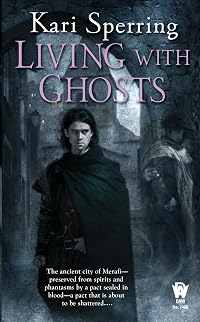
This is not a typical fantasy novel, no matter the silly goffick cover art. The plot doesn't follow a single ordinary arc, but meanders through witty conversations and characters' internal ruminations, while in the background there is the rising tension and horror of Merafi's coming downfall. The magic surges into a deadly crescendo near the end, but for much of the book it is only hinted at. Sperring's magic is illusive and nightmarish, with rules that hold together but are never fully explained.
There's something of Guy Gavriel Kay to the characters, in the way they move through the Merafian court. Gracielis was my favorite--full of wasted potential, perpetually polite, secretly despairing. I really enjoyed the world building, as well--Merafi is like seventeenth/eighteenth century France, but without sexism (Thiercelin is the decorative lazy husband to the serious-minded, indispensible Yvelliane, who is First Councillor, a nice role reversal) or heterosexism (various characters have lovers of either gender, and no one thinks about it in the least). Sperring knows how her society works, down to the last detail.
The book takes a while to get going, but the leisurely pace of the beginning is necessary to give the reader time to assimilate all the tangled relationships between characters. I do think there were a few too many view point characters: Joyain and Miraude each serve to expand the world a bit, but their plots could easily have been shifted to other characters. Seeing through the eyes of Thiercelin and Joyain and Miraude and Iareth and Yvelliane and Gracielis and even, at times, Kenan and Quenfrida was just too much. Plus occasional third person omniscient! Too many viewpoints. Joyain is, additionally, the one character who annoyed me. Even after repeated visitations by ghosts, nearly getting killed by supernatural mists that sliced at his flesh, seeing his friend be torn apart yet speak through ruined jaws, repeated warnings by other characters--he STILL declines to believe in magic, and indeedspreads the magical plague throughout Merafi because he wanders around getting drunk instead of enforcing the quarantine, like everyone told him to. He was so self-pitying and dumb I could hardly bear it.
Trigger warning:There's a suicide attempt on page 209 that's up there with reading Sylvia Plath. If depressed, I really do recommend having something else to read or someone to talk to at hand when you get to that part, just in case. show less
This is not a typical fantasy novel, no matter the silly goffick cover art. The plot doesn't follow a single ordinary arc, but meanders through witty conversations and characters' internal ruminations, while in the background there is the rising tension and horror of Merafi's coming downfall. The magic surges into a deadly crescendo near the end, but for much of the book it is only hinted at. Sperring's magic is illusive and nightmarish, with rules that hold together but are never fully explained.
There's something of Guy Gavriel Kay to the characters, in the way they move through the Merafian court. Gracielis was my favorite--full of wasted potential, perpetually polite, secretly despairing. I really enjoyed the world building, as well--Merafi is like seventeenth/eighteenth century France, but without sexism (Thiercelin is the decorative lazy husband to the serious-minded, indispensible Yvelliane, who is First Councillor, a nice role reversal) or heterosexism (various characters have lovers of either gender, and no one thinks about it in the least). Sperring knows how her society works, down to the last detail.
The book takes a while to get going, but the leisurely pace of the beginning is necessary to give the reader time to assimilate all the tangled relationships between characters. I do think there were a few too many view point characters: Joyain and Miraude each serve to expand the world a bit, but their plots could easily have been shifted to other characters. Seeing through the eyes of Thiercelin and Joyain and Miraude and Iareth and Yvelliane and Gracielis and even, at times, Kenan and Quenfrida was just too much. Plus occasional third person omniscient! Too many viewpoints. Joyain is, additionally, the one character who annoyed me. Even after repeated visitations by ghosts, nearly getting killed by supernatural mists that sliced at his flesh, seeing his friend be torn apart yet speak through ruined jaws, repeated warnings by other characters--he STILL declines to believe in magic, and indeed
Trigger warning:
I had the pleasure of hearing Kari Sperring read from the sequel to this book at FantasyCon a couple of years back and have come to know Kari since then. When it was announced that she had won the Sydney J. Bounds Award for Best Newcomer at the British Fantasy Awards in 2010 for this novel, she was reportedly surprised by the award, but it was well-deserved.This doesn't feel like a debut novel. The writing is rich and gently lyrical. The setting and the sense of place is palpable - at times you can smell the air (not always a pleasant experience). The characters are complex and diverse with different cultures showing through. There is a complex political situation which is revealed throughout the book, underpinned by the personal show more relationships between the characters. It's subtle, complex and full of political intrigue.There are a lot of characters, but it never feels lost or unfocused. The interweaving of motives and interests are always shifting so that it's hard to tell hero from villain. When the story comes to a climax in the final chapters you really don't know who's going to come out on top - not everyone survives it, but to say more would spoil the tale.If you like fantasy with a richly embroidered society, meticulous world-building, ambiguous characters that you can love and hate at the same time and a plot full of intrigue, this is for you. show less
Tiptree shortlist 2010. The characters were mostly well-drawn and plausible; except for a couple of clunky scenes to move the plot along the story flowed quite nicely; and the ghosts and disease conjured up from river fogs were suitably threatening.
The only disappointment was that the Bad Guys'characters and motives were rather sketchy, and seemed peripheral to the main story. Anyway, despite those few nitpicks a very enjoyable read.
The only disappointment was that the Bad Guys'characters and motives were rather sketchy, and seemed peripheral to the main story. Anyway, despite those few nitpicks a very enjoyable read.
I read this book second, though it is Sperring's first, and it knocked my socks off. It has some wonderful characters, of whom I grew very fond, and was hugely dismayed when some of them didn't make it (no spoilers). The bad guys were well drawn too and really horrible!
The eerie atmosphere builds steadily, and things become very dark, so one cannot imagine how the situation will be happily resolved.
I am very much looking forward to reading more by this author. I think I will be re-reading this book, as well as 'The Grass King's Concubine', which is a stand-alone book set in the same 'verse.
The eerie atmosphere builds steadily, and things become very dark, so one cannot imagine how the situation will be happily resolved.
I am very much looking forward to reading more by this author. I think I will be re-reading this book, as well as 'The Grass King's Concubine', which is a stand-alone book set in the same 'verse.
This came highly recommended by Sherwood Smith (and Library Thing thought I would adore it, very low proability).
I can see why they thought that ...
I loved the world, which is well constructed at many levels. I found many of the characters to be very well written - although the baddies are somewhat two-dimensional.
I kept thinking this _should_ be a page-turner, but putting the book down and going and doing something else (this may be because of the conditions in which I read it, rather than the book itself).
There were a couple of points where I failed to follow the author, a couple where I felt she was summarising before moving on (almost as if she had _expected_ me to nod off!) and a couple where I thought 'but another solution to show more this is .....').
At first, I liked the use of Earth nomenclature, but as I grew to understand that there was no Earth-referance, I disliked it more and more.
Would I read a sequel? Yes and no. Another book set in this world, like a shot. Possibly even one that has a few characters in common (their back stories remaining unimportant for new readers). But certainly not a what-this-character-did-next.
Personally, I'd like to find out more about the sugar industry (to see how differently colonialism plays out in this world). show less
I can see why they thought that ...
I loved the world, which is well constructed at many levels. I found many of the characters to be very well written - although the baddies are somewhat two-dimensional.
I kept thinking this _should_ be a page-turner, but putting the book down and going and doing something else (this may be because of the conditions in which I read it, rather than the book itself).
There were a couple of points where I failed to follow the author, a couple where I felt she was summarising before moving on (almost as if she had _expected_ me to nod off!) and a couple where I thought 'but another solution to show more this is .....').
At first, I liked the use of Earth nomenclature, but as I grew to understand that there was no Earth-referance, I disliked it more and more.
Would I read a sequel? Yes and no. Another book set in this world, like a shot. Possibly even one that has a few characters in common (their back stories remaining unimportant for new readers). But certainly not a what-this-character-did-next.
Personally, I'd like to find out more about the sugar industry (to see how differently colonialism plays out in this world). show less
I finished reading this book recently, and that fact that I finished it is testament in itself. It was interesting enough to hold me through a bout of illness when I was having difficulty concentrating on anything.
It helped no end that the chapters are broken down into shorter scenes, and each scene was just short enough for me to be able to concentrate until the end of it, but long enough to advance the story in an interesting manner.
It's a fantasy novel set in the city of Merafi (think of a culture around the 'Three Musketeers' level of history and then add in a limited amount of magic).
Gracielis sees dead people. It can be extremely annoying at times (it would be nice to have a bit of privacy...), but it is also a part of what he is. show more In Merafi, he earns his living as a gigolo, but back in his own country he trained (and failed) at a totally different profession.
As the story develops, it becomes clear that there is a major threat to the city of Merafi. A magical threat that is closely intertwined with the history of the city and its founders. Somehow it is all linked to Thiercelin's dead brother-in-law, Valdarrien. Thiercelin sees Valdarrien, yet Thiercelin is Merafian - he shouldn't be able to see a ghost.
The only person who may be able to help him is the gigolo...
The thing I like most about this book is the depth of the characters. Both Gracielis and Thiercelin come across as very real people (though the breach between Thiercelin and his wife feels a little contrived for the purpose of driving the plot). It's not just the main characters, the minor characters are well-drawn too. It's the people that drive this novel - they all have their own motivations and their own reasons for what they do. They don't all view life in the same way, but you feel their joys and their sorrows.
Some will live and some will die, and you will mourn the ones who die. show less
It helped no end that the chapters are broken down into shorter scenes, and each scene was just short enough for me to be able to concentrate until the end of it, but long enough to advance the story in an interesting manner.
It's a fantasy novel set in the city of Merafi (think of a culture around the 'Three Musketeers' level of history and then add in a limited amount of magic).
Gracielis sees dead people. It can be extremely annoying at times (it would be nice to have a bit of privacy...), but it is also a part of what he is. show more In Merafi, he earns his living as a gigolo, but back in his own country he trained (and failed) at a totally different profession.
As the story develops, it becomes clear that there is a major threat to the city of Merafi. A magical threat that is closely intertwined with the history of the city and its founders. Somehow it is all linked to Thiercelin's dead brother-in-law, Valdarrien. Thiercelin sees Valdarrien, yet Thiercelin is Merafian - he shouldn't be able to see a ghost.
The only person who may be able to help him is the gigolo...
The thing I like most about this book is the depth of the characters. Both Gracielis and Thiercelin come across as very real people (though the breach between Thiercelin and his wife feels a little contrived for the purpose of driving the plot). It's not just the main characters, the minor characters are well-drawn too. It's the people that drive this novel - they all have their own motivations and their own reasons for what they do. They don't all view life in the same way, but you feel their joys and their sorrows.
Some will live and some will die, and you will mourn the ones who die. show less
Members
- Recently Added By
Author Information

14+ Works 546 Members
Awards and Honors
Awards
Distinctions
Series
Belongs to Publisher Series
DAW Book Collectors (1468)
Common Knowledge
- Original publication date
- 2009
- First words
- Even the lieutenant's ghost looked startled as the door slammed shut.
Classifications
Statistics
- Members
- 179
- Popularity
- 182,855
- Reviews
- 11
- Rating
- (3.59)
- Languages
- English
- Media
- Paper, Ebook
- ISBNs
- 3
- ASINs
- 2