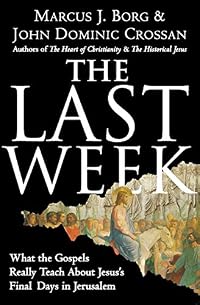
The Last Week: What the Gospels Really Teach About Jesus's Final Days in Jerusalem
by Marcus J. Borg, John Dominic Crossan
On This Page
Description
Top Jesus scholars Marcus J. Borg and John Dominic Crossan join together to reveal a radical and little-known Jesus. As both authors reacted to and responded to questions about Mel Gibson's blockbuster The Passion of the Christ, they discovered that many Christians are unclear on the details of events during the week leading up to Jesus's crucifixion. Using the gospel of Mark as their guide, Borg and Crossan present a day-by-day account of Jesus's final week of life. They begin their story show more on Palm Sunday with two triumphal entries into Jerusalem. The first entry, that of Roman governor Pontius Pilate leading Roman soldiers into the city, symbolized military strength. The second heralded a new kind of moral hero who was praised by the people as he rode in on a humble donkey. The Jesus introduced by Borg and Crossan is this new moral hero, a more dangerous Jesus than the one enshrined in the church's traditional teachings. The Last Week depicts Jesus giving up his life to protest power without justice and to condemn the rich who lack concern for the poor. In this vein, at the end of the week Jesus marches up Calvary, offering himself as a model for others to do the same when they are confronted by similar issues. Informed, challenged, and inspired, we not only meet the historical Jesus, but meet a new Jesus who engages us and invites us to follow him. show lessTags
Recommendations





Member Reviews
We read this book in Sunday school during Lent. It had been a while since I had read something this academic about the Bible. I fly through academic writing in my normal work, but since I wasn't quite as familiar with this type of writing, it took me quite a long time to read each chapter. That slowing down to think about things really deepened my understanding of Jesus' life and the Passion story.
I don't think of myself as a conservative christian, but this book was almost too liberal for me. It really pushed me to the edges of what I thought was permissible. Borg and Crossan bring up new issues that really changed my perspective on Holy Week. It's not about what happened at what time on Good Friday. It's not even whether or not the show more Resurrection is literal. Th ose questions that are so important to so many Christians and doubters are not the point. The point is the story, and what we are going to do about it.
How will the world change if we look beyond the historical facts and find the underlying truths? What should the world look like? How does God want us to act? How can we be Christians like the early church when we are not oppressed by the Romans, and, quite frankly, when we are the oppressors? This book pushes me to look beyond the academic questions and change my behavior to be more like Jesus. The book may be a bit further to one side than I am comfortable with, but that's the point. I am pushed in my own journey to explore questions I never thought to ask. show less
I don't think of myself as a conservative christian, but this book was almost too liberal for me. It really pushed me to the edges of what I thought was permissible. Borg and Crossan bring up new issues that really changed my perspective on Holy Week. It's not about what happened at what time on Good Friday. It's not even whether or not the show more Resurrection is literal. Th ose questions that are so important to so many Christians and doubters are not the point. The point is the story, and what we are going to do about it.
How will the world change if we look beyond the historical facts and find the underlying truths? What should the world look like? How does God want us to act? How can we be Christians like the early church when we are not oppressed by the Romans, and, quite frankly, when we are the oppressors? This book pushes me to look beyond the academic questions and change my behavior to be more like Jesus. The book may be a bit further to one side than I am comfortable with, but that's the point. I am pushed in my own journey to explore questions I never thought to ask. show less
The Last Week brings to light the historical meaning (as Borg and Crossan see it) of the last week of Jesus as told in the Gospel of Mark. This book was very interesting, though lacked the power of The First Christmas, which I reviewed previously. The main reason for this difference is that The First Christmas told the story of Christmas by comparing all the Gospel stories, as opposed to focusing on just one. Borg and Crossan chose to focus on Mark because he's the only one to have described the entire week in detail. However it made for a much less interesting, and more repetitive, book. Another difference was that in The First Christmas, Borg and Crossan focused a lot on why they thought some passages were parable rather than literal, show more and why others should be taken literally. The Last Week focused a lot less on this subject, and spent the bulk of the book simply interpreting the historical background of Mark's Gospel for our modern times. This, of course, is a very interesting subject, but the lack of that added myth vs. literal aspect made for a much less meaty book.
All in all, I'd say each of these books has its own merits, and which you read would depend on what you're looking for. Borg and Crossan are knowledgeable and well-researched historical Jesus scholars. So if you take the Bible quite literally and are looking to understand the historical background of the Passion of Jesus, The Last Week is the book for you. However, if you find the little "inconsistencies" of the Gospels interesting, then The First Christmas is the book for you. If you are at all interested in the subject, I would recommend one or the other (or both) of these books. show less
All in all, I'd say each of these books has its own merits, and which you read would depend on what you're looking for. Borg and Crossan are knowledgeable and well-researched historical Jesus scholars. So if you take the Bible quite literally and are looking to understand the historical background of the Passion of Jesus, The Last Week is the book for you. However, if you find the little "inconsistencies" of the Gospels interesting, then The First Christmas is the book for you. If you are at all interested in the subject, I would recommend one or the other (or both) of these books. show less
This account of Holy Week comes spectacularly blurbed by important people, but it was much too Old Time Religion to me. The authors do expand upon Biblical accounts to be sure, and they are competent writers, but Messiah's each and every statement and activity is cross-referenced back to Old Testament prophecy, exactly like the marginalia in your Granddad's Bible. It was looking like a slow go, so I aborted it well within the Nancy Pearl threshold. As one of the blurbers points out, to get a lot out of this, one must be a certain type of conservative Christian.
Top Jesus scholars Marcus J. Borg and John Dominic Crossan join together to reveal a radical and little-known Jesus. As both authors reacted to and responded to questions about Mel Gibson's blockbuster The Passion of the Christ, they discovered that many Christians are unclear on the details of events during the week leading up to Jesus's crucifixion.
Using the gospel of Mark as their guide, Borg and Crossan present a day-by-day account of Jesus's final week of life. They begin their story on Palm Sunday with two triumphal entries into Jerusalem. The first entry, that of Roman governor Pontius Pilate leading Roman soldiers into the city, symbolized military strength. The second heralded a new kind of moral hero who was praised by the show more people as he rode in on a humble donkey. The Jesus introduced by Borg and Crossan is this new moral hero, a more dangerous Jesus than the one enshrined in the church's traditional teachings.
The Last Week depicts Jesus giving up his life to protest power without justice and to condemn the rich who lack concern for the poor. In this vein, at the end of the week Jesus marches up Calvary, offering himself as a model for others to do the same when they are confronted by similar issues. Informed, challenged, and inspired, we not only meet the historical Jesus, but meet a new Jesus who engages us and invites us to follow him. show less
Using the gospel of Mark as their guide, Borg and Crossan present a day-by-day account of Jesus's final week of life. They begin their story on Palm Sunday with two triumphal entries into Jerusalem. The first entry, that of Roman governor Pontius Pilate leading Roman soldiers into the city, symbolized military strength. The second heralded a new kind of moral hero who was praised by the show more people as he rode in on a humble donkey. The Jesus introduced by Borg and Crossan is this new moral hero, a more dangerous Jesus than the one enshrined in the church's traditional teachings.
The Last Week depicts Jesus giving up his life to protest power without justice and to condemn the rich who lack concern for the poor. In this vein, at the end of the week Jesus marches up Calvary, offering himself as a model for others to do the same when they are confronted by similar issues. Informed, challenged, and inspired, we not only meet the historical Jesus, but meet a new Jesus who engages us and invites us to follow him. show less
Using the gospel of Mark as their guide, Borg and Crossan present a day-by-day account of Jesus's final week of life. They begin their story on Palm Sunday with two triumphal entries into Jerusalem. The first entry, that of Roman governor Pontius Pilate leading Roman soldiers into the city, symbolized military strength. The second heralded a new kind of moral hero who was praised by the people as he rode in on a humble donkey. The Jesus introduced by Borg and Crossan is this new moral hero, a more dangerous Jesus than the one enshrined in the church's traditional teachings.
Beginning with Palm Sunday and continuing through the following Sunday, resurrection day, Borg and Crossan lead us day-by-day through the events of Christianity's holy week. There are differences between the Gospel accounts, especially when it comes to John's Gospel, so the authors are at times forced to play favorites. Because Mark is the earliest Gospel, and because Mark goes out of his way to chronicle the day-by-day events of the Passion week, the authors chose Mark as their primary source.
The stage is set early, on the first day of the week, as Jesus rides a donkey down from the Mount of Olives, through the east gate of the city. On the opposite side of the city, Pontius Pilate, the Roman governor, arrives at the head of a column show more of imperial cavalry and soldiers. Jesus' procession hailed the arrival of the Kingdom of God; Pilate's, the power of the Empire. It's not going to go well; this becomes clear early on, as Jesus plans his symbolic resistance. He arrives back on Monday and "attacks" the Temple, overturning the tables of the money changers and the seats of those who sold doves.
The following two days, Tuesday and Wednesday, portray the disciples in their attempt to comprehend what is going on. The very first "Christian" perhaps appears during this time: An unnamed woman recognizes that Jesus is about to die, and anoints him for burial.
Thursday may be the most theologically significant day, as we experience the Passover meal, the Gethsemane prayer, and the arrest.
Good Friday needs no introduction. Jesus succumbs to the Roman machine, dies with a cry of despair, and leaves the disciples in a great state of confusion and sorrow through Saturday, the Sabbath. (Mark's Gospel itself says nothing at all about Saturday; the feelings and events must be inferred, or taken from elsewhere, such as the tradition of Christ descending into Hell.)
Finally, Easter, and the joy of resurrection. By far, this is the most confusing day of the week. Again, Mark's Gospel leaves us with little to go on; the original ending in Mark is very abrupt. Three women discover an empty tomb, and run away afraid, telling no one. It is only in the unfolding legends of other Gospel writers that we can try to piece together what this day meant to Jesus' followers. Regardless of how we imagine the actual events, the message is clear: Jesus lives! show less
The stage is set early, on the first day of the week, as Jesus rides a donkey down from the Mount of Olives, through the east gate of the city. On the opposite side of the city, Pontius Pilate, the Roman governor, arrives at the head of a column show more of imperial cavalry and soldiers. Jesus' procession hailed the arrival of the Kingdom of God; Pilate's, the power of the Empire. It's not going to go well; this becomes clear early on, as Jesus plans his symbolic resistance. He arrives back on Monday and "attacks" the Temple, overturning the tables of the money changers and the seats of those who sold doves.
The following two days, Tuesday and Wednesday, portray the disciples in their attempt to comprehend what is going on. The very first "Christian" perhaps appears during this time: An unnamed woman recognizes that Jesus is about to die, and anoints him for burial.
Thursday may be the most theologically significant day, as we experience the Passover meal, the Gethsemane prayer, and the arrest.
Good Friday needs no introduction. Jesus succumbs to the Roman machine, dies with a cry of despair, and leaves the disciples in a great state of confusion and sorrow through Saturday, the Sabbath. (Mark's Gospel itself says nothing at all about Saturday; the feelings and events must be inferred, or taken from elsewhere, such as the tradition of Christ descending into Hell.)
Finally, Easter, and the joy of resurrection. By far, this is the most confusing day of the week. Again, Mark's Gospel leaves us with little to go on; the original ending in Mark is very abrupt. Three women discover an empty tomb, and run away afraid, telling no one. It is only in the unfolding legends of other Gospel writers that we can try to piece together what this day meant to Jesus' followers. Regardless of how we imagine the actual events, the message is clear: Jesus lives! show less
A commentary focusing mostly on the Gospel of Mark, covering the time between Palm Sunday and the Easter apparitions of Jesus. I particularly appreciated the approach of parable for these narratives, and the emphasis on "what does it mean." There was probably an over-emphasis on the imperial power vs Christ aspect, but I can see the need for it as a corrective to the me-and-Jesus approach that so many Christians take. The image of the dual Palm Sunday processions in Jerusalem, presented in the first chapter, was a great one, and well used throughout.
Members
- Recently Added By
Lists

Nonfiction
41 works; 1 member
Author Information

65+ Works 14,159 Members
Marcus J. Borg was born on March 11, 1942 in Minnesota. He majored in philosophy and political science at Concordia College. He did graduate work at Union Theological Seminary in New York City and at Oxford University. He taught at various Midwest universities before joining the faculty at Oregon State University in 1979. He taught religion there show more until his retirement in 2007. During his lifetime, he wrote or co-wrote 21 books including Jesus: A New Vision, The Meaning of Jesus: Two Visions with N. T. Wright, and Convictions: How I Learned What Matters Most. He died after a prolonged illness on January 21, 2015 at the age of 72. (Bowker Author Biography) show less

72+ Works 11,294 Members
Considered by many to be the most learned scholar on the topic of Jesus Christ, John Dominic Crossan's adversaries question how he reconciles his Catholic faith with 20th century secular study. A former priest, Crossan is the author of The Essential Jesus: Original Sayings and Earliest Images, The Historical Jesus: The Life of a Mediterranean show more Jewish Peasant, Jesus: A Revolutionary Biography; The Birth of Christianity: Discovering What Happened in the Years Immediately After the Execution of Jesus, and The Cross That Spoke: The Origins of the Passion Narrative, among others. (Bowker Author Biography) show less
Common Knowledge
- People/Characters
- Jesus Christ
- Important places
- Jerusalem
Classifications
- Genres
- Religion & Spirituality, Nonfiction, History, General Nonfiction
- DDC/MDS
- 232.96 — Religion Christianity Jesus Christ and his family Family and life of Jesus Passion and death of Jesus
- LCC
- BT414 .B67 — Philosophy, Psychology and Religion Doctrinal Theology Doctrinal Theology Christology Life of Christ
- BISAC
Statistics
- Members
- 1,100
- Popularity
- 23,004
- Reviews
- 15
- Rating
- (4.04)
- Languages
- English, Portuguese, Spanish
- Media
- Paper, Audiobook, Ebook
- ISBNs
- 15
- UPCs
- 2
- ASINs
- 9