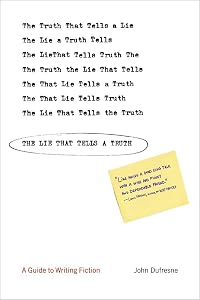
The Lie That Tells a Truth: A Guide to Writing Fiction
by John Dufresne
On This Page
Description
Finally, a truly creative--and hilarious--guide to creative writing, full of encouragement and sound advice. Provocative and reassuring, nurturing and wise, The Lie That Tells a Truth is essential to writers in general, fiction writers in particular, beginning writers, serious writers, and anyone facing a blank page.John Dufresne, teacher and the acclaimed author of Love Warps the Mind a Little and Deep in the Shade of Paradise, demystifies the writing process. Drawing upon the wisdom of show more literature's great craftsmen, Dufresne's lucid essays and diverse exercises initiate the reader into the tools, processes, and techniques of writing: inventing compelling characters, developing a voice, creating a sense of place, editing your own words. Where do great ideas come from? How do we recognize them? How can language capture them? In his signature comic voice, Dufresne answers these questions and more in chapters such as "Writing Around the Block," "Plottery," and "The Art of Abbreviation." Dufresne demystifies the writing process, showing that while the idea of writing may be overwhelming, the act of writing is simplicity itself. show lessTags
Recommendations
Member Reviews
I think that, even if this had been a terrible book about writing, I'd have devoured it, because when Dufresne writes, I see the Worcester of my childhood, the Worcester I see when my mother talks about her childhood, and I feel like I'm home. But it's a fantastic book, packed with useful prompts and exercises, and all kinds of advice (and instruction) about structure, grammar, point of view, dialect, the importance of reference books, the writer as obsessive observer of everything, and - most importantly - the need to write, constantly, to the detriment of everything else.
Dufresne illustrates his points with examples from his own life and writings - though there's a healthy helping of the writings and observations of others - and show more speaks engagingly about the process of writing. This is one of my first forays into the genre of books about writing, so I don't have much to compare it to (though with respect to conversation I think Dufresne makes many of the points Turco makes in The Book of Dialogue more clearly and with 100% fewer space travelers), but it's a fun, funny, enjoyable read, and I'm looking forward to using the prompts and exercises to generate more of my own writing. show less
Dufresne illustrates his points with examples from his own life and writings - though there's a healthy helping of the writings and observations of others - and show more speaks engagingly about the process of writing. This is one of my first forays into the genre of books about writing, so I don't have much to compare it to (though with respect to conversation I think Dufresne makes many of the points Turco makes in The Book of Dialogue more clearly and with 100% fewer space travelers), but it's a fun, funny, enjoyable read, and I'm looking forward to using the prompts and exercises to generate more of my own writing. show less
Dufresne's The Lie That Tells a Truth is an excellent guide to the craft, I enjoyed the philosophy, but I would suggest that it is more for those who are theory novices (as distinct from writing novices) because it leaned toward 'dumbing down' and explained a little too much, at times.
One thing that may also attract those who read to be taught how to be a writer (as against writers reading for the insights shared by another) is that he gives almost equal time to how to get ideas as he does to how to execute them. I found these 'idea parts' surprising and frustrating because I just don't think they have a place in a text aimed at writers. I know lots of people say they want to write but have no ideas and so would love a book full of how show more to get ideas but, to me, this is snake oil salesman stuff. When I hear someone who claims to want to write ask 'where do you get ideas?' I'm afraid my response is "Frankly, if you don't know then count yourself lucky not to be haunted by them and stick to the joy of reading!" If you have no ideas, then you have nothing you're compelled to express and, I think Dufresne would agree, no piece of writing - or art - is worth anything if the writer has nothing to say.
If I could give an extra half star for his including the correction of "try and" to "try to" in his "Small Craft Warnings" chapter at the end of the book, I would! show less
One thing that may also attract those who read to be taught how to be a writer (as against writers reading for the insights shared by another) is that he gives almost equal time to how to get ideas as he does to how to execute them. I found these 'idea parts' surprising and frustrating because I just don't think they have a place in a text aimed at writers. I know lots of people say they want to write but have no ideas and so would love a book full of how show more to get ideas but, to me, this is snake oil salesman stuff. When I hear someone who claims to want to write ask 'where do you get ideas?' I'm afraid my response is "Frankly, if you don't know then count yourself lucky not to be haunted by them and stick to the joy of reading!" If you have no ideas, then you have nothing you're compelled to express and, I think Dufresne would agree, no piece of writing - or art - is worth anything if the writer has nothing to say.
If I could give an extra half star for his including the correction of "try and" to "try to" in his "Small Craft Warnings" chapter at the end of the book, I would! show less
This is my favorite text on writing, hands down. Dufresne gives reasons for the building blocks of fiction and he makes the process so fun to read. He's also very good at guilting one into writing more.
A good, thought-provoking guide to writing fiction. It's in the same league as King's [b:On Writing|10569|On Writing|Stephen King|https://d202m5krfqbpi5.cloudfront.net/books/1348431774s/10569.jpg|150292].
Disciplined book by a creative guy. Piles of exercises and specifics. Only drawback when Dufresne engages in streams of consciousness to illustrate how a point or character might be worked out. Use for encouragement and confidence to start writing. Then use to critique and improve what you come up with. Or to break a block. Read all the highlighted material through when done.
Toward the end of the year, most of my reading time was devoted to class reading, including this semester's craft text, The Lie That Tells a Truth. As fiction writing guides go, I'd say that this was neither the best nor the worst I've ever read. The exercises included at the end of most chapters are inventive; I managed to get some good writing out of quite a few of them. Dufresne tackles some topics I've never seen addressed books in similar books, such as the use of "eye" dialect and the importance of reference books. But his examples of technique mostly come from his own writing, and while I like confidence, often Dufresne's tone makes his "advice" seem like a stern lecture.
Disciplined book by a creative guy. Piles of exercises and specifics. Only drawback when Dufresne engages in streams of consciousness to illustrate how a point or character might be worked out. Use for encouragement and confidence to start writing. Then use to critique and improve what you come up with. Or to break a block. Read all the highlighted material through when done.
Members
- Recently Added By
Author Information

24+ Works 2,358 Members
His novels Louisiana Power & Light & Love Warps the Mind a Little were New York Time Notable books of the Year. He lives in Dania, Florida. (Bowker Author Biography)
Classifications
Statistics
- Members
- 357
- Popularity
- 88,498
- Reviews
- 9
- Rating
- (3.84)
- Languages
- English
- Media
- Paper, Ebook
- ISBNs
- 3
- ASINs
- 1